01Facts
The dispute concerned property claimed by the writ petitioner through a registered partition deed dated 12 October 1990 and later conveyed through various sale deeds.
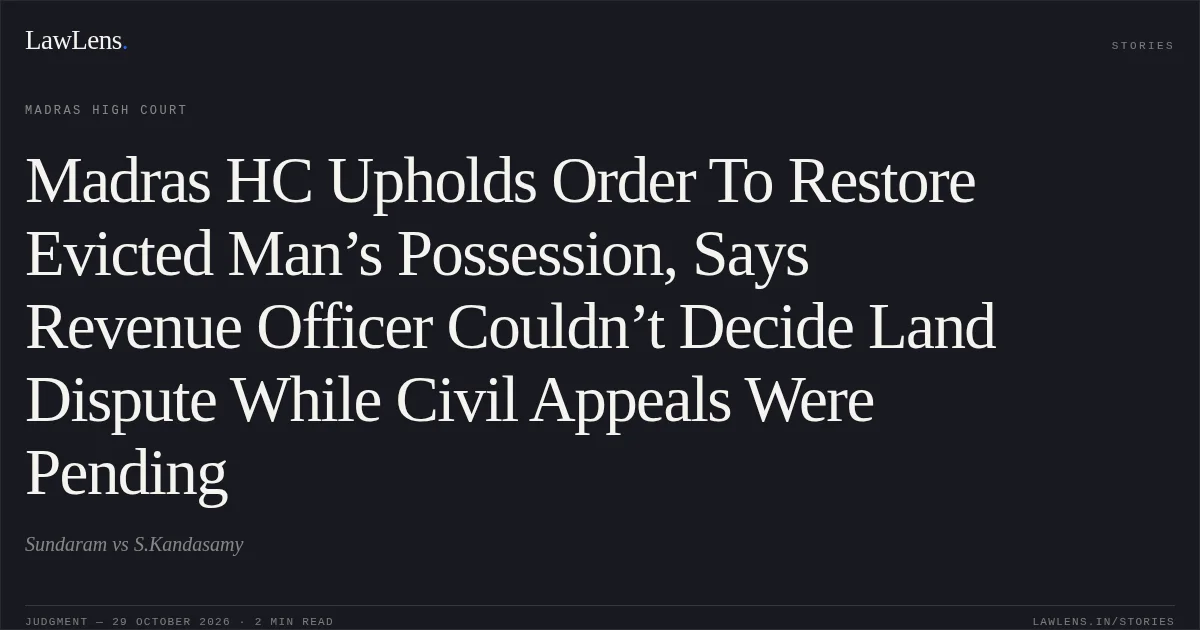
The petitioner and his family challenged the sale transactions in O.S. No. 81 of 2013; the purchasers separately sought an injunction and later a mandatory injunction for possession in O.S. No. 201 of 2013. Both suits were dismissed in 2019, and appeals filed by the respective parties remained pending.
¶ 5, 8 · p. 6, 8Following a complaint by one purchaser and an order of this Court directing police enquiry, the Revenue Divisional Officer directed the Tahsildar to put the purchasers in possession. The petitioner was evicted pursuant to that direction.
¶ 6 · p. 7The Single Judge allowed the petitioner’s writ petitions, holding that the Revenue Divisional Officer lacked jurisdiction to determine the civil dispute and directing restoration of possession. The purchasers appealed.
¶ 7 · p. 702Issues
i.1. Whether the Revenue Divisional Officer had jurisdiction to direct the petitioner’s eviction and put the purchasers in possession while the parties’ civil appeals concerning the property remained pending.
¶ 7–9 · pp. 7–9ii.2. Whether the Single Judge’s order allowing the writ petitions and directing restoration of possession disclosed any error warranting appellate interference.
¶ 9–10 · pp. 9–1003Law Applied
The judgment cites no statute or precedent.
It applies the principle that a revenue authority cannot adjudicate a civil dispute concerning rights to property or determine possession where that dispute is pending before the civil court.
¶ 8–9 · pp. 8–9Where a party seeking possession has not obtained a decree and its suit has been dismissed, possession may be obtained through the competent execution court only if that party ultimately succeeds in the pending appeal and secures an enforceable decree.
¶ 8–9 · pp. 8–904Reasoning
The purchasers’ suit seeking possession had been dismissed, and their appeal—as well as the petitioner’s appeal concerning the sale deed—was pending. The Revenue Divisional Officer nevertheless considered the dispute and directed the petitioner’s eviction.
¶ 8–10 · pp. 8–10The Division Bench held that the officer had exceeded his jurisdiction: the parties’ competing claims had to be resolved in the civil proceedings, and any possession order following a successful appeal had to be implemented through the competent execution court. The Single Judge therefore correctly set aside the revenue action and ordered restoration of possession.
¶ 8–10 · pp. 8–1005Holding
The High Court dismissed both writ appeals and left undisturbed the Single Judge’s order directing restoration of possession to the writ petitioner.
¶ 10–11 · p. 9It clarified that the findings of the Single Judge would not prejudice either party’s rights in the pending civil appeals. No costs were awarded, and the connected miscellaneous petitions were closed.
¶ 10–11 · p. 9Original Court PDF
SundaramvsS.Kandasamy
Click to open original judgment
Original judgment, available to read, download and summarize on LawLens.in