Facts
Late Mr. Sundaram, a Sanitary Worker in the Kotagiri Special Grade Town Panchayat, died in harness on 17 November 2017.
Source reference: pp.2–3, para.2–4His granddaughter, Keerthana, sought appointment on compassionate grounds, claiming that she was the adopted daughter of the deceased employee’s daughter and that she was maintaining the deceased employee’s widow.
Source reference: pp.2–3, para.2–4However, no valid adoption document was produced before the competent authority.
Source reference: pp.2–3, para.2–4Since the applicable compassionate-appointment scheme did not recognise a granddaughter or grandson of the deceased employee as an eligible dependent, her application was rejected on 11 November 2022.
Source reference: pp.2–3, para.2–4Keerthana challenged the rejection in W.P. No. 19487 of 2023. The learned Single Judge allowed the writ petition by order dated 8 August 2023. The District Collector thereafter preferred the present intra-court appeal under Clause 15 of the Letters Patent.
Source reference: p.1, para.1–2Issues
Whether the respondent, being the granddaughter of the deceased employee, was eligible for compassionate appointment under the applicable scheme?
Source reference: pp.2–3, para.3–4; p.8, para.16Whether the Court could expand the scope of the compassionate-appointment scheme on the grounds of adoption, maintenance of the deceased employee’s widow, or misplaced sympathy?
Source reference: pp.3, 8–9, para.5, 15–16Whether the writ court’s direction granting relief amounted to an impermissible expansion of the scheme and an interference with the constitutional scheme of public employment?
Source reference: pp.3–8, para.6–15Law Applied
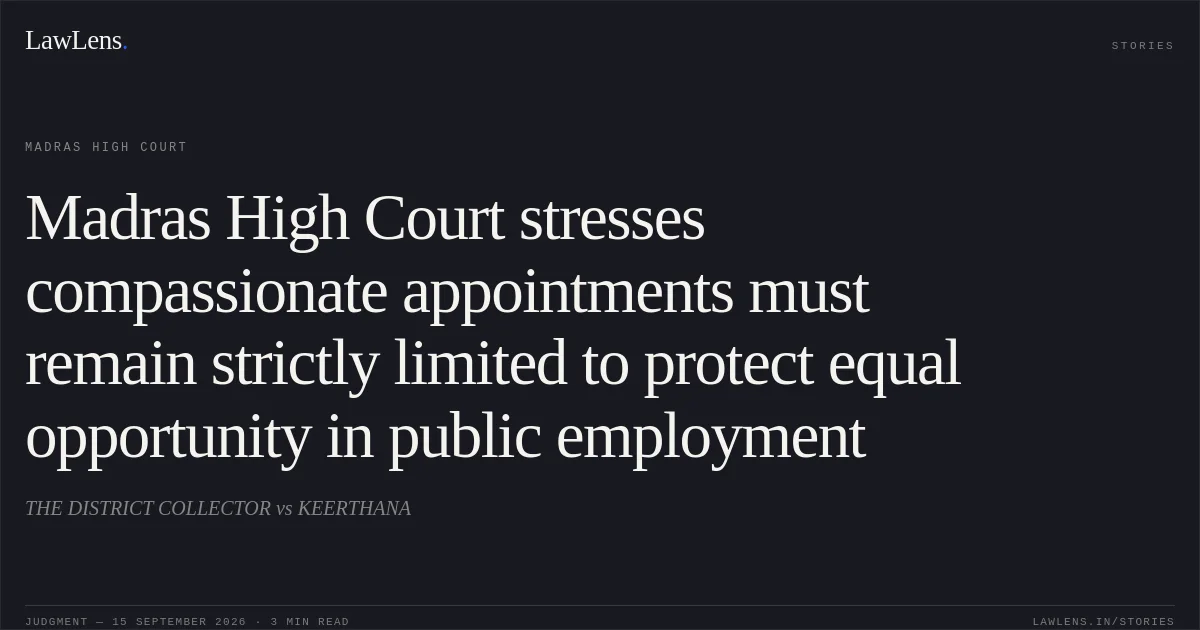
Compassionate appointment is an exceptional and restricted concession intended to mitigate the immediate financial distress caused by the sudden death of a government employee; it is not a hereditary right or a regular mode of public recruitment.
Source reference: pp.3–5, para.6–9Public employment must ordinarily conform to the equality and equal-opportunity guarantees under Articles 14 and 16 of the Constitution, and compassionate appointment cannot be extended beyond the terms of the governing scheme in a manner that prejudices candidates seeking employment through open competition.
Source reference: pp.3–6, para.6–12Article 335 further requires that claims relating to public employment be considered consistently with the maintenance of administrative efficiency.
Source reference: p.6, para.11–12The Court also applied the principle that judicial review under Article 226 cannot be used to enlarge the eligibility conditions prescribed by a compassionate-appointment scheme or to grant relief merely on sympathetic considerations.
Source reference: p.8, para.15–16Reasoning
The Court found that the respondent’s claim was both stale and outside the scope of the applicable scheme.
Source reference: p.3, para.6Her status as a granddaughter of the deceased employee rendered her ineligible, and the alleged adoption was unsupported by any valid adoption document.
Source reference: pp.2–3, para.3–4The fact that she was allegedly maintaining her grandmother, or that the grandmother had nominated her, could not override the express eligibility requirements of the scheme.
Source reference: p.3, para.5The Court emphasised that compassionate appointment is justified only where the deceased employee’s family is unable to sustain itself because the employee’s income was its principal means of livelihood; it cannot be treated as an appointment to any legal heir as a matter of course.
Source reference: pp.4–5, para.8–9; p.7, para.13Granting relief despite the respondent’s ineligibility would effectively expand an exceptional scheme, undermine equal opportunity in public employment, and prejudice meritorious candidates awaiting recruitment through the constitutional process.
Source reference: pp.5–8, para.10–16Holding
The Division Bench held that the respondent, being an ineligible granddaughter of the deceased employee and having failed to establish a valid adoption, had no enforceable right to compassionate appointment.
The writ court had impermissibly expanded the scheme on grounds of sympathy and was therefore not justified in granting relief under Article 226.
Source reference: p.8, para.16The order dated 8 August 2023 in W.P. No. 19487 of 2023 was set aside, the writ appeal was allowed, and no costs were imposed. Connected miscellaneous petitions, if any, were closed.
Source reference: p.9, para.17Original Court PDF
THE DISTRICT COLLECTORvsKEERTHANA
Click to open original judgment
Original judgment, available to read, download and summarize on LawLens.in