Facts
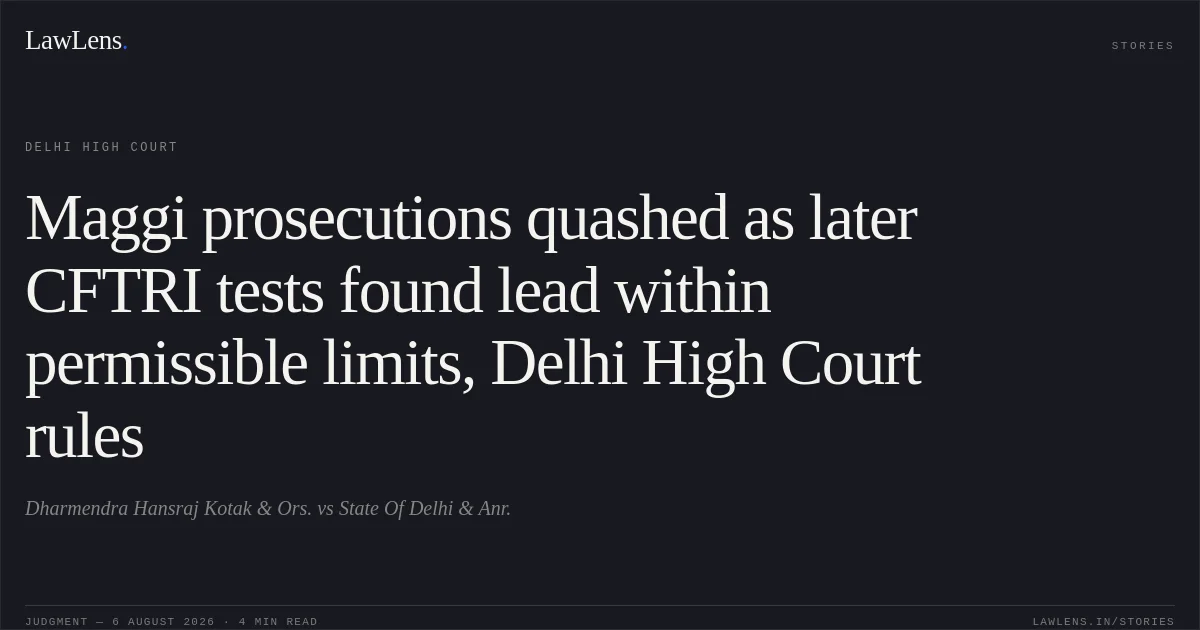
The petitions arose from criminal complaints filed under the Food Safety and Standards Act, 2006 (“FSS Act”) concerning samples of MAGGI Noodles collected from retail establishments in Delhi during May 2015.
Source reference: paras. 4–7; pp. 2–3The samples were drawn, sealed and forwarded for analysis in accordance with the prosecution’s case.
Source reference: paras. 4–7; pp. 2–3The Food Analyst’s reports dated 2 June 2015 declared the samples “unsafe” on the ground that the lead content exceeded the prescribed limit of 2.5 ppm; one complaint additionally alleged misbranding arising from the declaration “No Added MSG”.
Source reference: paras. 4–7; pp. 2–3The complaints alleged violations of Sections 20, 26 and 27 of the FSS Act, punishable under Section 59, and were instituted after consent under Section 30(2)(e).
Source reference: para. 9; p. 4The Trial Court issued summons on 6 November 2015 and 11 January 2016, while discharge applications were dismissed as not maintainable on 30 November 2022.
Source reference: paras. 10–12; p. 4The petitioners sought quashing under Section 482 Cr.P.C., contending that the prosecution’s foundation had eroded after the Bombay High Court set aside the ban on MAGGI Noodles, fresh testing was conducted through accredited and notified laboratories, and CFTRI reports obtained pursuant to directions of the Supreme Court found the lead content within permissible limits.
Source reference: paras. 13–21; pp. 5–7The State argued that the complaints were independently maintainable on the basis of the original Food Analyst reports, that the petitioners had not exercised their statutory right to seek referral analysis, and that the subsequent proceedings did not invalidate the Delhi prosecutions.
Source reference: paras. 22–29; pp. 7–10Issues
Whether the criminal complaints, summoning orders and consequential proceedings founded on the original Food Analyst reports should be quashed under Section 482 Cr.P.C. in light of the subsequent judicially supervised testing of MAGGI Noodles by CFTRI and other accredited laboratories?
Source reference: paras. 31–43; pp. 10–14Whether continuation of the prosecutions would amount to an abuse of the process of the Court where the original analytical reports had been subjected to serious legal and scientific scrutiny and subsequent testing found the product within permissible limits?
Source reference: paras. 34–44; pp. 11–14Whether the objections concerning the accreditation and notification status of the Delhi Food Laboratory, and the evidentiary effect of the subsequent referral reports, could justify interference at the Section 482 stage?
Source reference: paras. 18–20, 26–29 and 39–42; pp. 6–10, 13–14Law Applied
The Court applied Section 482 Cr.P.C., which empowers the High Court to prevent abuse of the process of any court and secure the ends of justice.
Source reference: para. 31; p. 10Relying on State of Haryana v. Bhajan Lal, 1992 Supp (1) SCC 335, and Rajiv Thapar v. Madan Lal Kapoor, (2013) 3 SCC 330, the Court held that quashing is permissible where the continuation of proceedings would constitute an abuse of process or where the foundation of the prosecution has ceased to exist.
Source reference: para. 31; p. 10Under the FSS Act, laboratory analysis must comply with the statutory framework concerning accredited and notified laboratories under Section 43; the Food Analyst’s report and the right to referral analysis are governed by Section 46(4), while prosecution consent is regulated by Section 30(2)(e) and offences relating to unsafe food are punishable under Section 59.
Source reference: paras. 9, 18–20, 34; pp. 4, 6–7, 11The Court also considered the effect of Section 98 concerning the continuation of existing State Food Testing Laboratories during the transitional period.
Source reference: para. 26; p. 9It treated the Bombay High Court’s decision in Nestle India Limited v. Food Safety and Standards Authority of India, 2015 SCC OnLine Bom 4713, the Supreme Court’s directions for CFTRI testing, and subsequent decisions of the Himachal Pradesh and Uttarakhand High Courts as relevant to determining whether the original reports could continue to sustain the prosecutions.
Source reference: paras. 34–42; pp. 11–14Reasoning
The Court found that the prosecutions rested entirely on the original Food Analyst reports alleging excessive lead content and that no independent evidence of adulteration existed.
Source reference: paras. 32, 39; pp. 10, 13The Bombay High Court had found serious legal infirmities in the laboratory reports underlying the regulatory action, particularly concerning accreditation and statutory notification, and directed fresh testing through duly qualified laboratories.
Source reference: para. 34; p. 11Subsequently, the Supreme Court directed testing by CFTRI, a recognised Referral Food Laboratory, and ordered that the CFTRI report form the basis of adjudication; the resulting reports found the relevant parameters within permissible limits.
Source reference: paras. 35–38; pp. 11–12Although the State characterised the Delhi prosecutions as independent proceedings and relied on the petitioners’ failure to seek referral analysis at the relevant time, the Court held that the later, court-supervised scientific evaluation could not be ignored because it substantially undermined the evidentiary value of the original reports.
Source reference: paras. 40–41; p. 13In the peculiar circumstances, requiring the petitioners to undergo trial on the basis of reports whose legal and scientific foundation had materially eroded would serve no useful purpose and would amount to abuse of process.
Source reference: paras. 42–44; pp. 13–14Holding
The Court answered the issues in favour of the petitioners.
It held that, in light of the Bombay High Court’s findings, the Supreme Court-directed CFTRI testing, the subsequent adjudicatory proceedings and the later High Court decisions concerning the same MAGGI sampling controversy, continuation of the prosecutions was unjustified and constituted an abuse of the process of the Court.
Source reference: paras. 43–44; p. 14The petitions were accordingly allowed, and the complaints, summoning orders dated 6 November 2015 and 11 January 2016, and all consequential proceedings were quashed.
Source reference: para. 45; p. 15Original Court PDF
Dharmendra Hansraj Kotak & Ors.vsState Of Delhi & Anr.
Click to open original judgment
Original judgment, available to read, download and summarize on LawLens.in