Facts
The police filed a charge sheet in Crime No. 390 of 2024 against three individuals, including Smt. Rakhi Garg (Opposite Party No. 2), for offenses under Sections 420, 467, 468, 471, 406, 506, and 120B of the IPC.
Source reference: p. 1At the stage of taking cognizance, Opposite Party No. 2 filed an application before the Chief Judicial Magistrate (C.J.M.), Agra, requesting the court not to take cognizance and to discharge her.
Source reference: p. 1-2On 26.09.2025, the C.J.M. took cognizance against two co-accused but allowed the application of Smt. Rakhi Garg, refusing to take cognizance and discharging her without providing the informant or the prosecution an opportunity to be heard.
Source reference: p. 2The revisionist (informant) challenged this order as being procedurally illegal.
Source reference: p. 2Issues
1. Whether the court may decide not to take cognizance of an offence without giving an opportunity of hearing to the informant, even though a charge sheet has been filed by the police?
Source reference: p. 22. Whether at the stage of considering a discharge application under Section 239 Cr.P.C., the informant/prosecution is entitled to an opportunity of hearing?
Source reference: p. 2Law Applied
The court relied on Section 239 of the Cr.P.C., which mandates that a Magistrate must give the prosecution and the accused an opportunity of being heard before deciding if a charge is groundless.
Source reference: p. 3The court applied the principle established by the Supreme Court in Bhagwant Singh v. Commr. of Police (1985) and Minu Kumari vs. State of Bihar (2006), which holds that if a Magistrate decides to drop proceedings or finds insufficient grounds against persons named in the FIR, notice to the informant and a grant of opportunity to be heard is mandatory.
Source reference: para. 12 & 14 / p. 3Reasoning
The Court observed that the C.J.M. passed the impugned order solely based on the material collected during investigation without recording that notice was issued to the informant or the prosecution.
Source reference: p. 2-3Applying the Minu Kumari precedent, the Court reasoned that when a court forms an opinion not to take cognizance despite a charge sheet being filed, it is under a mandatory legal obligation to hear the informant, as the failure to do so causes "prejudice" by making the FIR partially ineffective.
Source reference: p. 3Regarding the discharge aspect, the Court noted that Section 239 Cr.P.C. explicitly requires hearing the prosecution; thus, any order passed in its absence is inherently illegal and inappropriate.
Source reference: p. 3Holding
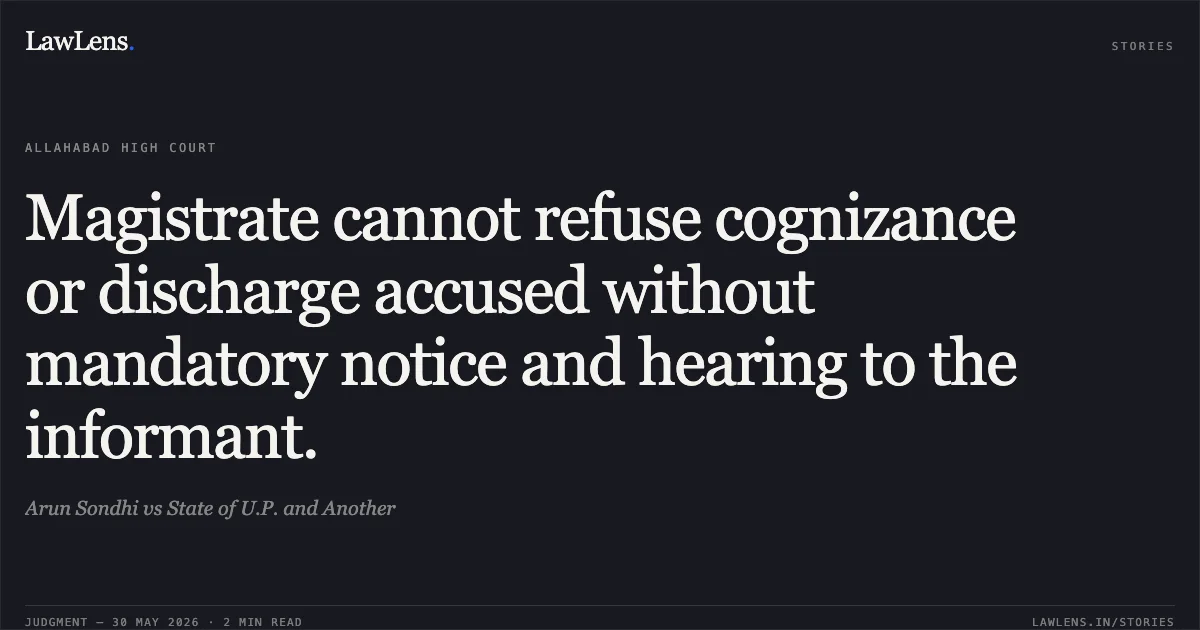
The Court answered both issues in the affirmative, holding that an opportunity of hearing is mandatory.
The High Court set aside the order dated 26.09.2025 to the extent of Opposite Party No. 2 and directed the C.J.M. to re-decide the application for not taking cognizance after providing a hearing to the informant and the prosecution.
Source reference: p. 3The criminal revision was allowed.
Source reference: p. 4Acts & Sections Cited
8 provisions across 2 statutes referred to in this judgment. Each provision opens on LawLens.
Indian Penal Code, 18606
Code of Criminal Procedure, 19732
Original Court PDF
Arun SondhivsState of U.P. and Another
Click to open original judgment
Original judgment, available to read, download and summarize on LawLens.in


