Facts
The Applicant challenged the order dated 29th January 2026 passed by the Additional Sessions Judge, Pune, which cancelled the bail previously granted to him by the Judicial Magistrate First Class (JMFC) on 19th August 2025.
Source reference: p. 2The Respondent No. 2 (Complainant) alleged that the Applicant extorted ₹2,00,000 and demanded a further ₹21,00,000 by threatening to file false cases under the SC/ST (Prevention of Atrocities) Act.
Source reference: p. 10-16During the investigation, WhatsApp chats and transcripts corroborated the extortion threats.
Source reference: p. 19-20Additionally, the prosecution pointed out that the Applicant has a criminal history of eight other FIRs.
Source reference: p. 30The Sessions Court cancelled the bail on the grounds that the JMFC lacked jurisdiction once Section 111(3) of the Bharatiya Nyaya Sanhita (BNS), 2023—pertaining to organized crime—was invoked.
Source reference: p. 23Issues
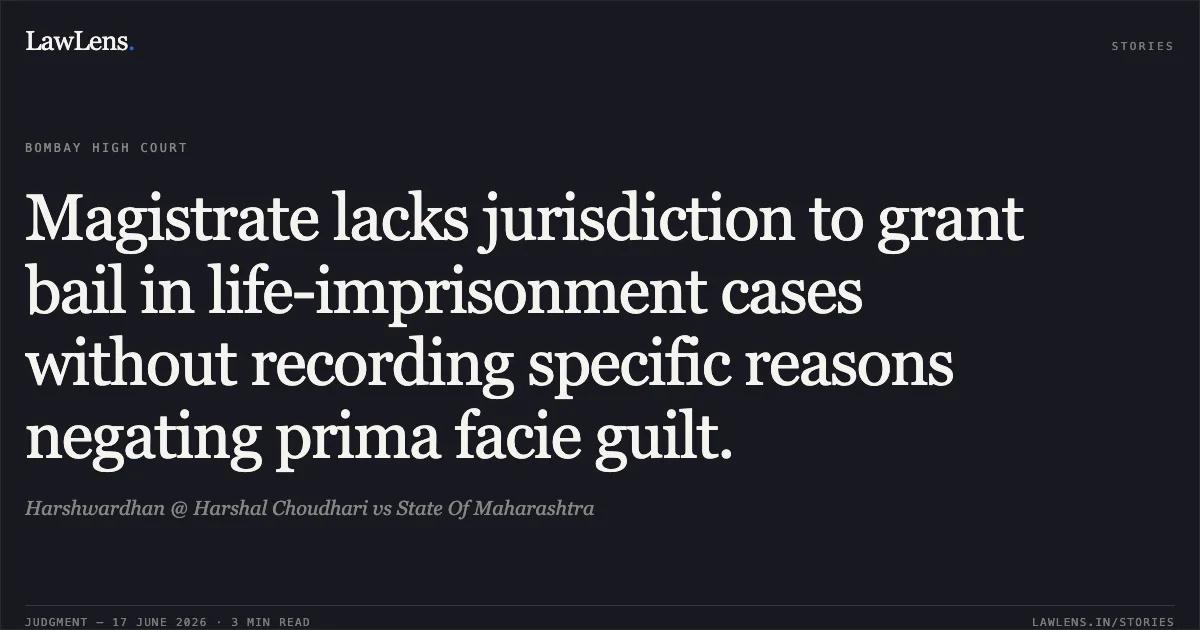
1. Whether the learned Magistrate had the jurisdiction to grant bail in a case involving Section 111(3) of the BNS, 2023, where the punishment extends to life imprisonment.
Source reference: p. 4, 222. Whether the bail granted by the JMFC was perverse and liable for cancellation due to non-consideration of the nature of the offence and the criminal antecedents of the Applicant.
Source reference: p. 23, 31-32Law Applied
The Court applied Section 111(3) of the Bharatiya Nyaya Sanhita (BNS), 2023, which defines and penalizes organized crime with a minimum of five years' imprisonment extending up to life.
Source reference: p. 22It heavily relied on the precedent set by the Supreme Court in Prahlad Singh Bhati v. NCT, Delhi Anr., which stipulates that while there is no absolute legal bar, a Magistrate should generally not grant bail in cases exclusively triable by a Court of Sessions or those punishable by death or life imprisonment unless they specifically negate reasonable grounds for believing the accused is guilty.
Source reference: p. 24, 27-28The Court also assessed the parameters for bail cancellation rooted in the principles of "perversity" and "non-application of mind" regarding the gravity of the offence and the character of the accused.
Source reference: p. 23, 32Reasoning
The Court found the JMFC’s order dated 19th August 2025 to be "totally illegal and perverse" because it completely ignored the addition of Section 111(3) of the BNS, which had been invoked on 6th August 2025.
Source reference: p. 22, 29Under the Prahlad Singh Bhati doctrine, a Magistrate exercising jurisdiction in life-imprisonment cases must recording a satisfaction that no reasonable grounds exist to believe the accused is guilty; the JMFC failed to record any such satisfaction.
Source reference: p. 28-29On merits, the High Court observed that the WhatsApp transcripts provided strong prima facie evidence of extortion.
Source reference: p. 20The Court further analyzed the Applicant's conduct, noting he had been absconding, had nine total FIRs against him, and attempted to mislead the Court regarding a Supreme Court transfer petition to delay the hearing.
Source reference: p. 3-4, 30, 34Consequently, the gravity of the "organized crime" and the risk of the Applicant absconding outweighed any arguments for liberty.
Source reference: p. 32-33Holding
The Court held that the JMFC acted without jurisdiction and with a total non-application of mind to the statutory gravity of the charges.
The High Court dismissed the Criminal Application, upholding the Sessions Court's order to cancel the bail.
Source reference: p. 33The Court further refused to grant any interim protection or stay on the order, citing the Applicant's habitual criminal nature and the high likelihood of him absconding.
Source reference: p. 34-35Acts & Sections Cited
25 provisions across 6 statutes referred to in this judgment. Each provision opens on LawLens.
Bharatiya Nagarik Suraksha Sanhita, 20231
Bharatiya Nyaya Sanhita, 2023
Scheduled Castes and the Scheduled Tribes (Prevention of Atrocities) Act, 19891
Information Technology Act, 20001
Indian Penal Code, 1860
Code of Criminal Procedure, 19732
Original Court PDF
Harshwardhan @ Harshal ChoudharivsState Of Maharashtra
Click to open original judgment
Original judgment, available to read, download and summarize on LawLens.in