Facts
The petitioners were granted bail in 2021 regarding an FIR under Sections 420/406/120B IPC; notably, the original bail order contained no travel restrictions.
Source reference: p. 2In 2024, the complainant (R-2) moved an application citing abscondence fears, leading the Chief Judicial Magistrate (CJM) to impose a condition requiring prior permission for international travel.
Source reference: p. 3This order was challenged via revision; the Sessions Court initially stayed and then set aside the restriction on 24.07.2025, remanding the matter for fresh consideration.
Source reference: p. 4On remand, the CJM passed the impugned order dated 06.11.2025, “clarifying” that the original 2021 bail order implicitly required such permission to ensure the accused remained on "Indian soil".
Source reference: p. 5-6The petitioners challenged this "clarification" as an illegal review of a final order.
Source reference: no citationIssues
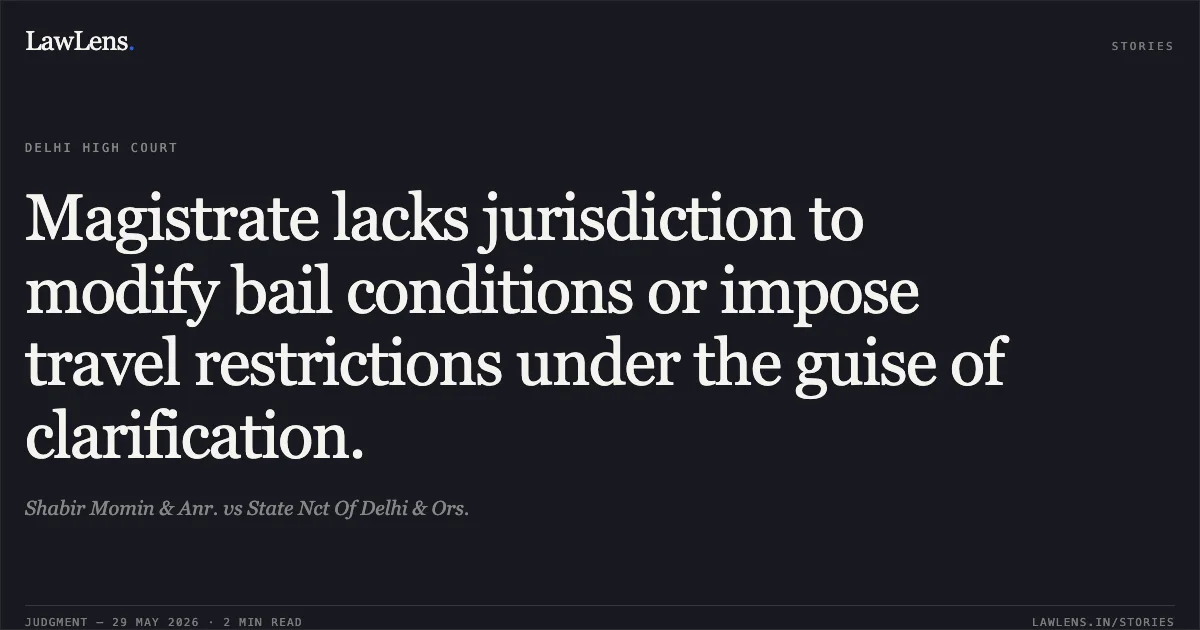
1. Whether a Magistrate has the jurisdiction to alter or add new conditions to a bail order under the guise of a "clarification" after the order has attained finality.
Source reference: p. 6 / para 5.12. Whether the bar against reviewing or altering judgments under Section 362 of the Cr.P.C. (now Section 402 BNSS) applies to bail conditions imposed by a Magistrate.
Source reference: p. 6 / para 5.2Law Applied
The court primarily applied Section 362 of the Cr.P.C. (and the corresponding provision in the BNSS), which prohibits a criminal court from altering or reviewing its judgment or final order except to correct clerical or arithmetical errors.
Source reference: p. 7The court relied on Section 439(1)(b) of the Cr.P.C. (Section 483 BNSS), which stipulates that the power to modify or set aside conditions imposed in a bail order is vested exclusively in the High Court or the Court of Session, not the Magistrate who passed the original order.
Source reference: p. 6, 14The court noted the technological advancements under Section 530 of the BNSS, which permits proceedings via electronic mode, mitigating concerns regarding an accused's physical absence from the country.
Source reference: p. 8Reasoning
The High Court reasoned that since the original bail order of 23.03.2021 contained no travel restrictions, the CJM’s subsequent order was not a "clarification" but a substantive modification.
Source reference: p. 13By inserting a new restrictive condition, the CJM effectively reviewed its own order, which is expressly barred by Section 362 Cr.P.C.
Source reference: p. 12The court found that the CJM bypassed the hierarchy of criminal procedure; if conditions were to be modified, the remedy lay with the Sessions Court or High Court under Section 439(1)(b).
Source reference: p. 14Furthermore, the court held the impugned order was a circumvention of the Sessions Court's previous remand order.
Source reference: p. 13-14Regarding the petitioners' travel during the pendency of the order, the court deemed the impugned order non-est (legally non-existent) for lack of jurisdiction, thereby rendering the technical infractions excusable, especially given the petitioners' consistent history of returning to India and participating in trial.
Source reference: p. 15Holding
The Court set aside the CJM’s order dated 06.11.2025, holding it was passed without jurisdiction.
It ruled that the petitioners remain bound only by the original 2021 bail conditions and do not require prior court permission to travel abroad.
Source reference: p. 16As an act of atonement for the technical infraction of the (then-active) CJM order, the petitioners were directed to pay costs of ₹2,00,000 each to 'Friendicoes SECA'.
Source reference: p. 16Acts & Sections Cited
1 provisions across 1 statute referred to in this judgment. Each provision opens on LawLens.
Negotiable Instruments Act, 18811
Original Court PDF
Shabir Momin & Anr.vsState Nct Of Delhi & Ors.
Click to open original judgment
Original judgment, available to read, download and summarize on LawLens.in