Facts
The appellant was named in an FIR (Sour Bazar P.S. Case No. 450/2020) regarding the murder of the informant’s husband, allegedly over a land dispute.
Source reference: p. 1-2Following an investigation, the police found no substantive evidence linking the appellant to the crime—noting a different version of events in the confessional statement of another accused— and consequently did not nominate the appellant for trial in the final report.
Source reference: p. 2-3However, via an order dated 21.09.2021, the Special Judge, SC/ST Act, Saharsa, differed from the police conclusion and took cognizance of offences under Sections 341, 323, 324, 302, 201, 120(B), 504, 506/34 of the IPC and Sections 3(1)(r)(s) & 3(2)(v) of the SC/ST Act against the appellant.
Source reference: p. 1-2The appellant challenged this cognizance order on the ground that it was cryptic and lacked judicial reasoning.
Source reference: p. 2Issues
1. Whether a cognizance-taking court is required to record specific reasons when differing from a police report that finds an accused person innocent.
Source reference: p. 4 / para 52. Whether the impugned order dated 21.09.2021 was passed with proper judicial application of mind or was mechanical in nature.
Source reference: p. 4 / para 5Law Applied
The court applied Section 14A(2) of the Scheduled Castes and Scheduled Tribes (Prevention of Atrocities) Act regarding appeals against orders.
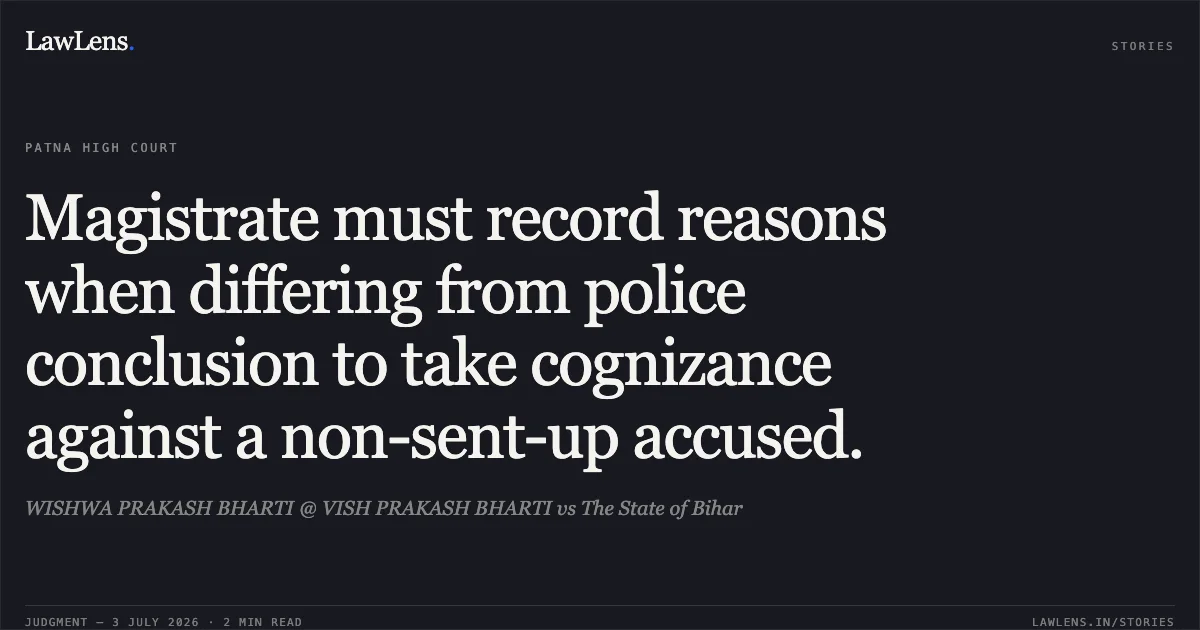
Source reference: p. 1While a Magistrate/Special Judge has the power to differ from a police "final form" (closure report), the court is legally obligated to record reasons, however brief, for such disagreement.
Source reference: p. 4Mahanth Ram Mohan Das vs. State of Bihar & Ors. (2026 SCC OnLine Pat 1993) and Pappu Kumar Chauhan @ Shiv Shankar Prasad vs. State of Bihar (Cr. APP(SJ) No. 2044 of 2025).
Source reference: p. 3Reasoning
The High Court observed that the trial court took cognizance against the appellant despite the police not sending him up for trial.
Source reference: p. 4The Court found that the impugned order failed to provide any rationale for disregarding the police’s conclusion of innocence or for bypassing the materials in the case diary—such as the confessional statement of Nirbudh Sada—which did not implicate the appellant.
Source reference: p. 2-3It was determined that simply stating that the case diary and charge sheets were "taken into consideration" does not satisfy the requirement of a reasoned judicial order when the court chooses to proceed against a person found innocent by investigators.
Source reference: p. 4Consequently, the High Court characterized the trial court’s approach as "mechanical" and a "non-judicial approach," rendering the order legally unsustainable.
Source reference: p. 4-5Holding
The Court held that the trial court must record reasons when differing from a police conclusion.
The High Court allowed the appeal and set aside the impugned order dated 21.09.2021 specifically as it pertained to the appellant. The matter was remanded to the trial court with a direction to pass a fresh, reasoned order on the point of cognizance regarding the appellant, in accordance with the law and without being prejudiced by the observations of the High Court.
Source reference: p. 5Acts & Sections Cited
9 provisions across 2 statutes referred to in this judgment. Each provision opens on LawLens.
Indian Penal Code, 18608
Scheduled Castes and the Scheduled Tribes (Prevention of Atrocities) Act, 19891
Original Court PDF
WISHWA PRAKASH BHARTI @ VISH PRAKASH BHARTIvsThe State of Bihar
Click to open original judgment
Original judgment, available to read, download and summarize on LawLens.in