Facts
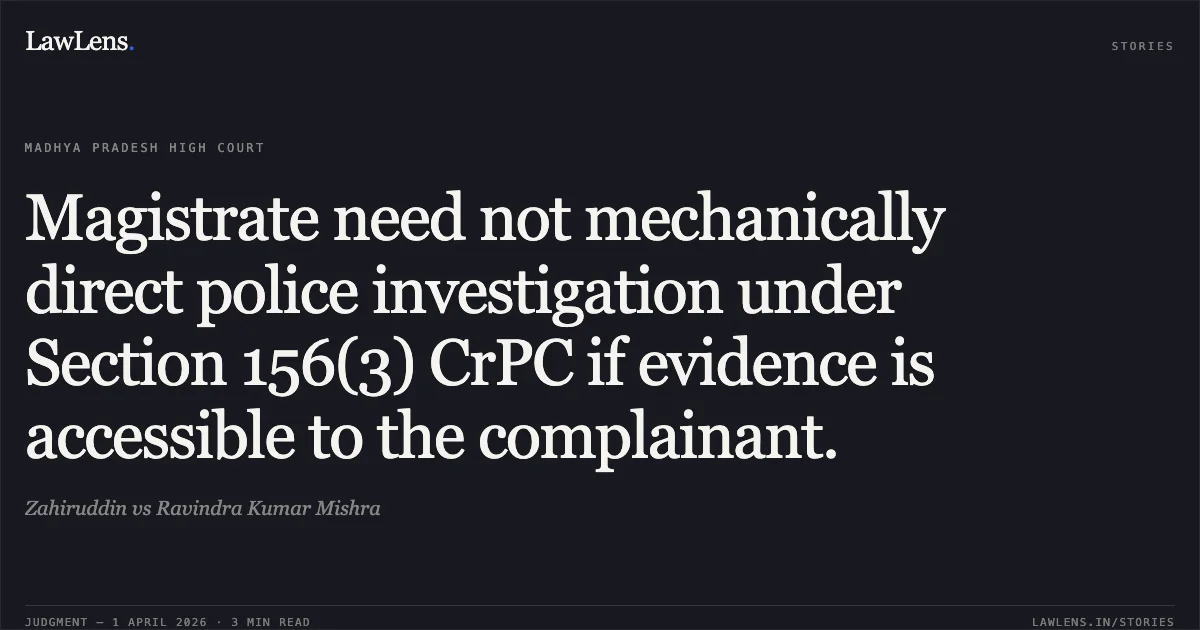
The petitioner, Zahiruddin, alleged that the Office of District Women and Child Development Department, Ratlam, committed irregularities in allotting the operation of Balika Grah and Swadhar Grah.
Source reference: para 2AHe claimed his association, Awsar Yuva Mandal Samiti, applied within the stipulated time, but the contract was awarded to another entity that had not applied timely
Source reference: para 2AAlleging fraud, forgery, and criminal conspiracy (Sections 420, 467, 468, 471, 201, and 120B of the IPC), the petitioner filed an application under Section 156(3) of the Cr.P.C. seeking a police investigation
Source reference: para 2A, 3The Judicial Magistrate First Class (JMFC), Ratlam, declined to forward the complaint for investigation, instead treating it as a private complaint and fixing it for recording the complainant's evidence under Section 200 Cr.P.C.
Source reference: para 2BThis order was upheld by the First Additional Sessions Judge, Ratlam, in revision
Source reference: para 1The petitioner subsequently moved the High Court under Section 482 Cr.P.C. to set aside these orders
Source reference: para 3Issues
1. Whether the Magistrate erred in exercising discretion to treat the application as a private complaint under Section 200 Cr.P.C. instead of directing a police investigation under Section 156(3) Cr.P.C.
Source reference: para 3, 72. Whether a police investigation is mandatory in every instance where a cognizable offence is alleged in a complaint filed before a Magistrate
Source reference: para 9Law Applied
The court primarily applied Sections 156(3), 200, and 202 of the Cr.P.C. regarding the Magistrate's power to order investigation versus taking cognizance of a complaint
Source reference: para 7, 8It relied on Mukesh Kharwar v. State of U.P., which posits that police investigation should be reserved for cases where the complainant cannot reasonably collect evidence, such as identifying unknown accused or conducting raids
Source reference: para 6It further applied Ramdev Food Products (P) Ltd. v. State of Gujarat, establishing that Section 156(3) directions require the application of judicial mind and are not to be issued mechanically
Source reference: para 7It cited Om Prakash Ambadkar v. State of Maharashtra, which held that if allegations are simple and evidence is within the complainant's reach, the Magistrate should proceed with the trial rather than referring the matter to the police
Source reference: para 9Reasoning
The court examined whether the nature of the allegations required the specialized expertise of the police.
Source reference: para 2AIt noted that the petitioner’s grievances stemmed from an administrative allotment process where he had already gathered significant information through the Right to Information Act.
Source reference: para 2AThe court observed that a preliminary inquiry by the police had previously found no cognizable offence, yet the JMFC opted to allow the petitioner to lead his own evidence under Section 200 Cr.P.C. rather than dismissing the matter entirely.
Source reference: para 11Applying the principles from Om Prakash Ambadkar, the court reasoned that the Magistrate is not a "post office" and must only direct a police investigation when the interest of justice would otherwise suffer.
Source reference: para 9Since the facts were within the petitioner's knowledge and the documents were accessible, the High Court determined that the JMFC properly exercised judicial discretion in opting for the complaint procedure to verify the allegations.
Source reference: para 11Holding
The High Court held that the JMFC's decision to proceed under Section 200 Cr.P.C. was neither improper nor illegal, as the Magistrate has the discretion to choose the post-cognizance inquiry path over a pre-cognizance police investigation.
The court affirmed that no manifest error was committed by the Revisional Court in upholding the JMFC's order.
Source reference: para 11Consequently, the petition under Section 482 Cr.P.C. was dismissed as meritless.
Source reference: para 12Acts & Sections Cited
15 provisions across 2 statutes referred to in this judgment. Each provision opens on LawLens.
Code of Criminal Procedure, 1973
Indian Penal Code, 18605
Original Court PDF
ZahiruddinvsRavindra Kumar Mishra
Click to open original judgment
Original judgment, available to read, download and summarize on LawLens.in