Facts
The petitioners (mother-in-law and husband) sought to quash an FIR, charge sheet, and cognizance order for offences under Section 498A of the IPC.
Source reference: para. 2The informant alleged consistent harassment and cruelty regarding a dowry demand for a car, including being beaten, driven out of the matrimonial home, and an attempt on her life by tampering with a gas stove.
Source reference: para. 7Following an investigation under Section 156(3) Cr.P.C., the police filed a charge sheet against the petitioners while exonerating two other co-accused due to lack of evidence.
Source reference: para. 3The Magistrate subsequently took cognizance based on the police report.
Source reference: para. 3The petitioners contended the allegations were vague, omnibus, and lacked specific dates or times.
Source reference: para. 4Issues
1. Whether the criminal proceedings should be quashed under Section 482 Cr.P.C. on the grounds that allegations are general and omnibus in nature.
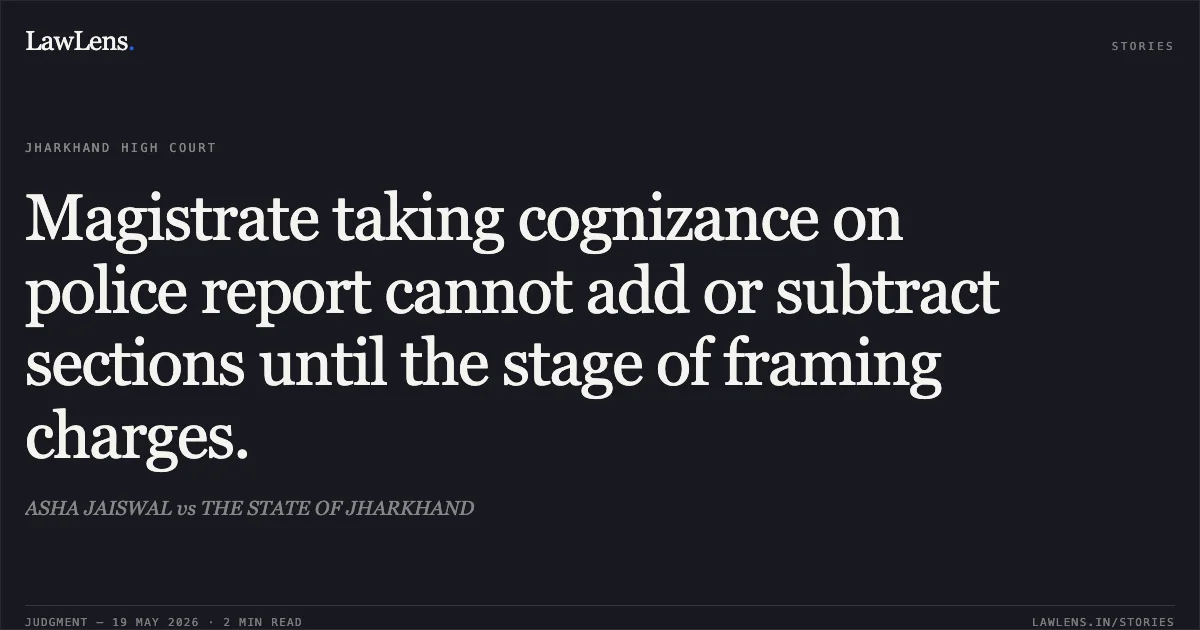
Source reference: para. 4-52. Whether a Magistrate, at the stage of taking cognizance based on a police report, has the authority to add or subtract sections of the IPC.
Source reference: para. 6-8Law Applied
The court applied Section 498A of the Indian Penal Code regarding matrimonial cruelty and Section 482 of the Cr.P.C. regarding inherent powers of the High Court.
Source reference: para. 2Precedent Dara Lakshmi Narayana & Ors. vs. State of Telangana & Anr. (2024 INSC 953) regarding the quashing of vague and omnibus allegations.
Source reference: para. 5State of Gujarat Vs. Girish Radhakrishnan Varde (2014) 3 SCC 659: A Magistrate taking cognizance upon a police report cannot add or subtract sections; such alterations are only permissible by the trial court at the stage of framing charges under Sections 216, 218, or 228 of the Cr.P.C.
Source reference: para. 8Reasoning
The Court distinguished the present case from Dara Lakshmi Narayana, noting that unlike that precedent, a charge sheet had already been submitted here after a police investigation found the allegations to be true.
Source reference: para. 6, 8The Court observed that the allegations were not merely "omnibus" but included specific instances of physical violence, life-threatening attempts (gas stove), and the misappropriation of valuables.
Source reference: para. 7Regarding the procedural challenge to the cognizance order, the Court reasoned that since the case was based on a police report, the Magistrate acted correctly in not interfering with the sections at the cognizance stage.
Source reference: para. 8The Court emphasized that the appropriate forum for the petitioners to argue the merits of the charges is during the "framing of charge" phase and noted the petitioners' non-cooperative attitude in failing to appear before the trial court.
Source reference: para. 8Holding
The Court answered the issues by holding that the Magistrate cannot alter sections at the cognizance stage and that the specific allegations necessitated a trial.
The High Court declined to exercise its inherent jurisdiction under Section 482 Cr.P.C., stating that this was a fit case for the Magistrate to decide upon the petitioners' submissions at the stage of framing charges, and dismissed the Criminal Miscellaneous Petition.
Source reference: para. 8-9Acts & Sections Cited
5 provisions across 1 statute referred to in this judgment. Each provision opens on LawLens.
Code of Criminal Procedure, 19735
Original Court PDF
ASHA JAISWALvsTHE STATE OF JHARKHAND
Click to open original judgment
Original judgment, available to read, download and summarize on LawLens.in