Facts
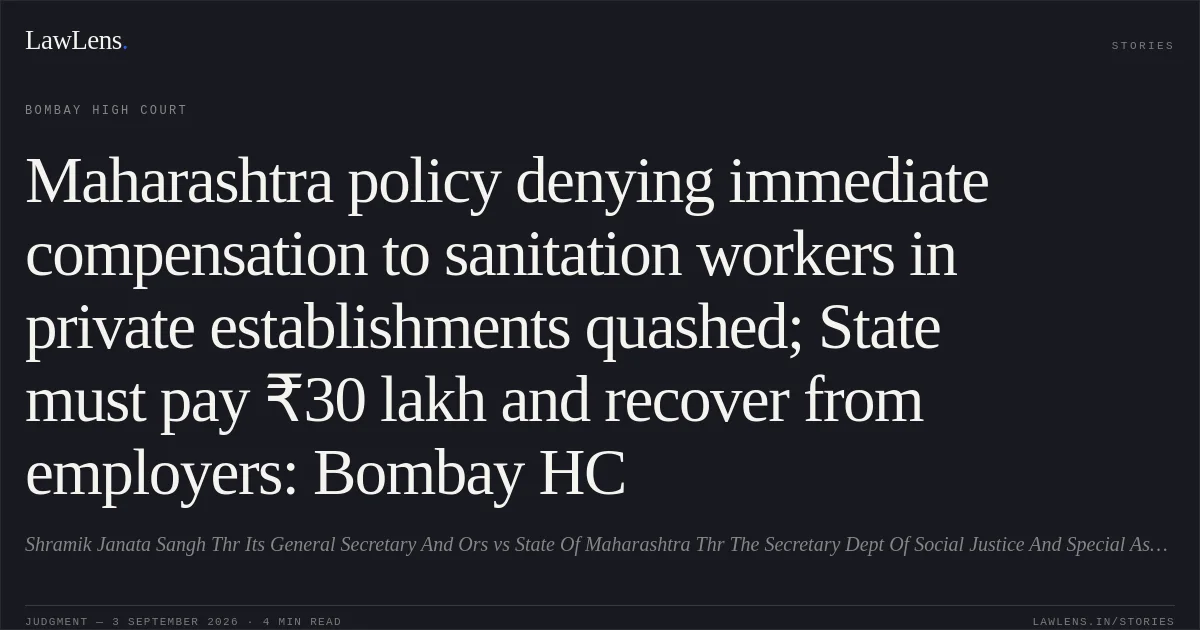
The petitioners challenged Item No. 11 of the Government Resolution dated 12 December 2019, which placed responsibility for paying compensation to dependants of sanitation workers who died during hazardous cleaning on private individuals, societies, institutions or contractors, rather than on the State or local authorities.
Source reference: para. 3, 7–8The challenge arose against the background of deaths of sanitation workers while cleaning sewers, septic tanks and sewage-treatment plants, including incidents within the jurisdiction of the Thane Municipal Corporation where workers allegedly entered such facilities without requisite permission, protective equipment or safety measures.
Source reference: para. 7, 9The petitioners also sought compensation, rehabilitation, identification of all sewer-death victims since 1993, constitution and functioning of vigilance committees, criminal action against responsible authorities, and enforcement of mechanical cleaning and safety protocols.
Source reference: para. 10During the proceedings, the State disclosed that compensation of ₹10 lakh had been paid in 81 reported cases, but the record did not comprehensively identify all persons who had died while engaged in “hazardous cleaning”.
Source reference: para. 13, 18–20The Court also noted that a subsequent Government Resolution dated 30 April 2025 reproduced the impugned discriminatory allocation of responsibility.
Source reference: para. 25–28Issues
Whether Item No. 11 of the Government Resolutions dated 12 December 2019 and 30 April 2025, which placed the initial responsibility for compensation for private-sector sanitation workers on private employers, was contrary to the Supreme Court’s directions and violative of Article 14 of the Constitution?
Source reference: paras. 25–28Whether the State Government and local authorities were required to identify all persons who had died while engaged in hazardous cleaning and pay compensation of ₹30 lakh to their dependants?
Source reference: paras. 19–20, 24Whether the State Government and local authorities were required to ensure rehabilitation of the dependants of sanitation workers and manual scavengers without differentiating between the two categories?
Source reference: paras. 21, 29–30Whether the existing statutory, governmental and administrative mechanisms sufficiently addressed the petitioners’ prayers concerning vigilance committees, criminal action and safety protocols for hazardous cleaning?
Source reference: paras. 21–23Law Applied
The Court applied the Prohibition of Employment as Manual Scavengers and their Rehabilitation Act, 2013, which prohibits manual scavenging, regulates hazardous cleaning and mandates rehabilitation of identified manual scavengers and their families.
Source reference: paras. 4, 16–18It relied on the Prohibition of Employment as Manual Scavengers and their Rehabilitation Rules, 2013, particularly the safety obligations requiring employers to provide protective gear, safety devices and prescribed safeguards before workers undertake sewer or septic-tank cleaning.
Source reference: paras. 4, 23The Court followed Safai Karamchari Andolan & Ors. v. Union of India & Ors., (2014) 11 SCC 224, which directed States and Union Territories to fully implement the 2013 Act, identify families of persons who died in sewerage work since 1993, and pay ₹10 lakh compensation for each death.
Source reference: para. 16It further applied Dr. Balram Singh v. Union of India & Ors., (2024) 11 SCC 601, especially paragraph 97.4, which enhanced compensation for sewer deaths to ₹30 lakh and placed the obligation to pay on the Union, Union Territory or State, as applicable, irrespective of the victim’s immediate employer.
Source reference: para. 17, 20The Court also relied on Article 14 and the constitutional guarantee of dignity, holding that sanitation workers performing the same hazardous work could not be discriminated against solely on the basis of whether they worked for a government or private establishment.
Source reference: para. 26Reasoning
The Court held that Item No. 11 created an impermissible classification between sanitation workers employed in government or local-authority establishments and those engaged through private societies or contractors, although both performed the same hazardous work and were equally protected by the 2013 Act.
Source reference: para. 26By making payment dependent upon recovery from a private employer, the policy exposed bereaved families to delay, uncertainty and litigation, contrary to the Supreme Court’s requirement of immediate compensation.
Source reference: paras. 25–28The Court therefore interpreted the directions in Safai Karamchari Andolan together with paragraph 97.4 of Dr. Balram Singh as imposing the primary obligation on the State or concerned public authority to make payment, with subsequent recovery permissible from the employer responsible for the death.
Source reference: paras. 26, 28Although the State had constituted vigilance committees and issued directions concerning Emergency Response Sanitation Units, FIRs, protective equipment and mechanical cleaning, the Court found implementation inadequate and the State’s data incomplete because it recorded identified manual scavenging deaths rather than all deaths during hazardous cleaning.
Source reference: paras. 18, 21–24, 29–30In light of the enhanced compensation of ₹30 lakh, the Court directed fresh identification of all hazardous-cleaning deaths and ordered rehabilitation of dependants without distinction between manual scavengers and other sanitation workers.
Source reference: para. 30Holding
The Bombay High Court made the Rule absolute.
It quashed Item No. 11 of the Government Resolutions dated 12 December 2019 and 30 April 2025 insofar as it discriminated against sanitation workers engaged in private establishments.
Source reference: para. 30(i)It directed the State Government to ensure payment of compensation to dependants of private-sector sanitation workers, with liberty to recover the amount from the concerned employer or establishment.
Source reference: para. 30(ii)The dependants of the identified deceased workers, including Devidas Chandrakant, Mahadeve Dhondiram Zope, Suraj Madhave, Ghanshyam Kori and Ritik Kurkute, were held entitled to compensation of ₹30 lakh each, if not already compensated, payable within eight weeks.
Source reference: para. 30(iii)The State was directed to identify, within six months, all persons who had died while engaged in hazardous cleaning under Section 2(d) of the 2013 Act and pay ₹30 lakh to the dependants of each victim.
Source reference: para. 30(iv)The State Government and local authorities were further directed to undertake rehabilitation of the dependants of sanitation workers and manual scavengers in accordance with the 2013 Act and the Supreme Court’s decisions, without discrimination between the categories.
Source reference: para. 30(v)Acts & Sections Cited
7 provisions across 1 statute referred to in this judgment. Each provision opens on LawLens.
Prohibition of Employment as Manual Scavengers and their Rehabilitation Act, 20137
Original Court PDF
Shramik Janata Sangh Thr Its General Secretary And OrsvsState Of Maharashtra Thr The Secretary Dept Of Social Justice And Special Assistance And Ors
Click to open original judgment
Original judgment, available to read, download and summarize on LawLens.in