Facts
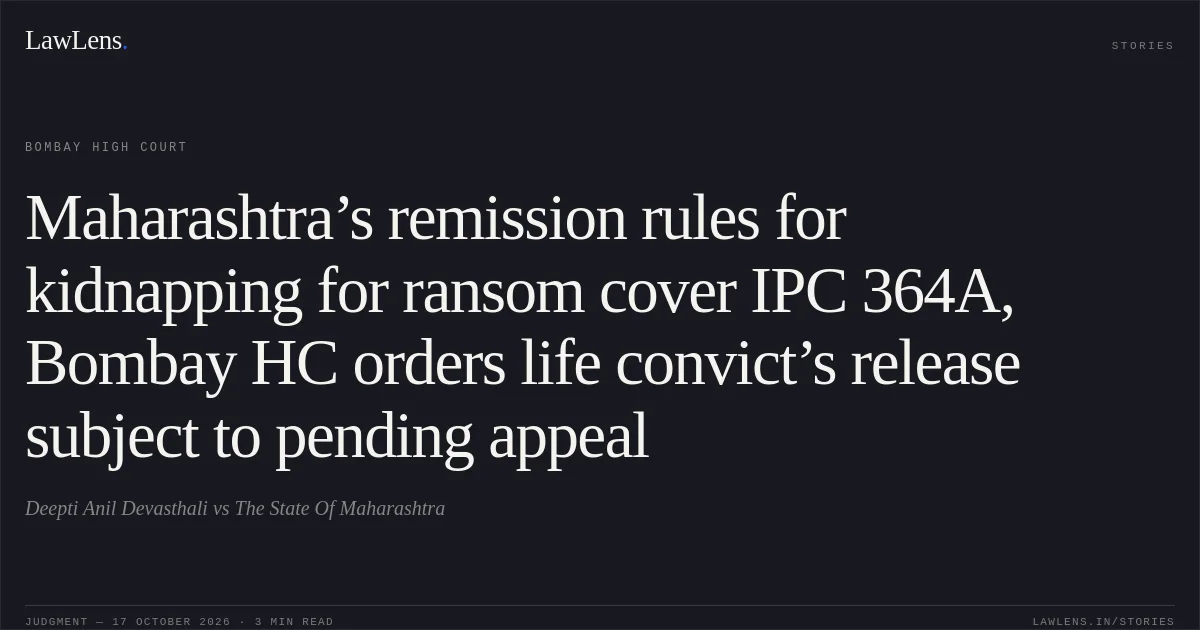
The petitioners were convicted in 2007 of, among other offences, kidnapping for ransom under Section 364A read with Section 120B of the IPC and sentenced to life imprisonment.
Source reference: para. 3–4The High Court later acquitted them of murder under Section 302 read with Section 120B, while affirming the life sentence for the Section 364A offence.
Source reference: para. 3–4Petitioner No. 1 challenged the State’s 22 September 2025 order categorising her under category 6(d) of the Maharashtra Government Resolution (GR) dated 15 March 2010, which required her to serve 30 years’ imprisonment with remissions.
Source reference: para. 8–9By the time of decision, she had completed 20 years of actual imprisonment and 26 years with remissions; an appeal by the State remained pending before the Supreme Court.
Source reference: para. 25–26Issues
1. Whether the State correctly categorised petitioner No. 1 under category 6(d) of the 2010 GR, applicable to prisoners whose death sentence has been commuted to life imprisonment, despite her acquittal of murder.
Source reference: para. 15–192. Whether category 7(a) of Annexure II to the 2010 GR, describing persons guilty of kidnapping for ransom, applied to her Section 364A conviction and permitted her release.
Source reference: para. 20–233. Whether petitioner No. 1 could be released subject to conditions while the State’s appeal remained pending before the Supreme Court.
Source reference: para. 26–29Law Applied
Sections 432 and 433 of the Code of Criminal Procedure, 1973 confer powers relating to remission and commutation; Section 433A restricts their exercise by requiring at least 14 years’ imprisonment in specified cases, and Section 435 requires consultation with the Central Government in certain cases.
Source reference: para. 27The Maharashtra GR dated 15 March 2010 sets separate premature-release categories for offences involving murder in Annexure I and offences not involving murder in Annexure II; category 6(d) of Annexure I concerns prisoners whose death sentence has been commuted to life imprisonment, while category 7(a) of Annexure II provides for 16 years’ imprisonment, including remissions, subject to a minimum of 10 years’ actual imprisonment, for persons guilty of kidnapping for ransom.
Source reference: para. 14, 17, 20–21Under M/s. Frick India Ltd. v. Union of India, (1990) 1 SCC 400, a heading cannot control clear operative words; where a heading is ambiguous, it may assist interpretation but cannot cut down the provision’s plain meaning.
Source reference: para. 22Reasoning
Because petitioner No. 1 had been acquitted of murder, the Court held that the provisions for murder-related cases—including category 6(d), concerning commuted death sentences—did not apply to her.
Source reference: para. 18–20It then read category 7(a) of Annexure II according to its operative description, “persons guilty of kidnapping for ransom.” Although its heading referred to Section 364 rather than Section 364A, the description captured the offence for which petitioner No. 1 was convicted; the heading could not displace those clear words.
Source reference: para. 21–23The Court also considered that a woman convicted of premeditated murder would fall under category 1(b) of Annexure I, with a 20-year period, and concluded that the GR should not be applied so as to require a longer period from petitioner No. 1, who was acquitted of murder.
Source reference: para. 24–26Given her completed period of imprisonment and the pending Supreme Court appeal, the Court ordered release subject to conditions and preserved the State’s ability to revisit categorisation after the appeal.
Source reference: para. 26–29Holding
The High Court quashed the State’s 22 September 2025 categorisation order and directed petitioner No. 1’s release on a personal bond of ₹50,000 with one or two sureties of like amount.
Release was subject to providing her residential address and contact details, quarterly attendance at the nearest police station, and obtaining prior permission of the Court before leaving India.
Source reference: para. 29The order was made subject to the Supreme Court’s decision, with liberty to the State to revisit categorisation afterward; the interim application, writ petition and pending criminal applications were disposed of.
Source reference: para. 29–31Acts & Sections Cited
32 provisions across 3 statutes referred to in this judgment. Each provision opens on LawLens.
Indian Penal Code, 1860
Code of Criminal Procedure, 19734
Prisons Act, 18941
Original Court PDF
Deepti Anil DevasthalivsThe State Of Maharashtra
Click to open original judgment
Original judgment, available to read, download and summarize on LawLens.in