Facts
The wife filed M.C. No. 18/2020 seeking divorce under Sections 13(1)(ia) and 13(1)(ib) of the Hindu Marriage Act, 1955.
Source reference: no citationDuring the proceedings, the husband sought visitation with their child under Section 26; the trial court allowed his application and ordered twice-monthly visits, weekday video calls, birthday and school-event access, and ten days of summer-vacation custody.
Source reference: pp. 3–5The wife challenged that order, relying in part on the child’s age and welfare, practical difficulties with the arrangements, and the husband’s alleged failure to pay maintenance.
Source reference: pp. 5–7Earlier, the High Court had enhanced maintenance for the wife and child to ₹60,000 per month and had indicated that the husband could seek modification of monthly visitation if the child became comfortable with him.
Source reference: pp. 9–10, 15After the Supreme Court directed the trial court to decide visitation, the trial court made the order now under challenge.
Source reference: pp. 10–11Issues
1. Whether the trial court’s visitation arrangements required interference or modification in light of the child’s welfare and the parties’ circumstances
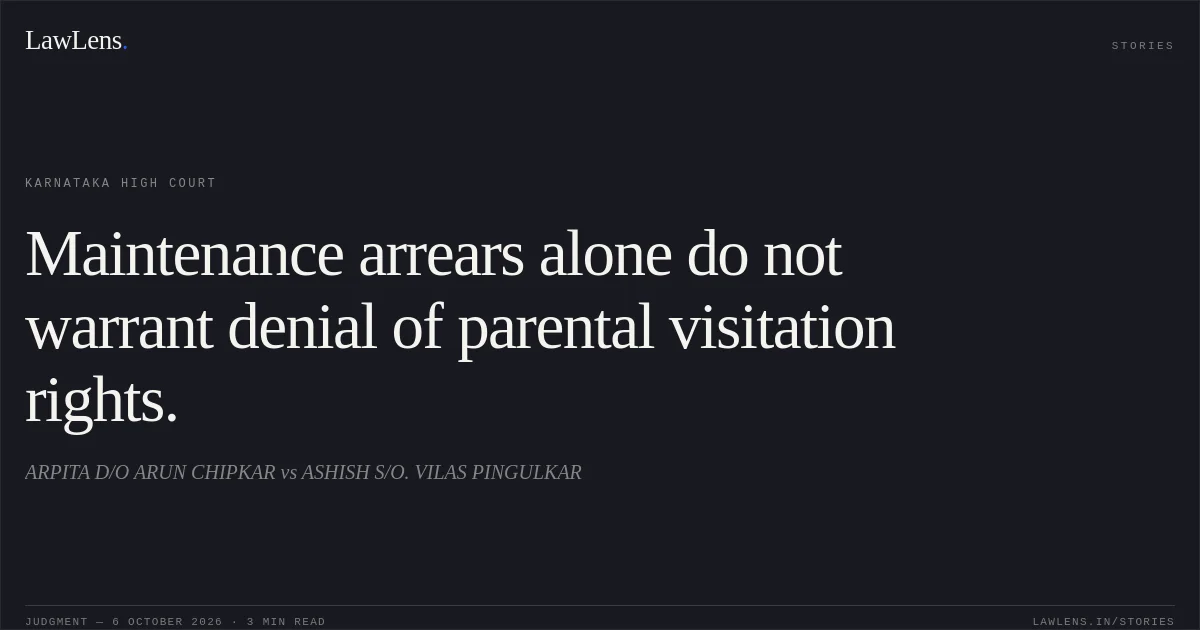
Source reference: pp. 5–7, 21–222. Whether the husband’s alleged default in paying maintenance was, by itself, a ground to deny or prevent enforcement of visitation rights
Source reference: pp. 12–18, 20–21Law Applied
Section 26 of the Hindu Marriage Act empowers the court to make interim orders concerning the custody, maintenance and education of minor children in matrimonial proceedings.
Source reference: pp. 20–22In deciding visitation, the child’s welfare and best interests are paramount; a parent’s entitlement to maintain a relationship with the child must be assessed consistently with that principle.
Source reference: pp. 20–22The Court relied on Manjusha Singhania v. Nimish Singhania for the principles that a child should not be deprived of a parent’s company merely because the parents are in conflict, and that visitation is considered on the distinct footing of the child’s welfare, rather than being made contingent solely on maintenance disputes.
Source reference: pp. 19–21It also considered the earlier order in H.P. Komala v. N. Ravikumar, which discussed possible consequences where a party fails to comply with a final maintenance order, and its own prior order in this dispute, which allowed the husband to seek modification of visitation if the child became comfortable with him.
Source reference: pp. 16–18, 15Reasoning
The Court held that the father could not be denied an opportunity to maintain a relationship with the child, and treated maintenance compliance as a separate obligation rather than a prerequisite to visitation.
Source reference: pp. 20–21Although the husband stated that he had paid maintenance due for the child, the wife disputed that he had paid the full amount ordered for her and the child; the Court directed him to pay all maintenance arrears in accordance with the earlier order.
Source reference: pp. 13–14, 20At the same time, it found the trial court’s arrangements required modification in light of the child’s welfare, present age and needs, and the parties’ convenience.
Source reference: pp. 21–22It therefore replaced the fixed twice-monthly arrangement with visits of up to three hours on a mutually convenient Saturday, Sunday or public holiday, subject to a maximum of three days per month, and did not retain the daily video-call direction.
Source reference: pp. 21–22Holding
The writ petition was disposed of with the trial court’s order modified.
The husband may meet the child for three hours on a mutually convenient Saturday, Sunday or public holiday, up to three days per month; attend school events; meet the child on her birthday for one hour; and have the child with him for ten days from the commencement of the summer vacation, subject to returning her to the wife and ensuring her safety and care.
Source reference: pp. 21–23The wife was directed to cooperate with and not obstruct the visitation arrangements, and the husband was directed to pay all maintenance arrears under the prior order.
Source reference: pp. 14, 22–23Acts & Sections Cited
3 provisions across 1 statute referred to in this judgment. Each provision opens on LawLens.
Hindu Marriage Act, 19553
Original Court PDF
ARPITA D/O ARUN CHIPKARvsASHISH S/O. VILAS PINGULKAR
Click to open original judgment
Original judgment, available to read, download and summarize on LawLens.in