Facts
The petitioner’s wife, Lucki Devi, lodged a complaint alleging cruelty, assault, dowry-related harassment, neglect during illness, and the petitioner’s alleged second marriage. Mirganj P.S. Case No. 31 of 2019 was registered under Section 498A of the Indian Penal Code and Sections 3/4 of the Dowry Prohibition Act; following investigation, a charge-sheet was filed and cognizance was taken
Source reference: paras. 3–5; pp. 2–3The petitioner sought anticipatory bail in A.B.P. No. 363 of 2019. By order dated 14 March 2019, the Sessions Judge granted bail subject to a condition requiring the petitioner to pay Rs. 10,000 to the informant-wife and file an affidavit expressing his willingness to maintain her, provide separate accommodation and essential commodities, and resume conjugal relations
Source reference: paras. 6–7; pp. 3–4On the wife’s subsequent petition, the Sessions Judge passed a further order dated 9 April 2019 clarifying that the amount of Rs. 10,000 was payable every month rather than as a one-time payment
Source reference: para. 7; pp. 4–5The petitioner challenged both orders before the High Court, contending that the condition was onerous and that the Sessions Judge had impermissibly reviewed the earlier bail order
Source reference: para. 9; p. 10Issues
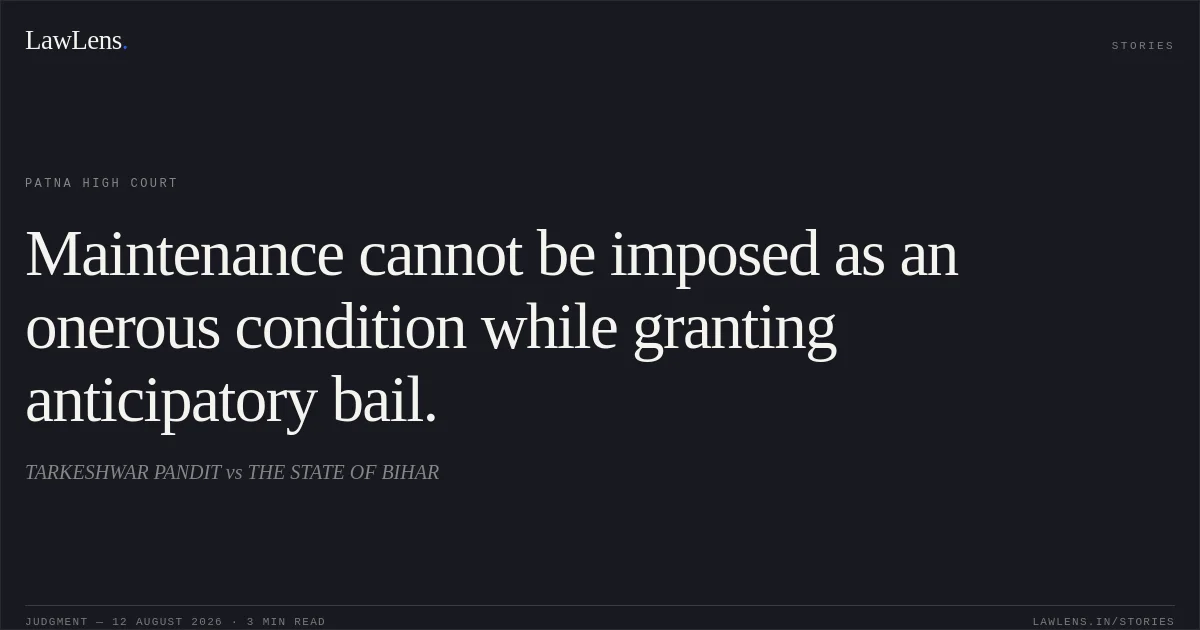
Whether a court exercising jurisdiction under Section 438 of the Code of Criminal Procedure may impose, as a condition of anticipatory bail, a direction requiring the accused-husband to pay a specified amount as monthly maintenance to the complainant-wife
Source reference: paras. 9–11; pp. 10–11Whether the Sessions Judge could subsequently review or clarify the anticipatory-bail order dated 14 March 2019, on the wife’s application, by converting the one-time payment condition into a recurring monthly maintenance obligation
Source reference: paras. 7–9, 14; pp. 4–5, 10, 12Whether the wife’s claim for maintenance should be adjudicated in independent proceedings before the competent family court rather than in an anticipatory-bail proceeding
Source reference: paras. 10, 15; pp. 10–11, 13Law Applied
The court applied the principle that conditions imposed while granting anticipatory bail under Section 438 CrPC must be relevant to securing the accused’s appearance, preventing flight from justice, and ensuring cooperation with the investigation and trial; conditions unrelated to those purposes cannot be imposed.
Source reference: para. 10; pp. 10–11Relying on Munish Bhasin v. State (Government of NCT of Delhi), (2009) 4 SCC 45, the court held that determination of maintenance ordinarily belongs to the competent court in appropriate proceedings where the parties can adduce evidence, and that directing payment of maintenance while exercising jurisdiction under Section 438 is onerous and unwarranted
Source reference: para. 10; pp. 10–11It further relied on Srikant Kumar @ Shrikant Kumar v. State of Bihar, 2025 SCC OnLine SC 2215, for the rule that bail conditions must be connected with the purposes of bail and must not be irrelevant to the exercise of power under Section 438 CrPC
Source reference: para. 11; p. 11The court also applied the principle that a judicial authority cannot review its own order except where such power is conferred by law
Source reference: para. 14; p. 12Reasoning
The High Court found that the condition requiring payment to the wife was not directed towards ensuring the petitioner’s presence at trial or preventing obstruction of the criminal process.
Source reference: paras. 6–9; pp. 3–10Although the original order described the Rs. 10,000 payment as demonstrating the petitioner’s willingness to maintain his wife, the subsequent order transformed that payment into a monthly maintenance obligation without adjudicating the parties’ respective financial circumstances or providing an appropriate forum for evidence
Source reference: paras. 6–9; pp. 3–10Applying Munish Bhasin, the court held that maintenance is a substantive matrimonial and financial claim to be determined by the competent family court, not imposed as an incidental condition of anticipatory bail
Source reference: para. 10; pp. 10–11The subsequent order was additionally held impermissible because the Sessions Judge effectively reviewed and enlarged the original bail condition on the basis of the wife’s application
Source reference: para. 14; p. 12Holding
The High Court allowed the petition and quashed the orders dated 14 March 2019 and 9 April 2019 in A.B.P. No. 363 of 2019, insofar as they related to the petitioner
It held that the direction to pay Rs. 10,000 as monthly maintenance was an onerous and legally unsustainable condition of anticipatory bail, and that the subsequent modification amounted to an impermissible review of the earlier order
Source reference: para. 14; p. 12The wife was expressly left free to initiate independent maintenance proceedings before the Family Court, Gopalganj, which was directed to decide any such proceeding in accordance with law
Source reference: para. 15; p. 13Acts & Sections Cited
4 provisions across 3 statutes referred to in this judgment. Each provision opens on LawLens.
Code of Criminal Procedure, 19731
Hindu Marriage Act, 19551
Original Court PDF
TARKESHWAR PANDITvsTHE STATE OF BIHAR
Click to open original judgment
Original judgment, available to read, download and summarize on LawLens.in