Facts
The petitioner-husband’s wife and minor son obtained a maintenance order dated 19.03.2022 under Section 125 Cr.P.C., directing him to pay ₹4,000 per month—₹2,000 each to the wife and son—from 10.02.2022, the date of filing of the maintenance application.
Source reference: p.2, para. 3The petitioner did not comply, claiming that he lacked the means to pay, and the respondents initiated execution proceedings under Section 125(3) Cr.P.C.
Source reference: p.2, paras. 4–5The Family Court, Khowai, subsequently sentenced him by order dated 04.02.2025 to simple imprisonment for two years and eleven months for default in payment of maintenance arrears amounting to ₹2,10,000.
Source reference: p.3, paras. 5, 11The maintenance order itself had not been challenged and had attained finality.
Source reference: p.4, para. 10The petitioner challenged only the legality of the term of imprisonment in the present revision under Sections 397 and 401 Cr.P.C.
Source reference: p.1, para. 1Issues
Whether a court executing a maintenance order under Section 125(3) Cr.P.C., corresponding to Section 144(3) BNSS, may sentence the defaulter to imprisonment exceeding one month for arrears of maintenance.
Source reference: pp.4–5, paras. 8–12Whether imprisonment for non-payment of maintenance extinguishes the defaulter’s continuing liability to pay the arrears.
Source reference: pp.6–7, paras. 13–16; pp.11–12, paras. 18–20Whether the Family Court’s order sentencing the petitioner to two years and eleven months was legally sustainable.
Source reference: pp.11–13, paras. 17–23Law Applied
The court applied Section 125(3) Cr.P.C., corresponding to Section 144(3) BNSS, which permits imprisonment for a breach of a maintenance order for a term up to one month, or until payment if made earlier, after execution of a warrant for levying the amount due.
Source reference: p.3, para. 8Relying on Shahada Khatoon v. Amjad Ali, (1999) 5 SCC 672, the court held that the statutory power cannot be enlarged to impose imprisonment exceeding one month, though successive proceedings may be initiated for subsequent defaults.
Source reference: pp.5–6, para. 13Under Kuldip Kaur v. Surinder Singh, (1989) 1 SCC 405, imprisonment is only a mode of enforcing recovery and does not satisfy or extinguish the maintenance liability.
Source reference: pp.6–8, para. 14Poongodi v. Thangavel, (2013) 10 SCC 618, reaffirmed that maintenance liability is continuing, that imprisonment does not discharge arrears, and that subsequent defaults may be pursued through appropriate proceedings.
Source reference: pp.8–11, para. 15The court further directed recovery in accordance with Section 421 Cr.P.C., corresponding to Section 461 BNSS.
Source reference: p.12, para. 20Reasoning
The original maintenance order was final and the petitioner’s default was undisputed; therefore, the High Court did not reopen the correctness of the maintenance determination.
Source reference: p.4, para. 10However, Section 125(3) Cr.P.C. expressly limits imprisonment for each breach to a maximum of one month, and the Supreme Court in Shahada Khatoon had categorically held that a magistrate cannot impose imprisonment for more than one month by aggregating arrears into a longer custodial sentence.
Source reference: pp.5–6, paras. 13, 21Accordingly, sentencing the petitioner to two years and eleven months for ₹2,10,000 in arrears exceeded the statutory authority of the Family Court.
Source reference: pp.11–13, paras. 17–22At the same time, consistent with Kuldip Kaur and Poongodi, the petitioner’s release from imprisonment would not wipe out his maintenance liability; the arrears remained recoverable through the statutory recovery mechanism under Sections 421 Cr.P.C./461 BNSS or through appropriate civil proceedings.
Source reference: pp.6–11, paras. 14–16; pp.12–13, paras. 20, 25–26Holding
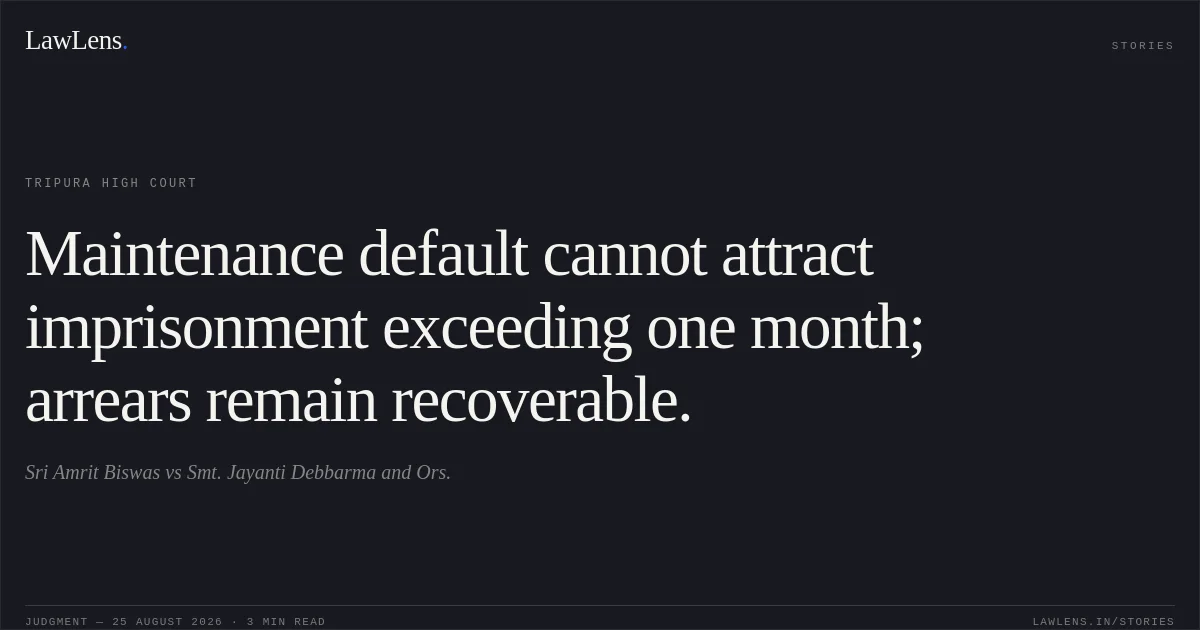
The High Court held that the Family Court could not sentence the petitioner to imprisonment exceeding one month for default in payment of maintenance.
It accordingly set aside and quashed the order dated 04.02.2025 sentencing him to two years and eleven months.
Source reference: p.13, paras. 21–23The Family Court was directed to issue an immediate release warrant and release the petitioner forthwith, unless he was required in another case.
Source reference: p.13, para. 24The respondents retained liberty to recover the arrears under Section 421 Cr.P.C./Section 461 BNSS and to pursue appropriate civil remedies.
Source reference: p.13, paras. 25–26The revision petition was disposed of accordingly.
Source reference: p.14, para. 28Acts & Sections Cited
2 provisions across 1 statute referred to in this judgment. Each provision opens on LawLens.
Bharatiya Nagarik Suraksha Sanhita, 20232
Original Court PDF
Sri Amrit BiswasvsSmt. Jayanti Debbarma and Ors.
Click to open original judgment
Original judgment, available to read, download and summarize on LawLens.in