Facts
The applicant filed an application for maintenance under Section 125 Cr.P.C. in 1996, which was dismissed for non-prosecution in 1998.
Source reference: para. 2A second application was filed in 1999 (Case No. 92/03), which underwent various restoration proceedings before being dismissed on merits by the Judicial Magistrate First Class, Sidhi, on 09.10.2014.
Source reference: para. 2The applicant claimed she married the respondent in 1991 and lived with him after "Gawna". However, in cross-examination, she admitted she never resided in the respondent's house.
Source reference: para. 8The trial court’s dismissal was upheld by the Sessions Judge, Sidhi, in Criminal Revision No. 148/2014 on 09.06.2015.
Source reference: para. 1The applicant subsequently moved the High Court under Section 482 Cr.P.C. challenging these concurrent findings.
Source reference: para. 1Issues
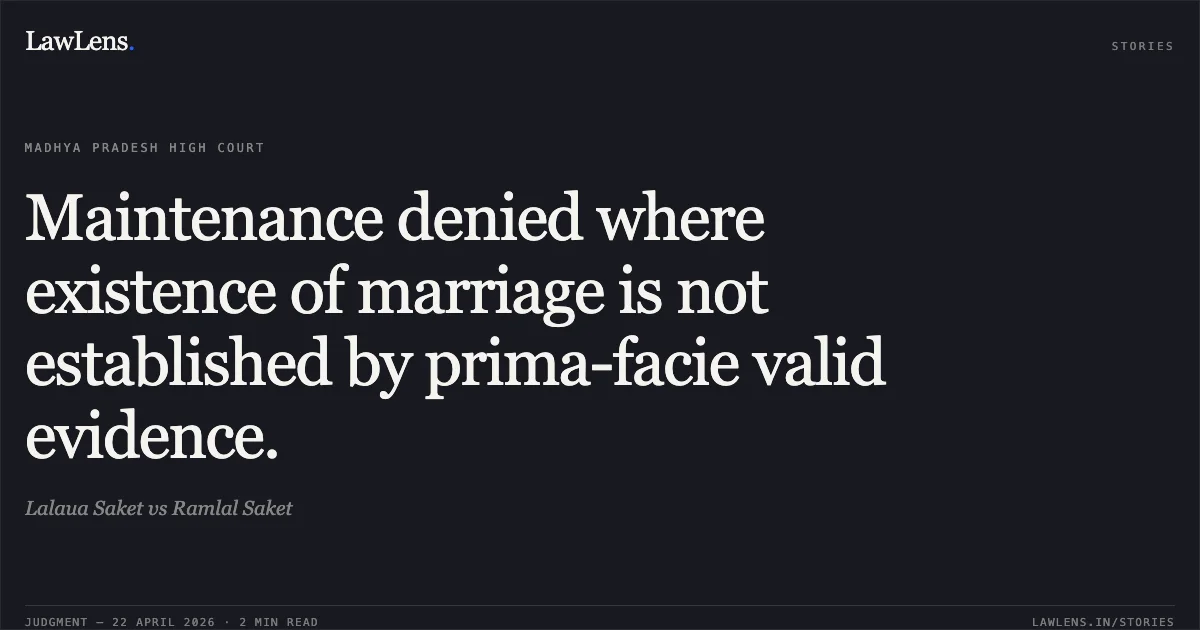
Whether the applicant established a valid marital relationship with the respondent, constituting her status as a "legally wedded wife" for the purposes of Section 125 Cr.P.C.
Source reference: para. 6Whether the concurrent findings of the lower courts were perverse or resulted in a miscarriage of justice warranting interference under the inherent jurisdiction of Section 482 Cr.P.C.
Source reference: para. 7Law Applied
The court primarily applied Section 125 of the Cr.P.C., which requires the claimant to establish a prima facie valid marital relationship as a sine qua non for maintenance.
Source reference: para. 6, 10It further applied the principles governing Section 482 Cr.P.C., noting that inherent jurisdiction is not a third appellate forum and interference in concurrent findings of fact is only permissible if they are manifestly perverse or based on no evidence.
Source reference: para. 7The court also noted that while strict proof of marriage (as required in matrimonial or criminal cases like bigamy) is not mandatory under Section 125, the claimant must still prove a marital status to be entitled to relief.
Source reference: para. 10Reasoning
The Court analyzed the evidence and found that the applicant’s own admissions fatally undermined her claim; she admitted in cross-examination that she never resided with the respondent, which contradicted her assertion of cohabitation.
Source reference: para. 8The testimony of the priest (PW-4), though supporting the marriage in the examination-in-chief, was discredited in cross-examination as he admitted the respondent was married to another woman (daughter of Ganga Saket).
Source reference: para. 8The Court observed that the respondent’s reply in earlier proceedings (Annexure P/3), when read holistically, did not constitute an admission of marriage but rather a denial.
Source reference: para. 8The High Court determined that the lower courts did not act mechanically but properly evaluated the inconsistencies in the applicant's version. Since the evidence created a substantial doubt regarding the existence of the marriage, the benefit could not be extended to the applicant based solely on sympathetic grounds or marginalization.
Source reference: para. 9-11Holding
The Court answered the issues in the negative, holding that the applicant failed to establish her status as a legally wedded wife.
The court affirmed that the concurrent findings were neither perverse nor illegal and that no abuse of the process of law was evident. Consequently, the High Court dismissed the petition, maintaining the orders of the trial and revisional courts.
Source reference: para. 11-13Acts & Sections Cited
2 provisions across 1 statute referred to in this judgment. Each provision opens on LawLens.
Code of Criminal Procedure, 19732
Original Court PDF
Lalaua SaketvsRamlal Saket
Click to open original judgment
Original judgment, available to read, download and summarize on LawLens.in