Facts
The petitioner and opposite party no. 2 were married on 20 February 2008.
Source reference: no citationThe petitioner alleged dowry-related harassment, separation from the matrimonial home, and inability to maintain herself, while asserting that the husband was financially capable of paying maintenance.
Source reference: no citationShe filed a maintenance petition under Section 125 CrPC on 26 March 2014, claiming ₹40,000 per month as maintenance and ₹50,000 as litigation expenses.
Source reference: pp. 2–3By order dated 26 September 2024, the Family Court directed the husband to pay ₹10,000 per month from the date of filing of the maintenance case.
Source reference: paras. 1–2The petitioner challenged the order principally on the ground that the amount was inadequate and that the Family Court had failed to properly assess the husband’s income, assets, liabilities, and her requirements.
Source reference: paras. 3–7The husband disclosed a net monthly salary of approximately ₹1.64 lakh, but contended that the petitioner was highly qualified, enrolled as an advocate, and capable of maintaining herself.
Source reference: paras. 9–12A decree of divorce had also been passed in favour of the husband, though the petitioner’s appeal against it remained pending.
Source reference: para. 2Issues
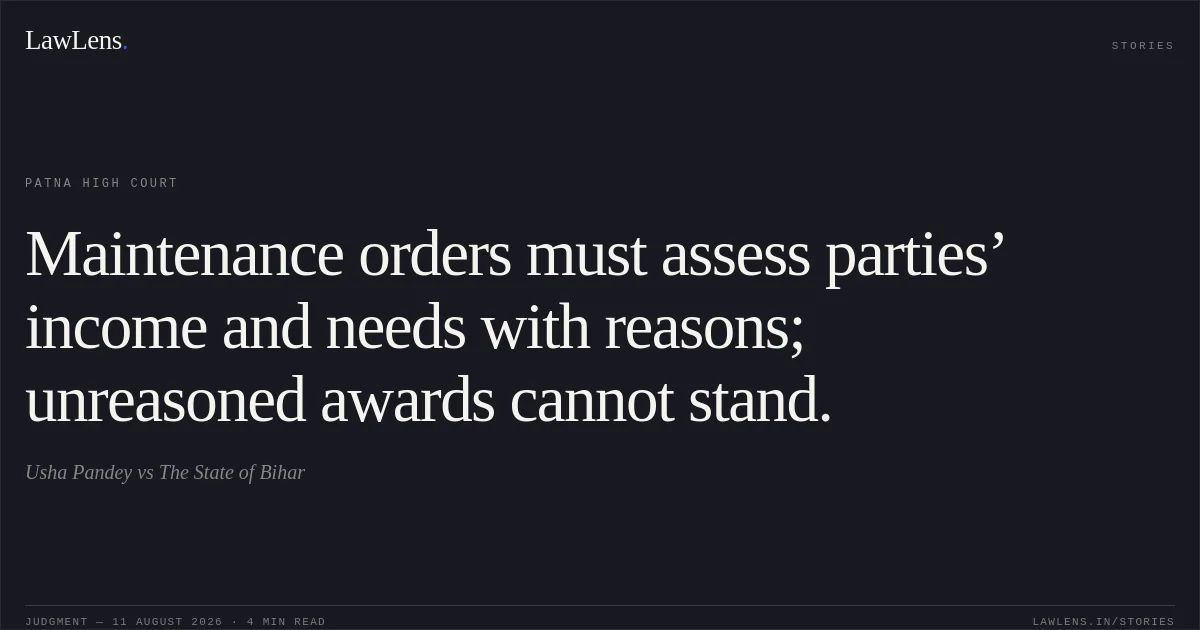
Whether the Family Court properly assessed the parties’ financial circumstances and the petitioner’s needs while fixing maintenance at ₹10,000 per month?
Source reference: paras. 14–15Whether the impugned maintenance order could be sustained when it did not contain reasoned findings regarding the husband’s income, liabilities, and the petitioner’s maintenance requirements?
Source reference: paras. 15–17Whether the High Court, in revision, should itself determine the appropriate quantum of maintenance or remand the matter for fresh determination by the Family Court?
Source reference: paras. 16–17Law Applied
The Court applied Section 125 CrPC, under which a wife unable to maintain herself may claim maintenance from a husband having sufficient means who neglects or refuses to maintain her.
Source reference: no citationThe quantum must be determined by considering the parties’ status, the wife’s reasonable needs, the husband’s actual income and liabilities, and the standard of living during the marriage; it cannot be fixed mechanically or according to an automatic percentage of the husband’s income.
Source reference: paras. 4, 6, 11In Smt. Jasbir Kaur Sehgal v. District Judge, Dehradun, (1997) 7 SCC 7, the Supreme Court held that maintenance should enable the wife to live in reasonable comfort consistent with her status and mode of life.
Source reference: para. 4Rajnesh v. Neha, (2021) 2 SCC 324, requires disclosure and consideration of the parties’ assets, liabilities, income, educational and professional qualifications, and other relevant financial circumstances while determining maintenance.
Source reference: paras. 6, 9, 11The Court also relied on Raj Kishore Jha v. State of Bihar, (2003) 11 SCC 519, for the principle that reason is the “heartbeat” of every judicial conclusion; an order lacking reasons is unsustainable.
Source reference: para. 16Since a revisional court does not ordinarily reappreciate evidence and determine disputed facts itself, it may remand the matter for fresh adjudication.
Source reference: para. 17Reasoning
The High Court found that the Family Court had not recorded a definite finding regarding the husband’s assessed income or liabilities.
Source reference: para. 15Although it noted, on the basis of the husband’s affidavit, that he earned ₹1.64 lakh per month as a legal counsel, it simultaneously observed that the petitioner had not proved his fixed income through documentary evidence, without reconciling the two positions.
Source reference: para. 15The Family Court also failed to assess the petitioner’s actual requirements and gave no reasons for fixing maintenance at ₹10,000 per month.
Source reference: para. 15The competing assertions regarding the petitioner’s qualifications, alleged legal practice, earning capacity, and the husband’s income and liabilities required factual assessment by the Family Court.
Source reference: no citationApplying the requirement of a reasoned determination under Raj Kishore Jha, together with the financial-disclosure and needs-based principles in Rajnesh v. Neha, the High Court held that the quantum order could not be sustained.
Source reference: paras. 16–17However, because determining the appropriate amount would require appreciation of facts and evidence, the High Court declined to fix the quantum itself and considered remand appropriate.
Source reference: paras. 16–17Holding
The revision petition was allowed to the extent that the Family Court’s order dated 26 September 2024, insofar as it fixed maintenance at ₹10,000 per month, was set aside.
The matter was remanded to the Principal Judge, Family Court, West Champaran at Bettiah, for fresh determination after recording reasoned findings on the husband’s income and liabilities, the petitioner’s maintenance requirements, and the appropriate quantum of maintenance.
Source reference: para. 17The remand order did not affect maintenance already paid or accruing; the husband was directed to continue paying the existing current maintenance amount until fresh orders were passed by the Family Court.
Source reference: para. 18Acts & Sections Cited
1 provisions across 1 statute referred to in this judgment. Each provision opens on LawLens.
Code of Criminal Procedure, 19731
Original Court PDF
Usha PandeyvsThe State of Bihar
Click to open original judgment
Original judgment, available to read, download and summarize on LawLens.in