Facts
Respondent No. 1, a senior citizen and the petitioners’ father/father-in-law, alleged that the petitioners subjected him to continuous harassment, intimidation and hostile behaviour, compelling him to leave his residential premises at Ulubari, Guwahati, and reside in rented accommodation and hotels.
Source reference: para. 3, p. 3Upon reconsideration, the Maintenance Tribunal, Kamrup (M), by order dated 29 January 2026, directed the petitioners to vacate and hand over possession of the Ulubari residential premises to respondent No. 1 within 30 days and directed the jurisdictional police to ensure compliance.
Source reference: paras. 5–6, pp. 4–5On examining the available record, the High Court found that no proper index or order sheet had been maintained and that, apart from the final order, there was no record demonstrating compliance with the prescribed procedure.
Source reference: para. 14, p. 9Issues
Whether the Maintenance Tribunal could direct eviction of the petitioners where their continued occupation allegedly deprived the senior citizen of peaceful residence, security and dignity, notwithstanding that no monetary maintenance had been awarded?
Source reference: paras. 16–18, pp. 10–12Whether the impugned order was vitiated by failure to afford the petitioners an opportunity of hearing and of leading evidence in accordance with Section 5(3) and Section 8 of the 2007 Act and Rule 13 of the Assam Rules, 2012?
Source reference: paras. 7–10, pp. 5–7; paras. 19–20, pp. 12–13Whether the Maintenance Tribunal, as a quasi-judicial body, was required to maintain proper order sheets and follow the principles of natural justice and the prescribed statutory procedure?
Source reference: paras. 14–15, pp. 9–10Law Applied
The Court applied the Maintenance and Welfare of Parents and Senior Citizens Act, 2007, particularly Sections 4, 5, 7 and 8. “Maintenance” includes food, clothing, residence and medical attendance and treatment; therefore, the statutory obligation may extend beyond bare financial support to ensuring a peaceful and secure residence for a senior citizen.
Source reference: paras. 16–19, pp. 10–12Under Section 5(3), the parties must be afforded an opportunity of being heard, while Section 8 permits the Tribunal to adopt a summary procedure subject to the applicable State Rules.
Source reference: paras. 7–8, pp. 5–6; para. 19, p. 12Rule 13 of the Assam Rules, 2012 requires the prescribed procedure, including conciliation where appropriate and, upon failure of conciliation, an opportunity to both parties to lead evidence followed by a summary inquiry.
Source reference: paras. 8–10, pp. 6–7The Court relied on S. Vanitha v. Deputy Commissioner, Bengaluru Urban District, (2021) 15 SCC 730, and Joybrata Kundu v. State of Assam, judgment dated 19 May 2026 in WA No. 403/2022, for a purposive interpretation of “maintenance” encompassing dignity and security, while also applying the principle in Samtola Devi v. State of Uttar Pradesh, 2025 SCC OnLine SC 669, concerning procedural fairness and natural justice.
Source reference: paras. 10, 16–19, pp. 7, 10–12Reasoning
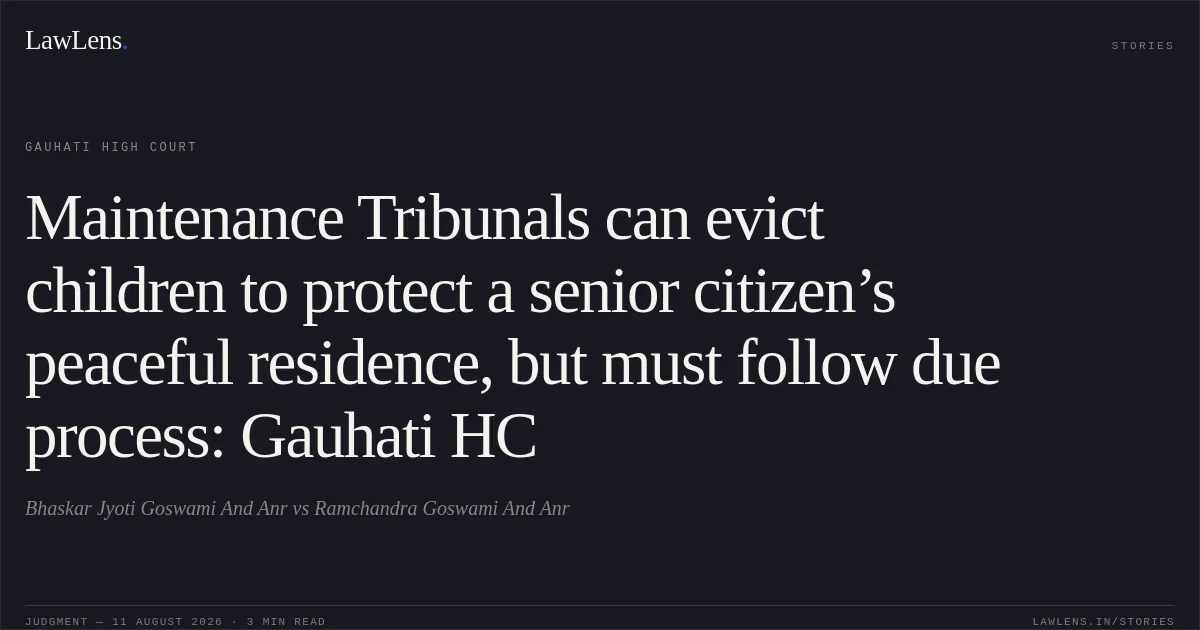
The Court held that an eviction direction may fall within the protective scope of “maintenance” where a senior citizen is unable to peacefully and securely reside in his own property because of the conduct or continued presence of children or relatives.
Source reference: paras. 16–18, pp. 10–12However, the Tribunal’s substantive power to grant such relief did not dispense with its procedural obligations. Since the Tribunal was exercising quasi-judicial powers, it was required to follow natural justice, maintain proper order sheets, afford an opportunity of hearing, and allow both parties to lead evidence under Rule 13 of the Assam Rules, 2012.
Source reference: paras. 14–15, 17, pp. 9–11The record contained no order sheets or other material showing that the petitioners had been granted an opportunity to lead evidence or that the prescribed summary inquiry had been conducted.
Source reference: paras. 14, 20, pp. 9, 12–13This procedural failure alone rendered the eviction order unsustainable, irrespective of whether the Tribunal could ultimately grant eviction on the merits.
Source reference: para. 20, p. 13Holding
The High Court held that the Maintenance Tribunal may, in an appropriate case, direct eviction to secure a senior citizen’s peaceful residence, dignity and security.
Nevertheless, the impugned order dated 29 January 2026 was set aside because the Tribunal had failed to demonstrate compliance with the mandatory requirements of hearing, opportunity to lead evidence and summary inquiry under the 2007 Act and Rule 13 of the Assam Rules, 2012.
Source reference: paras. 17–20, pp. 11–13The matter was remanded to the Maintenance Tribunal, Kamrup (M), to provide both parties an opportunity to lead evidence, conduct the requisite summary inquiry, and pass a fresh order in accordance with law as expeditiously as possible.
Source reference: paras. 21–22, p. 13The civil revision petition under Article 227 was accordingly disposed of.
Source reference: para. 23, p. 13Acts & Sections Cited
5 provisions across 1 statute referred to in this judgment. Each provision opens on LawLens.
Maintenance and Welfare of Parents and Senior Citizens Act, 20075
Original Court PDF
Bhaskar Jyoti Goswami And AnrvsRamchandra Goswami And Anr
Click to open original judgment
Original judgment, available to read, download and summarize on LawLens.in