Facts
The petitioner/complainant challenged the concurrent acquittal of respondents Nos. 1–4 of an offence under Section 498-A of the Indian Penal Code (IPC).
Source reference: para. 1She alleged that, after her marriage to respondent No. 1, the respondents harassed her over a demand for a four-wheeler and eventually ousted her from the matrimonial home.
Source reference: para. 2Following investigation, the respondents were charged and acquitted by the Additional Chief Judicial Magistrate, Bhind; the Fifth Additional Sessions Judge, Bhind, dismissed her appeal.
Source reference: para. 2The judgment records the marriage date as 6 April 2019, although its account of the prosecution chronology refers to events in 2009 and 2012.
Source reference: para. 2Issues
Whether the courts below erred in acquitting respondents Nos. 1–4 under Section 498-A IPC, such that the acquittal warranted interference in revision.
Source reference: paras. 3, 5–6, 9Whether the grant of maintenance under Section 125 CrPC established the allegations of cruelty for purposes of the criminal charge under Section 498-A IPC.
Source reference: paras. 3, 7Law Applied
Sections 397 and 401 CrPC provide the procedural basis for the revision; the charge was under Section 498-A IPC.
Source reference: no citationThe prosecution must prove guilt beyond reasonable doubt, and where the evidence permits two views, the view favourable to the accused is to be adopted, as stated in State of Gujarat v. Jayrajbhai Punjabhai Varu, (2016) 14 SCC 151.
Source reference: para. 8Suspicion, however strong, cannot substitute for proof beyond reasonable doubt; an acquittal should not be disturbed where the trial court’s finding is not perverse, illegal, or impossible, as stated in Nikhil Chandra Mondal v. State of W.B., (2023) 6 SCC 605.
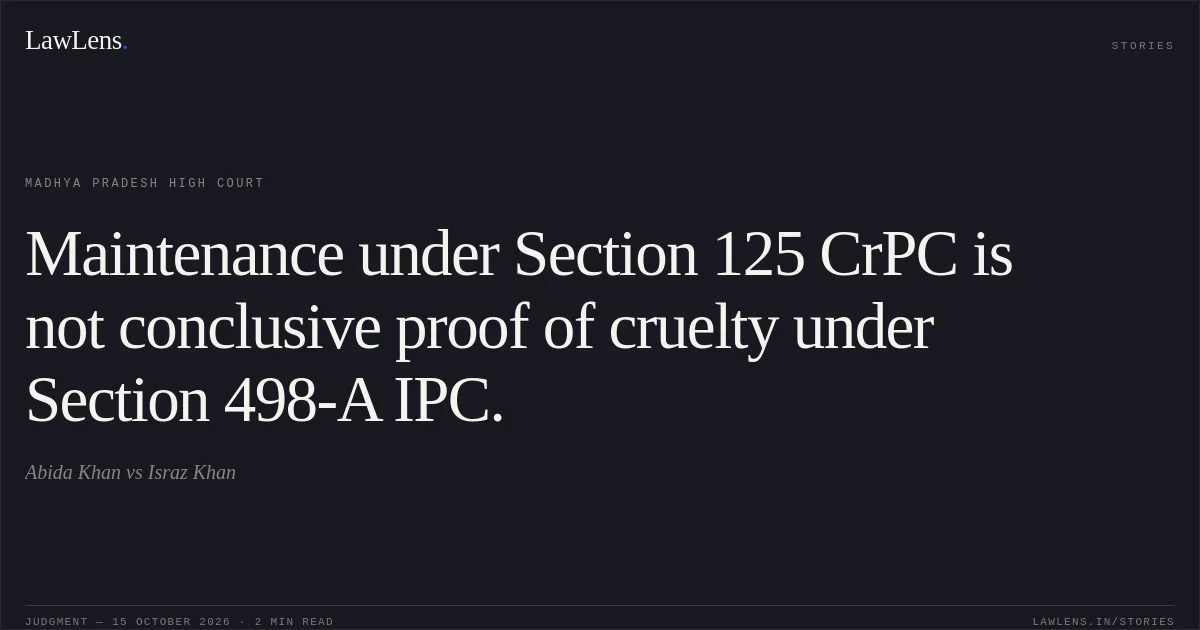
Source reference: para. 8A Section 125 CrPC maintenance proceeding is summary and beneficial in nature, and its outcome is not conclusive proof of allegations in a separate Section 498-A IPC prosecution.
Source reference: para. 7Reasoning
The High Court found that the trial court had identified material inconsistencies between the complainant’s testimony and that of her parents concerning the period she lived at the matrimonial home, as well as omissions in what she had told a witness about alleged assaults and threats.
Source reference: paras. 5–6The trial court also considered the divorce notice and the defence evidence in assessing whether the FIR had been lodged in response to that notice; the High Court found no basis to treat that assessment as perverse or otherwise warranting interference.
Source reference: paras. 6, 9The maintenance order did not resolve the criminal charge because the two proceedings had distinct purposes and standards of proof.
Source reference: para. 7Applying the rule that suspicion cannot replace proof beyond reasonable doubt, the Court concluded that the concurrent acquittals disclosed no illegality or perversity.
Source reference: paras. 8–9Holding
The High Court held that the courts below had committed no illegality or perversity in acquitting respondents Nos. 1–4 of the charge under Section 498-A IPC.
It found no ground for interference and dismissed the revision.
Source reference: para. 9Acts & Sections Cited
3 provisions across 1 statute referred to in this judgment. Each provision opens on LawLens.
Code of Criminal Procedure, 19733
Original Court PDF
Abida KhanvsIsraz Khan
Click to open original judgment
Original judgment, available to read, download and summarize on LawLens.in
![The competent authority must decide the appeal by a reasoned, speaking order within four weeks.. DR NISHANT GOYAL vs HEALTH. CAT - ['Delhi']. LawLens](/stories/thumbnails/the-competent-authority-must-decide-the-appeal-by-a-reasoned-speaking-order-within-four-we-51ef3c532385466483f4156703e7e0bc.webp)
![Competent authority must decide the pending representation by a reasoned order within four weeks.. AJAY YADAV vs MUNICIPAL CORPORATION OF DELHI (GNCTD). CAT - ['Delhi']. LawLens](/stories/thumbnails/competent-authority-must-decide-the-pending-representation-by-a-reasoned-order-within-four-1bec6310839148709c127f0a0c64e2b5.webp)
