Facts
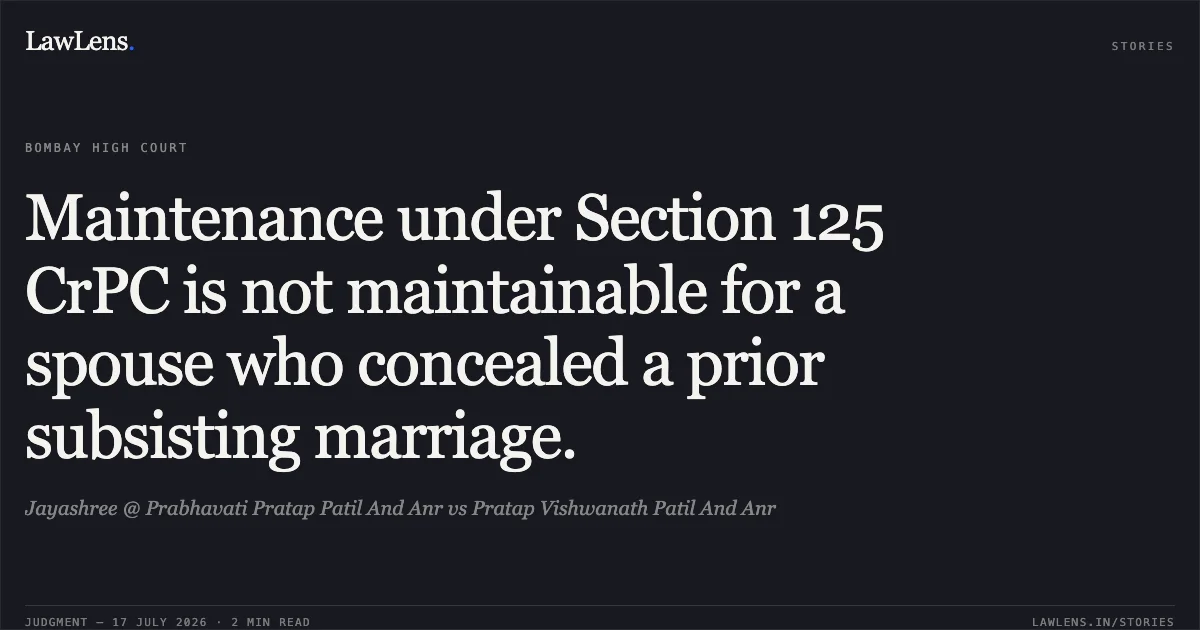
The Petitioners (wife and minor son) filed for maintenance under Section 125 Cr.P.C.
Source reference: para 3The Respondent-husband contested the claim, asserting that the Petitioner No. 1 (wife) had concealed her subsistence of a previous marriage with one Shri Kaliram Bhiva Tare and had not obtained a divorce.
Source reference: para 4The Magistrate initially granted maintenance to both.
Source reference: para 5On revision, the Sessions Court set aside the maintenance for Petitioner No. 1, holding the marriage null and void due to the prior existing marriage.
Source reference: para 2, 6The High Court noted that the marriage was formally annulled under Section 11 of the Hindu Marriage Act (HMA) and that Petitioner No. 1 cohabited with the Respondent for only three months.
Source reference: para 8, 16Issues
1. Whether a woman whose marriage is annulled due to the concealment of a subsistence first marriage (contravening Section 5(i) of the HMA) qualifies as a "wife" entitled to maintenance under Section 125 of the Cr.P.C.
Source reference: para 11Law Applied
Section 125 of the Cr.P.C., interpreted through the Full Bench decision in Yamunabai Anantrao Adhav v. Anantrao Shivram Adhav, which established that "wife" means only a legally wedded wife and excludes those whose marriage is void under Section 5(i) of the Hindu Marriage Act.
Source reference: para 10Chanmuniya v. Virendra Kumar Singh Kushwaha, which suggested a broad interpretation for long-term "live-in" relationships.
Source reference: para 12Vimala (K.) v. Veeraswamy (K.), which clarified that a second wife whose marriage is void due to a surviving first marriage is generally not entitled to maintenance.
Source reference: para 15Reasoning
The Court reasoned that Petitioner No. 1 does not satisfy the legal definition of a "wife" because her marriage was annulled by a competent court for violating Section 5(i) of the HMA.
Source reference: para 14While acknowledging precedents that favor women in "de facto" marriages or long-term live-in relationships, the Court found these inapplicable because the parties cohabited for only approximately three months, failing the "reasonably long period" test set out in Chanmuniya.
Source reference: para 16, 17Crucially, the Court distinguished this case from others based on the element of "deceit" and "concealment" regarding the first marriage; it held that a party cannot take advantage of their own wrong to claim a summary remedy under beneficial legislation.
Source reference: para 18Holding
The Court held that Petitioner No. 1 is not entitled to maintenance as she is not a legally wedded wife and her conduct involved deceitful concealment of a prior marriage.
The High Court dismissed the Writ Petition and upheld the Sessions Court's order.
Source reference: para 20The maintenance for Petitioner No. 2 (the child) remained undisturbed as paternity was not the grounds for the challenge.
Source reference: para 14Acts & Sections Cited
6 provisions across 3 statutes referred to in this judgment. Each provision opens on LawLens.
Code of Criminal Procedure, 19731
Hindu Marriage Act, 19552
Indian Penal Code, 18603
Original Court PDF
Jayashree @ Prabhavati Pratap Patil And AnrvsPratap Vishwanath Patil And Anr
Click to open original judgment
Original judgment, available to read, download and summarize on LawLens.in