Facts
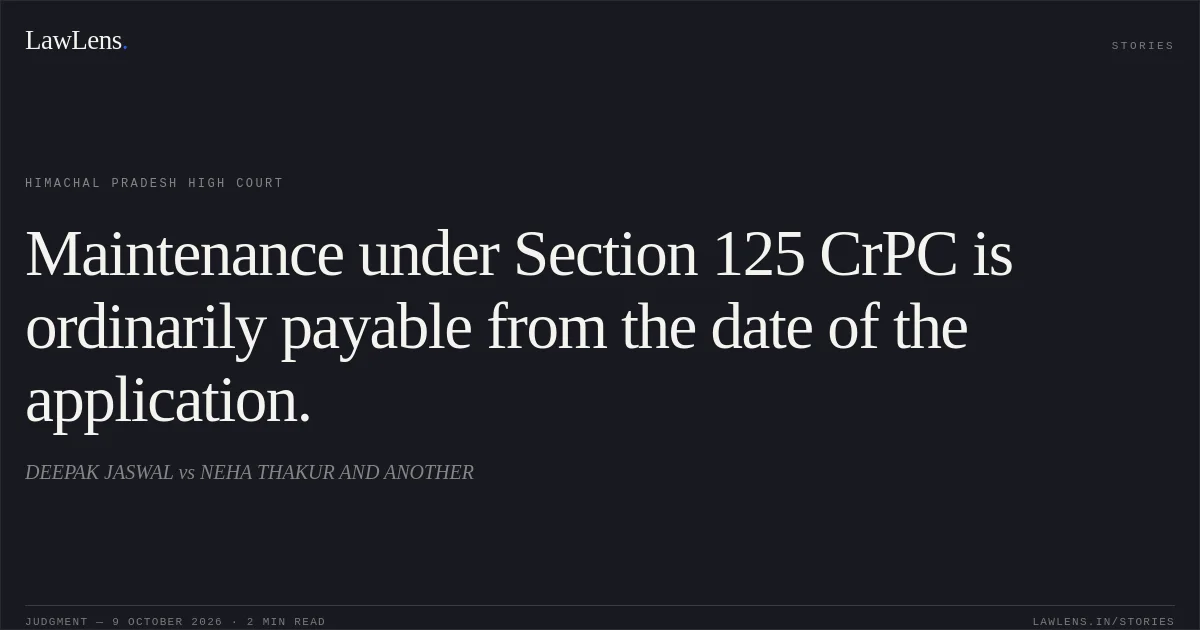
The respondents, a wife and minor son, obtained an order under Section 125 CrPC directing the petitioner to pay monthly maintenance of Rs.10,000 to each of them from the date their application was filed, 5 September 2019.
Source reference: p.2, para. 2The petitioner challenged the order, alleging that the wife had concealed her employment as a staff nurse, asserting that his retirement and other liabilities affected his ability to pay, and disputing the award of maintenance from the application date rather than the order date.
Source reference: pp.2–3, para. 3The wife’s evidence before the Family Court was that she worked as a staff nurse for three to four months after marriage and then left the job; evidence of later employment related to a position commencing in March 2025.
Source reference: pp.10–11, paras. 10–11Issues
Whether the wife had concealed material information about her employment or income when seeking maintenance
Source reference: pp.4–5, 10–12, paras. 4, 6, 10–12Whether the petitioner’s retirement and financial circumstances justified setting aside or reducing the maintenance awarded
Source reference: pp.3, 12–14, paras. 3, 13–15Whether maintenance could properly be awarded from the date of filing the application
Source reference: pp.3, 5–10, paras. 3, 7–9Whether the Family Court’s findings warranted interference in the High Court’s revisional jurisdiction
Source reference: pp.4, 13–14, paras. 4, 16–17Law Applied
Section 125 CrPC provides for maintenance to eligible wives and children.
Source reference: no citationIn Rajnesh v. Neha, (2021) 2 SCC 324, the Supreme Court stated that maintenance should ordinarily be awarded from the date of the application, given the delay that may attend maintenance proceedings and the provision’s protective purpose.
Source reference: pp.5–7, para. 8The High Court also relied on a 2025 Supreme Court decision, cited in the judgment as 2025 SCC OnLine SC 1342, which reaffirmed that approach.
Source reference: pp.7–10, para. 9In revision, the High Court does not sit as an appellate court to reappreciate evidence; interference is warranted where the impugned findings disclose perversity.
Source reference: pp.4, 13–14, paras. 4, 16–17Reasoning
The Family Court had considered the wife’s nursing employment and found that she left the job after three to four months of marriage; the petitioner did not demonstrate that this finding was perverse or unsupported by the record.
Source reference: p.10, paras. 10–11The evidence of her later employment concerned a position beginning in 2025, while the maintenance application was filed in 2019; the salary slips were not duly exhibited, and the later evidence did not establish concealment of income when the application was filed.
Source reference: pp.11–12, para. 12The petitioner was 34 years old and had a pension and other post-service emoluments, so his departure from the Navy did not, by itself, displace his obligation to maintain his wife and minor son.
Source reference: pp.12–13, paras. 13–15Applying Rajnesh, the Court rejected the challenge to maintenance from the application date and found no perversity justifying revisional interference.
Source reference: pp.5–10, 13–14, paras. 8–9, 16–17Holding
The High Court rejected the petitioner’s challenges concerning the wife’s alleged concealment, his retirement, and the date from which maintenance was payable.
Finding no perversity in the Family Court’s order, it dismissed the revision petition and disposed of any pending miscellaneous applications.
Source reference: pp.13–14, paras. 15–18Acts & Sections Cited
1 provisions across 1 statute referred to in this judgment. Each provision opens on LawLens.
Code of Criminal Procedure, 19731
Original Court PDF
DEEPAK JASWALvsNEHA THAKUR AND ANOTHER
Click to open original judgment
Original judgment, available to read, download and summarize on LawLens.in
![Authorities must consider employees’ claims under cited precedents, subject to similarity and applicable rules.. Anwar Ul Hassan Chesti vs D/o Health And Medical Education Ut Of Jammu & Kashmir. CAT - ['Srinagar']. LawLens](/stories/thumbnails/authorities-must-consider-employees-claims-under-cited-precedents-subject-to-similarity-an-ea3a30d13510422ca1f750e161753fd2.webp)