01Facts
The appellant transitioned CENVAT credit into GST through Form TRAN-1.
pp. 2–5The department alleged excess transitional credit and issued a notice under Section 73 of the CGST Act, 2017, seeking recovery of ₹13,17,806.
pp. 2–5The adjudicating authority confirmed the demand with interest and penalty; the first appellate authority set aside the demand relating to capital-goods credit of ₹3,52,678 but upheld the remaining demand.
pp. 2–5Before the Tribunal, the appellant challenged, among other matters, the CGST authorities’ jurisdiction to determine the admissibility of CENVAT credit under the erstwhile law. The Tribunal addressed that jurisdictional objection first.
pp. 10–1102Issues
i.Whether CGST authorities may use Section 73 of the CGST Act to recover CENVAT credit transitioned through TRAN-1 when the alleged inadmissibility arises under the erstwhile law.
pp. 10–11, 19–20ii.Whether Section 174(2)(e) preserves proceedings under the erstwhile law for determining and recovering allegedly inadmissible CENVAT credit.
pp. 14–1603Law Applied
Section 140 of the CGST Act provides for the transition of eligible credit, while Section 73 provides for recovery of tax not paid or short paid, erroneous refunds, and input tax credit wrongly availed or utilised under the GST regime.
pp. 12–14Section 174(2)(e) preserves investigations, adjudications, legal proceedings, and recovery remedies concerning liabilities under repealed laws, allowing them to be instituted or continued as if those laws had not been repealed.
pp. 14–16Relying on Usha Martin Ltd. v. Additional Commissioner, Central GST and Excise, (2022) 145 taxmann.com 224 (Jharkhand), and the Calcutta High Court’s decision in Kunjal Synergies Private Limited v. Assistant Commissioner of CGST & CX, MAT 2333 of 2023, the Tribunal applied the rule that CGST authorities cannot use Section 73 to determine whether CENVAT credit was admissible under the erstwhile Central Excise Act, Finance Act, and CENVAT Credit Rules; such proceedings may instead be pursued under the saved provisions of the former law.
pp. 11–19Provisions in the judgment · 11 · Linked ones open on LawLens
Central Goods and Services Tax Act, 2017 10 provisions
Section 112Section 140Section 73Section 74Section 2Section 174Section 173Section 164Section 16Section 50Central Excise Act, 1944 Section 11
04Reasoning
The Tribunal characterised the demand as concerning the alleged inadmissibility of CENVAT credit under the pre-GST regime, transitioned through TRAN-1, rather than an independent GST-law contravention.
pp. 19–20It followed Usha Martin and Kunjal Synergies, which treated the determination of admissibility under the former laws as outside the jurisdiction of CGST authorities acting under Section 73, while recognising that Section 174 preserves recourse under the erstwhile laws.
pp. 11–19The Revenue’s assertion that the cases were distinguishable did not identify a material difference in the legal issue.
p. 20The Tribunal therefore did not decide the substantive eligibility or quantification of the transitional credit.
pp. 19–2005Holding
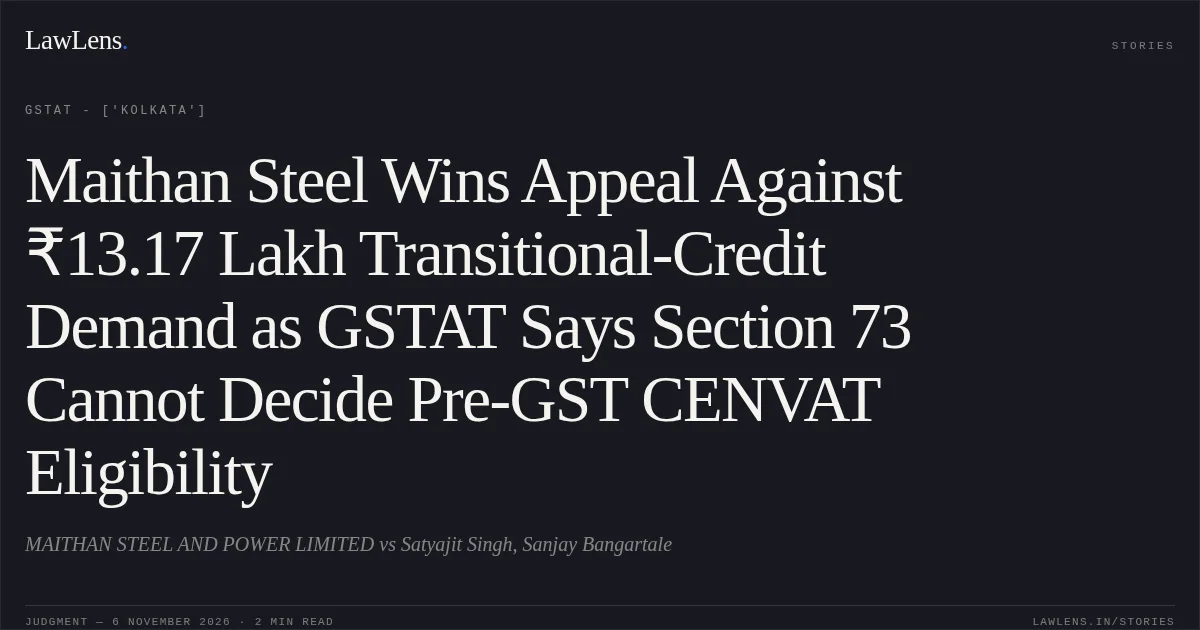
The Tribunal held that proceedings under Section 73 of the CGST Act to recover the allegedly inadmissible transitioned CENVAT credit were without jurisdiction and legally unsustainable.
p. 20It set aside the first appellate order, allowed the taxpayer’s appeal, and made no order as to costs.
p. 20Original Court PDF
MAITHAN STEEL AND POWER LIMITEDvsSatyajit Singh, Sanjay Bangartale
Click to open original judgment
Original judgment, available to read, download and summarize on LawLens.in