Facts
The appellants, being the widow and two major sons of the deceased (Devabhai Mepabhai Bhuva), filed a claim petition under Section 166 of the Motor Vehicles Act, 1988, following a fatal motor accident
Source reference: para. 3The deceased was 50 years old and self-employed in agriculture and cattle rearing
Source reference: para. 5.1The Motor Accident Claims Tribunal (Aux.), Amreli, awarded Rs. 2,19,680 with 9% interest, determining the deceased’s monthly income at Rs. 2,400 based on minimum wages
Source reference: para. 3.1/5The Tribunal deducted 20% of the total compensation on account of the deceased's contributory negligence
Source reference: para. 6.2/19The appellants moved the High Court for enhancement, arguing that the Tribunal failed to consider future prospects and adequate compensation under conventional heads
Source reference: para. 3.1/5.1Issues
1. Whether the Tribunal erred in failing to award future prospects for a self-employed deceased aged 50 years
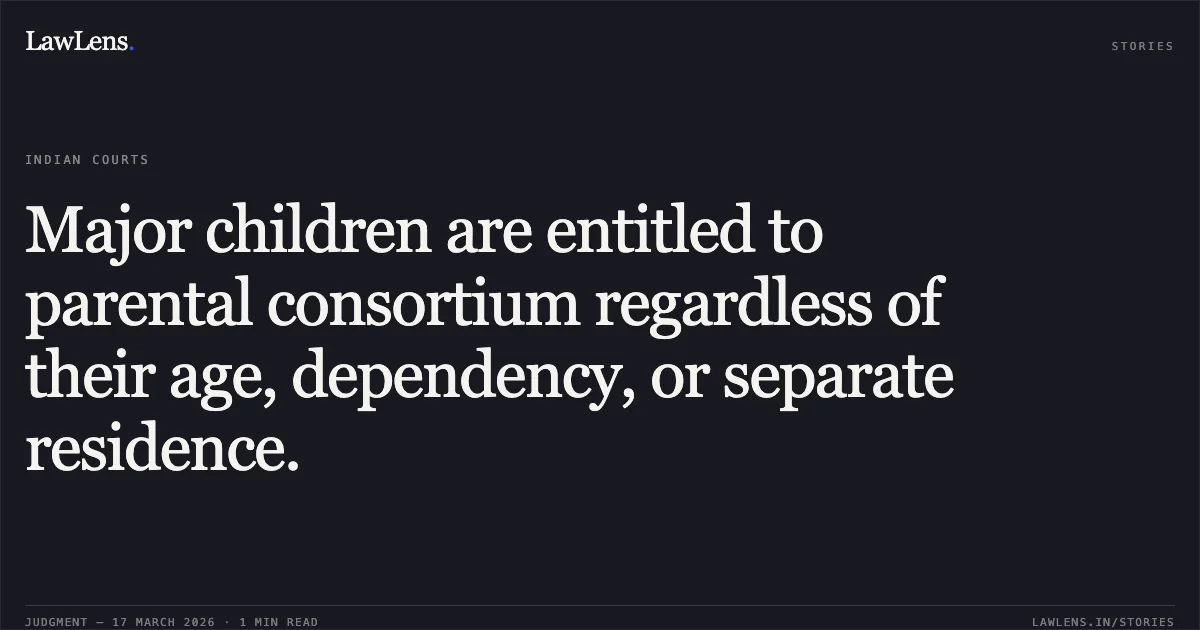
Source reference: para. 9/122. Whether major sons residing separately from the deceased are entitled to parental consortium under the Act
Source reference: para. 6.1/15-163. Whether the amounts awarded under conventional heads (Loss of Estate, Funeral Expenses, and Consortium) require upward revision in light of current precedents
Source reference: para. 5.2/18Law Applied
The court primarily applied Section 166 and 173 of the Motor Vehicles Act, 1988, regarding the adjudication of "just compensation"
Source reference: para. 3/14It relied on National Insurance Company Ltd. v. Pranay Sethi (2017) to mandate a 25% addition for future prospects for self-employed individuals aged 40–50 and to establish standardized amounts for conventional heads with a 10% incremental rise every three years
Source reference: para. 12/17-18The court followed Sarla Verma v. Delhi Transport Corp. (2009) for the 1/3rd deduction for personal expenses and the multiplier of 13
Source reference: para. 12Furthermore, it applied Magma General Insurance Co. Ltd v. Nanu Ram (2018) and United India Insurance Co. Ltd. v. Satinder Kaur (2020) to define "consortium" as a compendious term including parental consortium for children regardless of dependency
Source reference: para. 7/14Reasoning
The Court observed that the Tribunal failed to account for the future rise in income despite the deceased being self-employed
Source reference: para. 12Applying Pranay Sethi, the Court added 25% to the established income of Rs. 2,400, totaling Rs. 3,000 per month
Source reference: para. 12After a 1/3rd deduction for personal expenses and applying a multiplier of 13, the dependency loss was recalculated at Rs. 3,12,000
Source reference: para. 12Regarding consortium, the Insurance Company’s contention that major, independent sons are ineligible was rejected
Source reference: para. 15The Court held that "parental consortium" compensates for the loss of parental aid, protection, and guidance, which is not strictly tied to financial dependency or co-residence
Source reference: para. 15-16Consequently, following the 10% incremental rule from Pranay Sethi, the Court enhanced the consortium to Rs. 48,400 per claimant and raised funeral expenses and loss of estate to Rs. 18,150 each
Source reference: para. 18-19The 20% deduction for contributory negligence remained undisturbed as it was not challenged
Source reference: para. 19Holding
The Court allowed the appeal and modified the award, increasing the total compensation from Rs. 2,19,680 to Rs. 3,94,800 after deducting 20% for negligence
The appellants are entitled to an additional enhanced amount of Rs. 1,75,120 with 9% interest per annum from the date of the claim petition until realization
Source reference: para. 20The Court directed the Insurance Company to deposit the enhanced amount within six weeks and ordered the Tribunal to disburse the same to the claimants after deducting any unpaid Court fees
Source reference: para. 21Acts & Sections Cited
2 provisions across 1 statute referred to in this judgment. Each provision opens on LawLens.
Motor Vehicles Act, 19882
Original Court PDF
RAMUBEN W/O DEVABHAI MEPABHAI BHUVAvsVINODBHAI MANJIBHAI GOLAKIYA
Click to open original judgment
Original judgment, available to read, download and summarize on LawLens.in