Facts
On July 18, 2006, the deceased, Mukundbhai Ghelabhai Doshi (70 years old), was fatally struck by a negligently driven motorcycle while walking.
Source reference: para. 2The claim petition was filed by his widow and two adult sons. During the pendency of the proceedings in 2012, the widow passed away.
Source reference: para. 7The Motor Accident Claims Tribunal (MACT), Rajkot, awarded only Rs. 55,000/-, holding that the sons were not entitled to compensation for loss of dependency as they were adults with independent incomes and the widow had died.
Source reference: para. 7, 11The claimants appealed to the High Court seeking enhancement and challenging the eligibility of major sons to claim dependency.
Source reference: para. 5Issues
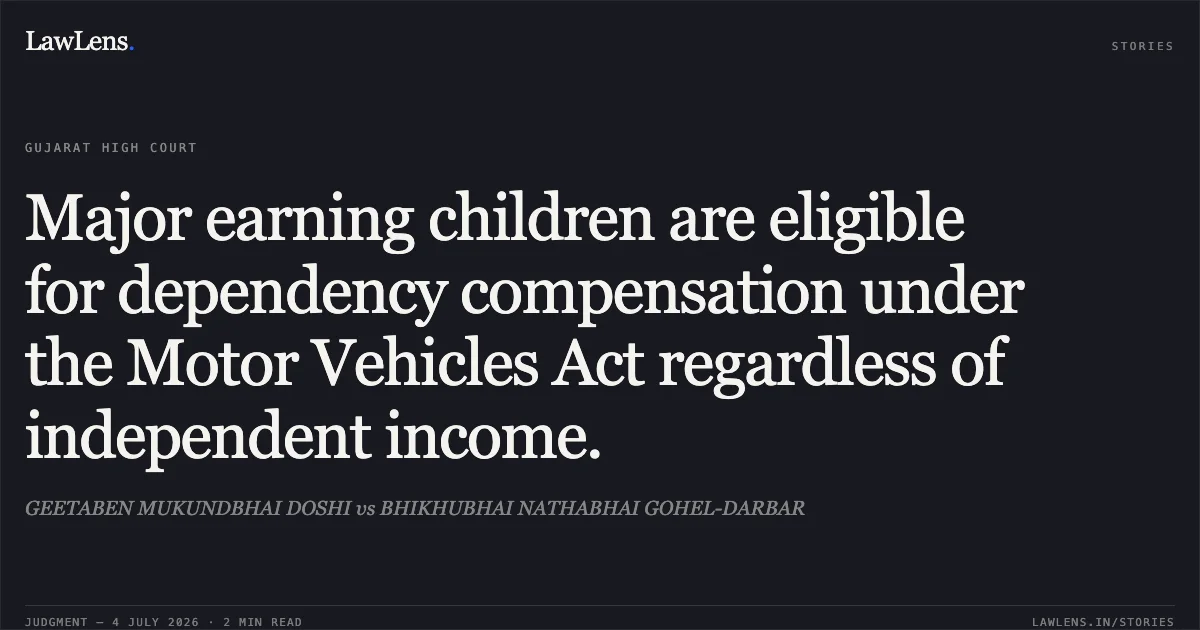
Whether major, earning sons are "legal representatives" entitled to claim compensation for loss of dependency under the Motor Vehicles Act, 1988?
Source reference: para. 5, 11Whether the Tribunal erred in its quantum assessment by excluding future loss of dependency and awarding meager sums under conventional heads?
Source reference: para. 7-8Law Applied
Section 166(1)(c) of the Motor Vehicles Act, 1988, which permits "all or any of the legal representatives" to claim compensation.
Source reference: para. 11-12National Insurance Co. Ltd. v. Birender Singh (2020), establishing that even major, earning sons are legal representatives and the Tribunal must consider their dependency rather than limiting claims to conventional heads.
Source reference: para. 13Manjuri Bera v. Oriental Insurance Co. Ltd. (2007) regarding married daughters.
Source reference: para. 16Kirti v. Oriental Insurance Co. Ltd. (2021), which mandates that dependency must be assessed at the time of filing the petition.
Source reference: para. 18National Insurance Co. Ltd. v. Pranay Sethi (2017) for conventional heads and Magma General Insurance Co. Ltd. v. Nanu Ram (2018) for parental consortium.
Source reference: para. 8, 21Reasoning
The High Court observed that Section 166 of the MV Act is broad in its definition of claimants.
Source reference: para. 12The court rejected the Insurance Company's argument that adult sons with independent incomes cannot claim dependency, noting that as "legal representatives," they are entitled to a full assessment.
Source reference: para. 13Crucially, the court held that because the widow was alive and a co-claimant at the time the petition was filed, the right to claim dependency was established at the outset.
Source reference: para. 18The Court verified the deceased’s income through Income Tax Returns (Exh. 70), assessing his net annual income at Rs. 1,81,038/-. Applying a 1/3 deduction for personal expenses and a multiplier of 5 (given the deceased's age of 70), the court recalculated the loss of dependency to be Rs. 6,03,460/-.
Source reference: para. 19Holding
The Court partly allowed the appeal, ruling that the sons are eligible claimants.
It enhanced the total compensation from Rs. 55,000/- to Rs. 7,84,960/-, including Rs. 6,03,460/- for loss of dependency, Rs. 1,45,200/- for consortium (3 claimants), and Rs. 18,150/- each for loss of estate and funeral expenses.
Source reference: para. 22-23The Insurance Company was directed to deposit the additional amount of Rs. 7,29,960/- with 9% interest per annum within six weeks.
Source reference: para. 23-24Acts & Sections Cited
5 provisions across 1 statute referred to in this judgment. Each provision opens on LawLens.
Motor Vehicles Act, 19885
Original Court PDF
GEETABEN MUKUNDBHAI DOSHIvsBHIKHUBHAI NATHABHAI GOHEL-DARBAR
Click to open original judgment
Original judgment, available to read, download and summarize on LawLens.in