Facts
The petitioners (agriculturists) were sued by private respondents under Section 5 of the Mamlatdar’s Courts Act, 1906, regarding the alleged obstruction of a natural rain-water stream
Source reference: para 3.1, 3.2On 28.07.2020, the Mamlatdar rejected the suit, a decision later confirmed by the Deputy Collector in revision on 28.01.2021
Source reference: para 3.4, 3.5Despite these concurrent findings, the Mamlatdar subsequently entered the petitioners' field with police, removed structures, and dug a sewer
Source reference: para 3.6Following this, the Mamlatdar issued letters dated 08.06.2021 and 29.06.2021 on the same set of facts, directing the parties to maintain "status quo," effectively re-opening the adjudicated matter
Source reference: para 3.8, 3.10The petitioners challenged these subsequent orders under Article 226 of the Constitution
Source reference: para 2Issues
1. Whether the Mamlatdar has the jurisdiction to re-agitate or review the same issue between the same parties once the proceedings have attained finality under the Mamlatdar’s Courts Act, 1906?
Source reference: para 9, 142. Whether a quasi-judicial authority possesses inherent powers of review in the absence of express statutory provision?
Source reference: para 17, 18Law Applied
The court applied the maxim Nemo debet lis vexari pro eadem causa (no man should be vexed twice for the same cause)
Source reference: para 10It relied on the principle from Patel Narshi Thakarshi v. Praduman Singhji and Chunibhai v. Narayan Rao, which established that the power of review is not an inherent power and must be expressly conferred by law
Source reference: para 18, 19The court further applied the doctrine from Dr. (Smt.) Kuntesh Gupta v. Management of Hindu Kanya Mahavidyalaya, asserting that a quasi-judicial authority's order passed without review jurisdiction is a nullity
Source reference: para 20Regarding maintainability, the court applied the Whirlpool Corporation v. Registrar of Trade Marks exception, allowing writ jurisdiction despite alternative remedies when the impugned order is passed without jurisdiction
Source reference: para 23Reasoning
The Court reasoned that the Mamlatdar's subsequent orders for status quo were illegal because the dispute had already attained finality through previous concurrent orders by the Mamlatdar and the Deputy Collector
Source reference: para 13Since the private respondents did not challenge the higher authority's (Deputy Collector) order, the Mamlatdar became functus officio regarding those specific facts.
Source reference: para 13The Court observed that the Mamlatdar’s Courts Act conducts summary proceedings and does not grant the Mamlatdar the power to "review" or "rectify" his own finalized orders
Source reference: para 15, 17The Court found the Mamlatdar’s actions arbitrary, noting that taking a diametrically opposite view on identical facts without a material change in circumstances or statutory backing constitutes an abuse of the process of law and an impermissible overreach of jurisdiction
Source reference: para 14, 22Holding
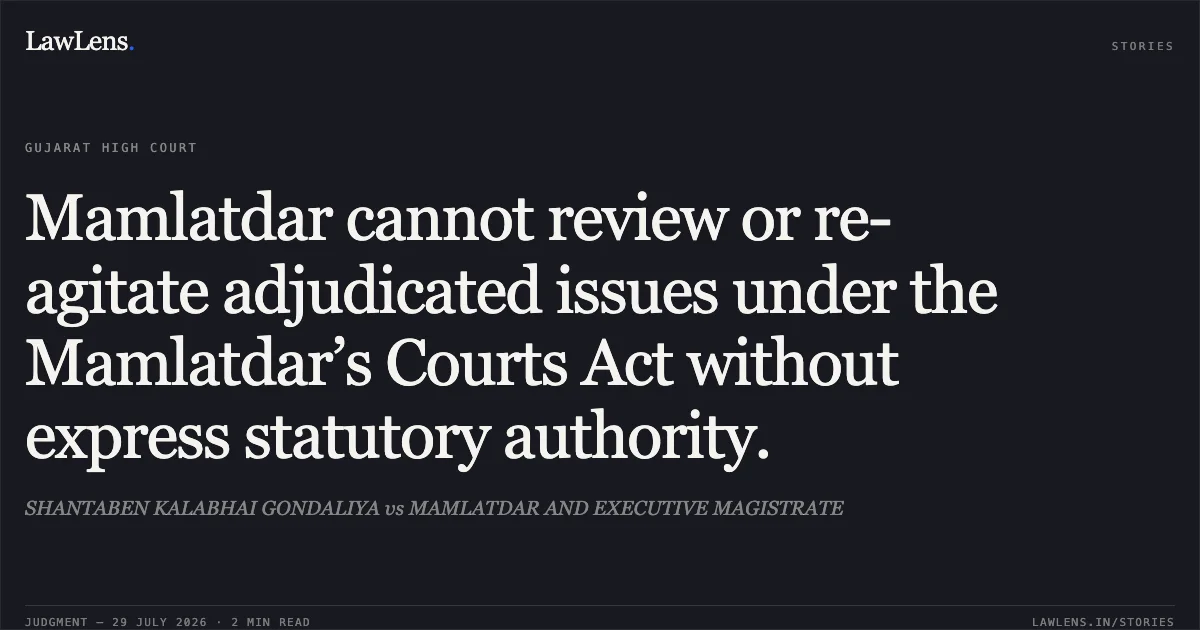
The Court answered the issues in the negative, holding that the Mamlatdar acted wholly without jurisdiction in reviewing his earlier order which had merged into the revisional order of the Deputy Collector
The Court quashed and set aside the Mamlatdar’s orders dated 08.06.2021 and 29.06.2021 and made the Rule absolute
Source reference: para 24Acts & Sections Cited
7 provisions across 1 statute referred to in this judgment. Each provision opens on LawLens.
Mamlatdar’s Courts Act, 1906.7
Original Court PDF
SHANTABEN KALABHAI GONDALIYAvsMAMLATDAR AND EXECUTIVE MAGISTRATE
Click to open original judgment
Original judgment, available to read, download and summarize on LawLens.in