Facts
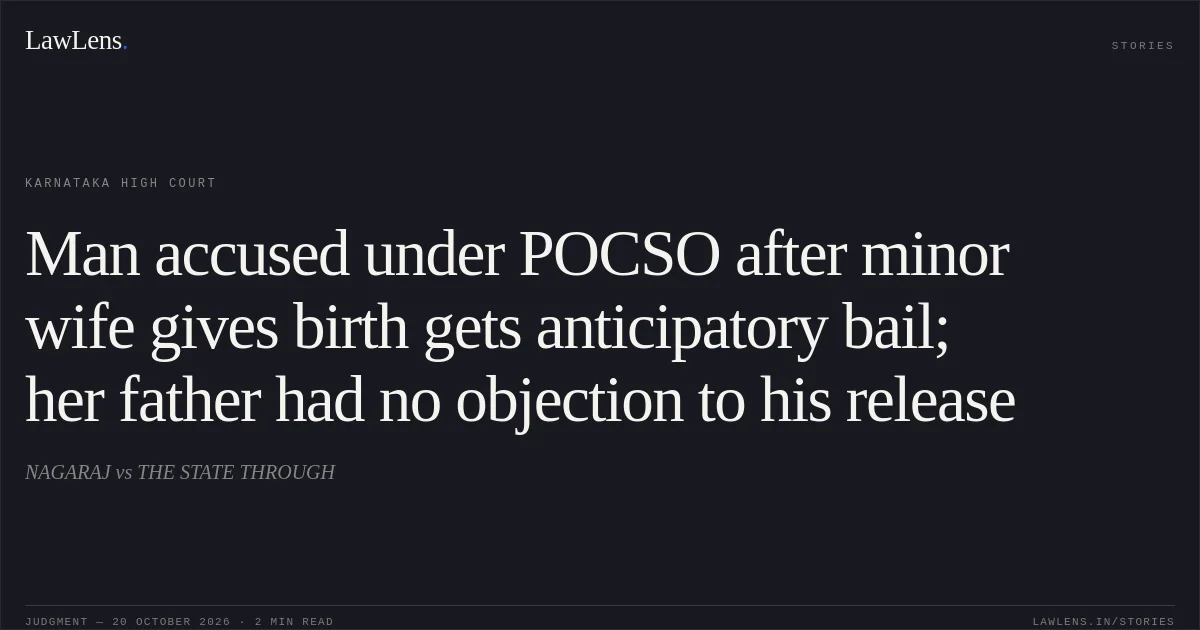
The petitioner sought anticipatory bail in Crime No. 168/2026, registered under Section 64(2)(m) of the Bharatiya Nyaya Sanhita, 2023 (BNS), and Sections 4 and 6 of the Protection of Children from Sexual Offences Act, 2012 (POCSO Act).
Source reference: p. 2–3The case arose after the victim gave birth; her Aadhaar card recorded her date of birth as 26 December 2007.
Source reference: p. 4–5The judgment states that she married the petitioner on 5 June 2025, became pregnant, and gave birth on 19 July 2022—an apparent chronological inconsistency in the judgment.
Source reference: p. 4–5The petitioner argued that the relationship followed a marriage arranged by the victim’s parents and that there had been no force.
Source reference: p. 3–5The prosecution opposed bail, citing the gravity of the alleged offences and the petitioner’s alleged abscondence; the victim’s father, the complainant, did not oppose the petition.
Source reference: p. 3–5The Court noted that the charge sheet had been filed, while further investigation remained possible.
Source reference: p. 6–7Issues
1. Whether the petitioner was entitled to anticipatory bail despite the allegations under Sections 4 and 6 of the POCSO Act and the prosecution’s assertion that he had absconded.
Source reference: p. 3, 8–92. Whether the filing of the charge sheet, the complainant’s lack of objection, and conditions requiring cooperation with further investigation justified granting anticipatory bail.
Source reference: p. 6–9Law Applied
The Court considered Section 482 of the Bharatiya Nagarik Suraksha Sanhita, 2023 (BNSS), under which the petitioner sought anticipatory bail, alongside Section 64(2)(m) of the BNS and Sections 4 and 6 of the POCSO Act, under which the offences were alleged.
Source reference: p. 2–3It assessed whether bail could be granted subject to conditions addressing the prosecution’s concerns, including appearance before the police, cooperation with any further investigation, and non-interference with witnesses.
Source reference: p. 7–10The order cites no judicial precedents.
Source reference: p. 2–10Reasoning
The Court accepted that the victim was under 18 at the relevant time and that the POCSO offences had been invoked on that basis.
Source reference: p. 4–5, 8It nevertheless considered that the victim’s parents had arranged the marriage, the complainant did not oppose bail, and the charge sheet had already been filed.
Source reference: p. 3–4, 6–9Although the petitioner had allegedly been absconding and further investigation could follow, the Court found those concerns could be addressed through conditions requiring surrender, cooperation with the police, court attendance, and non-tampering with witnesses.
Source reference: p. 3–4, 6–9It also considered the petitioner’s presence potentially relevant to the child born to the victim.
Source reference: p. 8Holding
The Court allowed the petition and directed that the petitioner be released on bail in the event of arrest, on executing a personal bond of ₹2,00,000 with two sureties for the like sum.
Conditions included surrendering to the police within 15 days, appearing and assisting with further investigation when required, attending court when directed, and not tampering with witnesses or committing further offences.
Source reference: p. 9–10The prosecution may seek cancellation of bail if any condition is breached.
Source reference: p. 9–10Acts & Sections Cited
6 provisions across 4 statutes referred to in this judgment. Each provision opens on LawLens.
Bharatiya Nagarik Suraksha Sanhita, 20232
Code of Criminal Procedure, 19731
Bharatiya Nyaya Sanhita, 20231
Original Court PDF
NAGARAJvsTHE STATE THROUGH
Click to open original judgment
Original judgment, available to read, download and summarize on LawLens.in