Facts
Respondent No. 2 lodged a complaint alleging that the petitioner, a developer and power-of-attorney holder for certain landowners, conspired with others and planning authorities to obtain layout approval that included the complainant’s property, and then sold sites incorporating that property.
Source reference: p. 2–3, 11The complaint alleged wrongful gain and offences under Sections 465, 468, 471, 420 and 120B read with Section 34 of the IPC.
Source reference: p. 2–3, 11The petitioner sought to quash the complaint and FIR, arguing that he acted only as an attorney holder, that the dispute was civil, and that prior proceedings and subsequent planning documents showed the alleged overlap had been addressed.
Source reference: p. 3–7The complainant opposed the petition, relying on the parties’ earlier joint memo, sale documents and other records, and maintained that the complainant’s property had been included and sold.
Source reference: p. 8–10Issues
1. Whether the complaint and FIR should be quashed under Section 482 CrPC when they contain specific allegations of criminal conduct connected with the approval and sale of sites.
Source reference: p. 11–132. Whether the Court could determine, at the quashing stage, whether the disputed property was included in the approved layout or sold, in light of the competing documents and prior proceedings.
Source reference: p. 12–13Law Applied
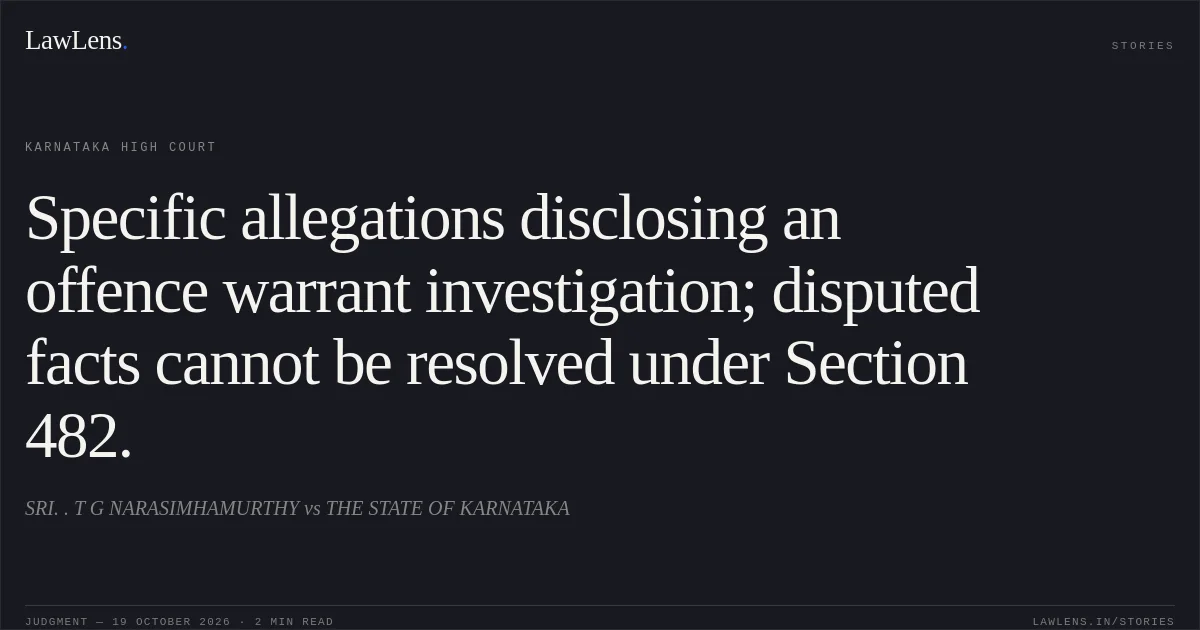
The Court considered its inherent jurisdiction under Section 482 CrPC and the principle that, when deciding whether to quash an FIR, the Court examines the complaint’s allegations; if those allegations disclose an offence, the investigation should ordinarily proceed.
Source reference: p. 11–12It relied on Dinesh Bai Chandu Bai Patel v. State of Gujarat, reported in (2018) 3 SCC 104, for the proposition that the truth of the allegations is for the investigating officer to determine.
Source reference: p. 11–12The FIR invoked Sections 465, 468, 471, 420 and 120B read with Section 34 IPC.
Source reference: p. 2–3Reasoning
The complaint specifically alleged that the petitioner participated in obtaining layout approval that included the complainant’s property and in selling sites incorporating it.
Source reference: p. 11–12Although the petitioner relied on prior civil and administrative proceedings, the joint memo and later planning documents, the complainant disputed their effect and produced sale-related material.
Source reference: p. 8–10, 12–13The Court held that deciding whether the complainant’s property was in fact included or sold would require assessment of disputed facts and documents, which it could not undertake in a quashing petition.
Source reference: p. 12–13Since the allegations warranted investigation, their truth or otherwise was left to the investigating officer.
Source reference: p. 12–13Holding
The Court declined to quash the complaint or FIR, finding no basis to interfere with the investigation at that stage.
The criminal petition was dismissed.
Source reference: p. 13Acts & Sections Cited
6 provisions across 2 statutes referred to in this judgment. Each provision opens on LawLens.
Code of Criminal Procedure, 19731
Indian Penal Code, 18605
Original Court PDF
SRI. . T G NARASIMHAMURTHYvsTHE STATE OF KARNATAKA
Click to open original judgment
Original judgment, available to read, download and summarize on LawLens.in