01Facts
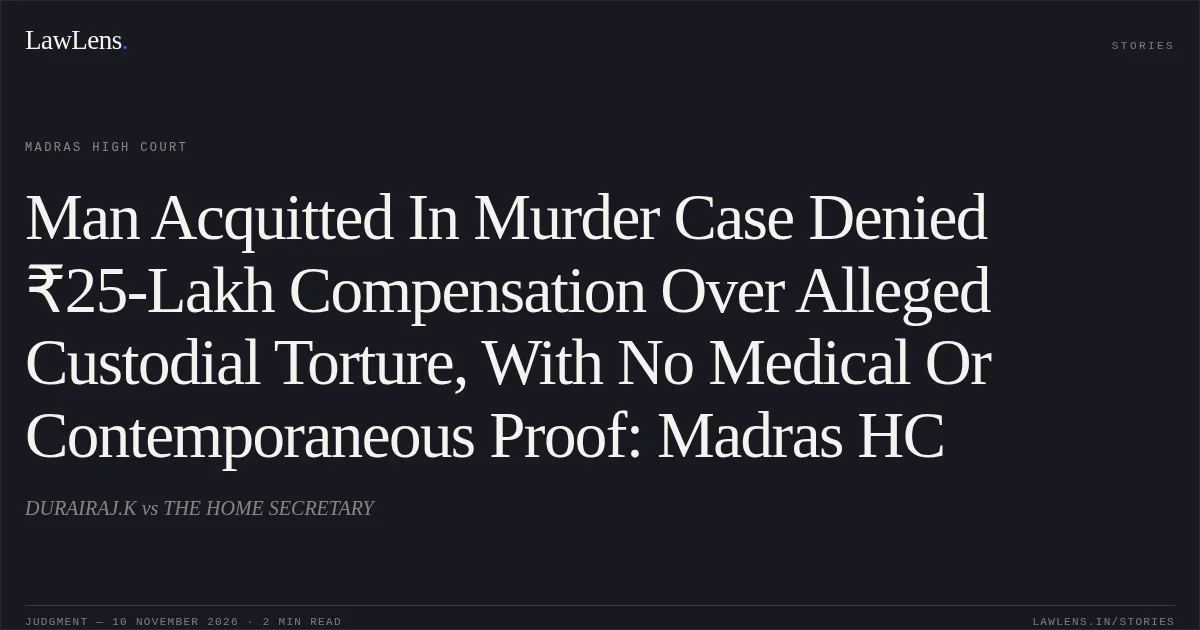
The petitioner sought ₹25 lakhs in compensation, alleging that he was illegally detained for nearly two weeks, tortured, and falsely implicated in Crime No. 10 of 2014 for murder under Section 302 IPC. He claimed the alleged assault caused partial disability and that his petty shop closed after he lost his reputation and livelihood.
¶ 1–4 · pp. 2–3The State denied the allegations, asserting that the petitioner surrendered voluntarily and that no contemporaneous complaint or medical evidence supported his claims.
¶ 5–8 · pp. 4–6After further investigation identified another person as the perpetrator, the petitioner was acquitted because the prosecution had not proved his guilt beyond reasonable doubt.
¶ 3, 8 · p. 3, 5He then sought compensation through a writ petition under Article 226.
¶ 1 · p. 202Issues
i.Whether the petitioner established a clear violation of his fundamental rights warranting compensation under Article 226 for alleged illegal detention and custodial torture.
¶ 11–14 · pp. 6–8ii.Whether the petitioner’s acquittal and alleged malicious implication, without sufficient supporting material, entitled him to compensation in writ proceedings.
¶ 8–14 · pp. 5–803Law Applied
Article 226 empowers a constitutional court to award compensation for an established violation of fundamental rights, but that power is not exercised automatically upon an accused person’s acquittal.
¶ 11 · p. 6Applying D. Arun v. P. Subramani and Others, W.A. No. 349 of 2016, the Court stated that acquittal or discharge alone does not establish malicious prosecution; the claimant must establish that the prosecution was initiated with an oblique motive to harass.
¶ 9, 13 · pp. 6–7Where the claim depends on disputed facts requiring detailed evidentiary examination, the writ court need not undertake a roving enquiry in the absence of sufficient undisputed material demonstrating a fundamental-rights violation.
¶ 13 · p. 7Provisions in the judgment · 1 · Linked ones open on LawLens
Indian Penal Code, 1860 Section 302
04Reasoning
The Court found no contemporaneous complaint to the Magistrate or police, medical record of assault, or medical material linking the alleged partial disability to police conduct. The asserted loss of livelihood and closure of the shop were likewise unsupported by independent documentary evidence.
¶ 12 · p. 7Nor had the petitioner produced sufficient material showing personal animosity or an ulterior motive on the part of the investigating officer; acquittal, particularly where the prosecution failed to prove guilt beyond reasonable doubt, did not by itself establish malicious prosecution.
¶ 8, 13 · p. 5, 7Determining the allegations would require examination of disputed records and evidence, which the Court considered inappropriate in the circumstances of this writ petition.
¶ 13 · p. 705Holding
The Court held that the petitioner had not established a clear and demonstrable violation of fundamental rights warranting the claimed compensation of ₹25 lakhs.
¶ 14 · p. 8It dismissed the writ petition, while granting liberty to the petitioner to pursue remedies before the appropriate forum in accordance with law; any connected miscellaneous petitions were closed.
¶ 15 · p. 8Original Court PDF
DURAIRAJ.KvsTHE HOME SECRETARY
Click to open original judgment
Original judgment, available to read, download and summarize on LawLens.in