Facts
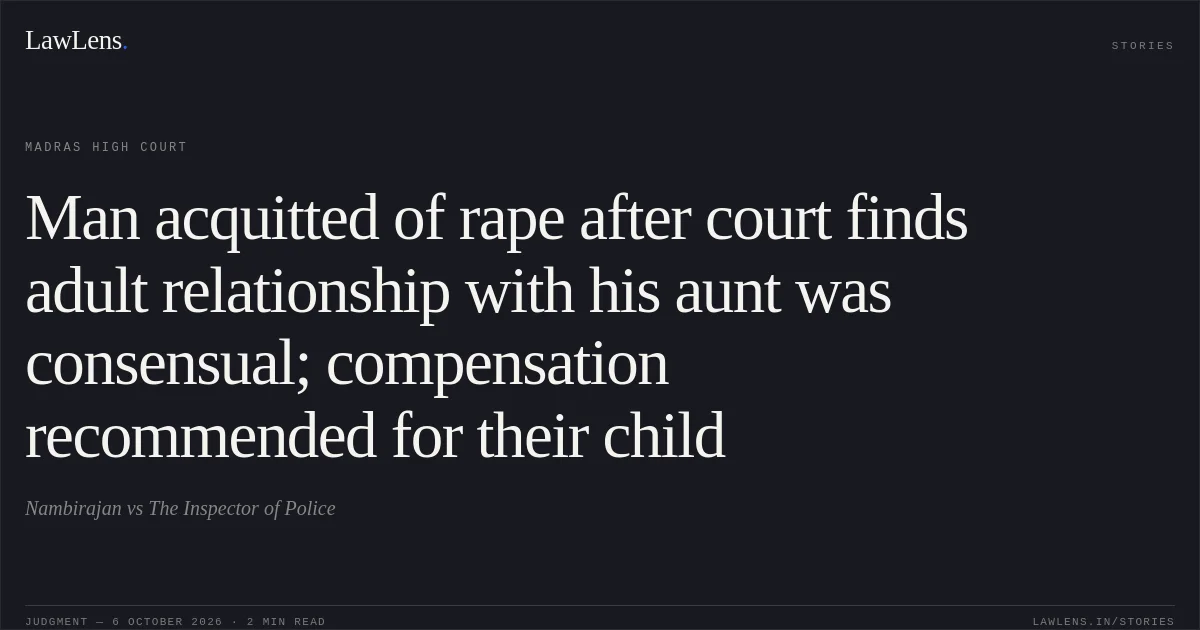
The prosecution alleged that the appellant repeatedly had sexual intercourse with PW1 after promising to marry her, and that she became pregnant and later gave birth to a child.
Source reference: para. 2, 9DNA testing identified the appellant as the child’s biological father.
Source reference: para. 2, 9The trial court convicted the appellant under Sections 417 and 376 IPC, sentencing him to one year’s and ten years’ rigorous imprisonment, respectively; it acquitted the other accused and acquitted the appellant of the remaining charges.
Source reference: para. 4–6The appellant appealed against his conviction and sentence.
Source reference: para. 1Issues
Whether the appellant’s conviction and sentence were sustainable.
Source reference: para. 8Whether the sexual relationship, on the evidence, established offences under Sections 376 and 417 IPC.
Source reference: para. 10–14Law Applied
The Court considered Sections 376 and 417 IPC in light of the distinction between rape and consensual sexual intercourse induced by a false promise of marriage.
Source reference: para. 13Relying on Mahesh Damu Khare v. State of Maharashtra, (2024) 11 SCC 398, it applied the principle that, where a woman knowingly maintains a physical relationship over a prolonged period, the prosecution must establish that the promise to marry was the direct reason for the relationship; absent that nexus, consent is not vitiated on that basis and neither offence under Sections 376 nor 417 IPC is made out.
Source reference: para. 13The Court also referred to Section 357A CrPC and the Victim Compensation Scheme in directing consideration of compensation for the victim.
Source reference: para. 15Reasoning
The Court treated PW1’s evidence and complaint as showing that she and the appellant had been in love for about a year before the alleged occurrence and continued their physical relationship until she became pregnant.
Source reference: para. 11, 13It also noted PW1’s evidence that she and the appellant were aunt and nephew within a prohibited degree of relationship, and reasoned that she knew their marriage was not possible in their community; on that basis, it considered her claim that she relied on the promise to marry not credible.
Source reference: para. 12Applying Mahesh Damu Khare, the Court concluded that the evidence did not establish that the promise to marry was the direct cause of the sexual relationship and therefore did not establish the offences under Sections 376 or 417 IPC.
Source reference: para. 13–14Holding
The appeal was allowed, and the trial court’s judgment of conviction and sentence was set aside.
The appellant’s bail bond was discharged, and any fine paid was ordered to be refunded.
Source reference: para. 14The Court recommended that the District Legal Services Authority, Tirunelveli, examine the victim’s case and award appropriate compensation under the Victim Compensation Scheme.
Source reference: para. 15Acts & Sections Cited
11 provisions across 2 statutes referred to in this judgment. Each provision opens on LawLens.
Code of Criminal Procedure, 19734
Indian Penal Code, 18607
Original Court PDF
NambirajanvsThe Inspector of Police
Click to open original judgment
Original judgment, available to read, download and summarize on LawLens.in