01Facts
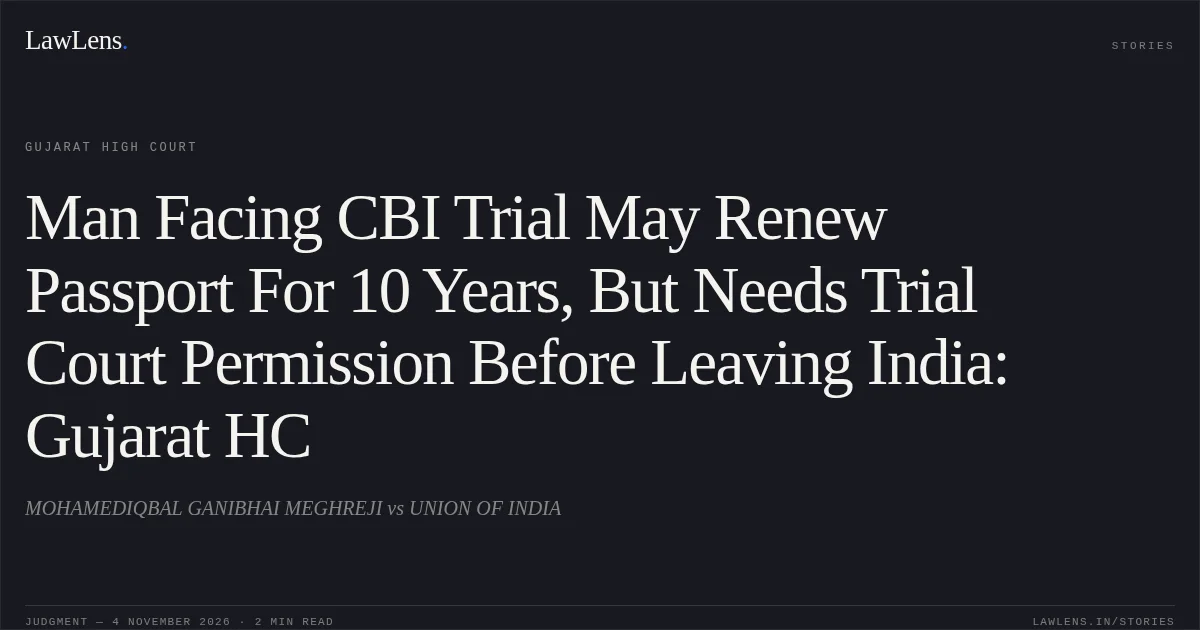
The petitioner, an accused in a pending CBI criminal case, sought permission from the trial court to renew his passport for ten years.
¶ 5, 8–10The trial court permitted renewal for only three years and directed that he not leave India without its prior permission.
¶ 5, 8–10The petitioner challenged the three-year limit, relying on his business and family travel needs, and sought a ten-year passport.
¶ 5, 8–10The Regional Passport Officer opposed the petition as premature because no renewal application had yet been filed with that office.
¶ 5, 8–10The High Court held that the petitioner could apply to the Passport Office only after obtaining the court’s permission, and therefore rejected the prematurity objection.
¶ 1002Issues
i.1. Whether the petitioner should be permitted to renew or reissue his passport for the ordinary ten-year period rather than the three-year period allowed by the trial court
¶ 9–15ii.2. Whether the petitioner should be permitted to leave India without prior permission from the trial court, or whether that condition should remain in force
¶ 2(d)–(e), 6, 12, 1503Law Applied
The Court considered Section 6(2)(f) of the Passports Act, 1967, and the Central Government’s Notification No. G.S.R. 570(E) dated 25 August 1993, which are relevant to passport issuance where criminal proceedings are pending.
¶ 11It also referred to Rule 12 of the applicable Passport Rules, under which an ordinary passport is ordinarily valid for ten years, subject to the Passport Authority’s power to issue one for a shorter period for reasons communicated in writing.
¶ 13The Court relied on Harsh Mahesh Tanna v. State of Gujarat & Anr., which treated ten years as the ordinary renewal period and distinguished passport issuance from permission to travel abroad.
¶ 11It also relied on Mahesh Kumar Agarwal v. Union of India & Anr., where the Supreme Court directed issuance of an ordinary passport for ten years while preserving the requirement of prior court permission to leave India.
¶ 12Provisions in the judgment · 6 · Linked ones open on LawLens
Bharatiya Nagarik Suraksha Sanhita, 2023 Section 528
Indian Penal Code, 1860 Section 420Section 468Section 471
04Reasoning
The Court concluded that the ordinary passport period is ten years and that the judgments cited supported granting that period notwithstanding the petitioner’s pending trial.
¶ 11–14It rejected the Passport Officer’s prematurity objection because the petitioner’s application to that office would arise only after the court granted the necessary permission.
¶ 10However, the ten-year passport did not itself confer permission to travel: given the pending criminal case, the Court retained the requirement of prior permission from the trial court and left that court free to impose appropriate conditions on any travel request.
¶ 1505Holding
The petition was allowed to the extent that the trial court’s order was modified to permit renewal or reissue of the petitioner’s passport for ten years.
¶ 15–16The petitioner was directed not to leave India without obtaining prior permission from the trial court, which may impose conditions in accordance with law.
¶ 15–16The petition was otherwise disposed of, and the Rule was made absolute accordingly.
¶ 15–16Original Court PDF
MOHAMEDIQBAL GANIBHAI MEGHREJIvsUNION OF INDIA
Click to open original judgment
Original judgment, available to read, download and summarize on LawLens.in