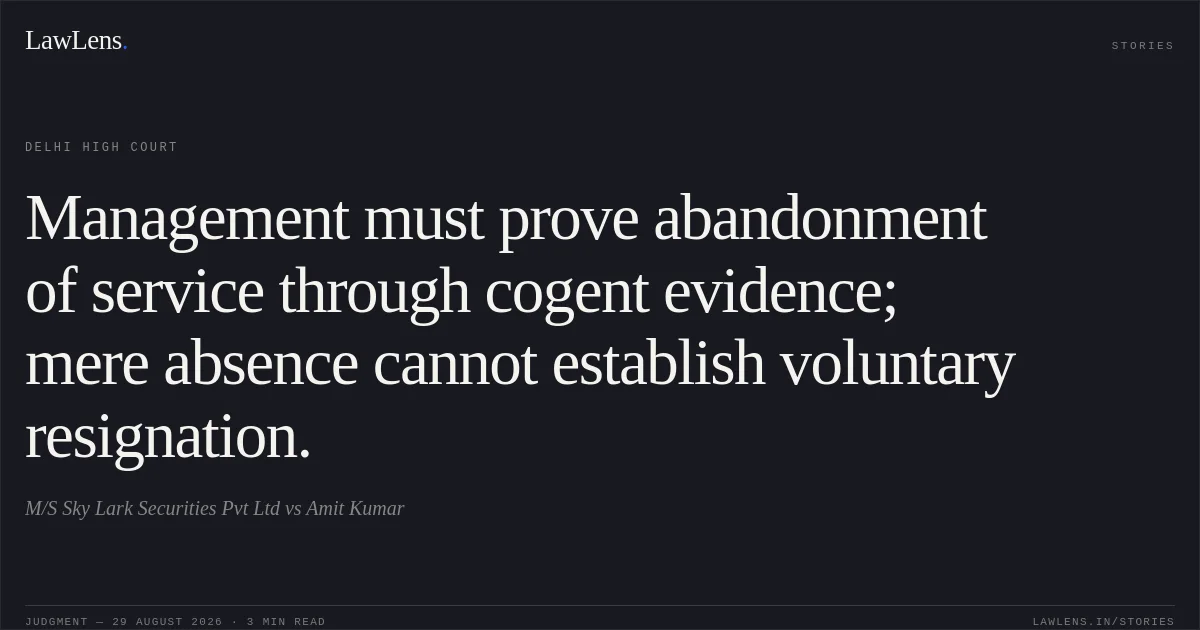
Facts
The respondent worked as a security guard with the petitioner from 1 November 2011 at monthly wages of ₹5,500. He claimed that his services were terminated on 31 May 2017 after he demanded payment of notified minimum wages.
Source reference: p.2, paras. 2–3The petitioner contended that the respondent had voluntarily abandoned employment, was engaged on a part-time contractual basis, and had declined deployment to another site.
Source reference: p.2, para. 3The Labour Court rejected this defence, finding that the petitioner neither proved the date or circumstances of abandonment nor issued any show-cause notice, absenteeism notice, or conducted an enquiry.
Source reference: pp.2–3, paras. 4–5The Labour Court held the termination illegal and, considering that the respondent had rejoined service, awarded ₹80,000 as lump-sum compensation in lieu of back wages, with 8% interest in case of delayed payment.
Source reference: pp.4–5, paras. 9–12Issues
Whether the Labour Court was justified in holding that the respondent’s services had been illegally terminated, rather than voluntarily abandoned, in the absence of credible evidence from the management.
Source reference: pp.2–4, paras. 4–9Whether the Labour Court erred in awarding ₹80,000 as lump-sum compensation in lieu of back wages despite the respondent’s subsequent rejoining and admission that he had undertaken petty work after termination.
Source reference: pp.4–5, paras. 10–12Whether the impugned Award disclosed any error warranting interference by the High Court in writ jurisdiction.
Source reference: p.5, paras. 13–15Law Applied
The Court applied the settled labour-law principle that an employer alleging abandonment must produce cogent and credible material establishing the employee’s voluntary cessation of service; mere non-reporting for duty is insufficient, particularly where the employer has not called upon the employee to resume duty, issued appropriate notices, or conducted disciplinary proceedings.
Source reference: p.3, paras. 4–5The Court further applied the principle that back wages are not automatic upon a finding of illegal termination and may be moderated after considering the employee’s subsequent employment or earnings and the overall circumstances of the case.
Source reference: pp.4–5, paras. 10–12No specific statutory provision or precedent is identified by name in the supplied judgment; the judgment refers generally to a catena of authorities on abandonment of service.
Source reference: p.3, para. 5Reasoning
The High Court found that the Labour Court had reasonably concluded that abandonment was not proved: the petitioner failed to identify the respondent’s last working day, produced no notice requiring him to report for duty, and initiated no enquiry or disciplinary action.
Source reference: pp.2–3, paras. 4–5The alleged movement order and rejoining offers were considered belated and unsupported by the petitioner’s conduct during conciliation and the proceedings before the Labour Court, making the defence an afterthought.
Source reference: pp.3–4, paras. 6–8Although the respondent was held entitled to back wages for the relevant period, the Labour Court did not grant full back wages because he had admitted doing petty work after termination and had subsequently rejoined service.
Source reference: pp.4–5, paras. 10–12The High Court held that the resulting lump-sum award was based on the evidence and sound reasoning and disclosed no ground for writ interference.
Source reference: p.5, para. 13Holding
The High Court answered the issues against the petitioner. It upheld the finding that the respondent had been illegally terminated and that the petitioner had failed to prove voluntary abandonment.
It also upheld the award of ₹80,000 as lump-sum compensation in lieu of back wages, together with 8% interest if unpaid within thirty days of publication of the Award.
Source reference: p.5, para. 12The writ petition was dismissed for lack of merit, and the pending applications were disposed of.
Source reference: p.5, paras. 14–15Original Court PDF
M/S Sky Lark Securities Pvt LtdvsAmit Kumar
Click to open original judgment
Original judgment, available to read, download and summarize on LawLens.in
![A police constable cannot be removed for unauthorized absence without a Rule 359-compliant inquiry.. Mohammad Sidiq Khan vs D/o Home Ut Of Jammu & Kashmir. CAT - ['Srinagar']. LawLens](/stories/thumbnails/a-police-constable-cannot-be-removed-for-unauthorized-absence-without-a-rule-359-compliant-7b43fc316bd94f22a62676153bbc9d54.webp)
![A Review DPC lacks authority to determine or alter inter se seniority.. SAURABH KUMAR vs REVENUE. CAT - ['Patna']. LawLens](/stories/thumbnails/a-review-dpc-lacks-authority-to-determine-or-alter-inter-se-seniority-4b21640f20af46fcabdfc8273d2ce959.webp)