Facts
The Petitioner joined the Respondent as a Secretarial Assistant on 1 July 1997 and was subsequently promoted as IT Support Analyst and IT Delivery Analyst. His role involved providing second-line desktop support, advising on IT processes, assisting employees, reviewing technical information, coaching employees, and supporting the Respondent’s IT operations.
Source reference: paras. 2, 8–9; pp. 2, 6–7After the Petitioner was denied a salary increment, he alleged that he was compelled to resign. He thereafter proceeded on medical leave. The Respondent suspended him and issued a show-cause notice alleging that he had remotely accessed the company’s IT systems and damaged critical files and servers across several locations. His services were terminated on 27 March 2012.
Source reference: para. 2; pp. 2–3The Petitioner demanded reinstatement with continuity of service and back wages. The dispute was referred to the Labour Court, Mumbai, as Reference (IDA) No. 51 of 2015. The Labour Court first considered whether the Petitioner was a “workman” under Section 2(s) of the Industrial Disputes Act, 1947, and answered the issue in the negative. It consequently did not examine the validity of the termination or the relief claimed.
Source reference: paras. 1–3; pp. 1–3The Petitioner challenged the Award before the Bombay High Court, contending that he performed technical work and had no managerial powers, including the power to appoint, dismiss, or sanction leave. The Respondent maintained that he exercised managerial and administrative authority, was the only IT Analyst serving the relevant region, had access to the company’s servers, guided employees, interacted with vendors, and made software-related decisions accepted by the management.
Source reference: paras. 4–6; pp. 4–5Issues
Whether the Petitioner was a “workman” within the meaning of Section 2(s) of the Industrial Disputes Act, 1947, having regard to the dominant nature of his duties and responsibilities.
Source reference: para. 8; p. 6Whether the Labour Court erred in holding that the Petitioner performed managerial or administrative functions rather than technical or clerical work.
Source reference: paras. 10–18; pp. 8–12Whether the absence of authority to sanction leave, appoint employees, or dismiss employees established that the Petitioner was a workman.
Source reference: paras. 14–16; pp. 10–12Law Applied
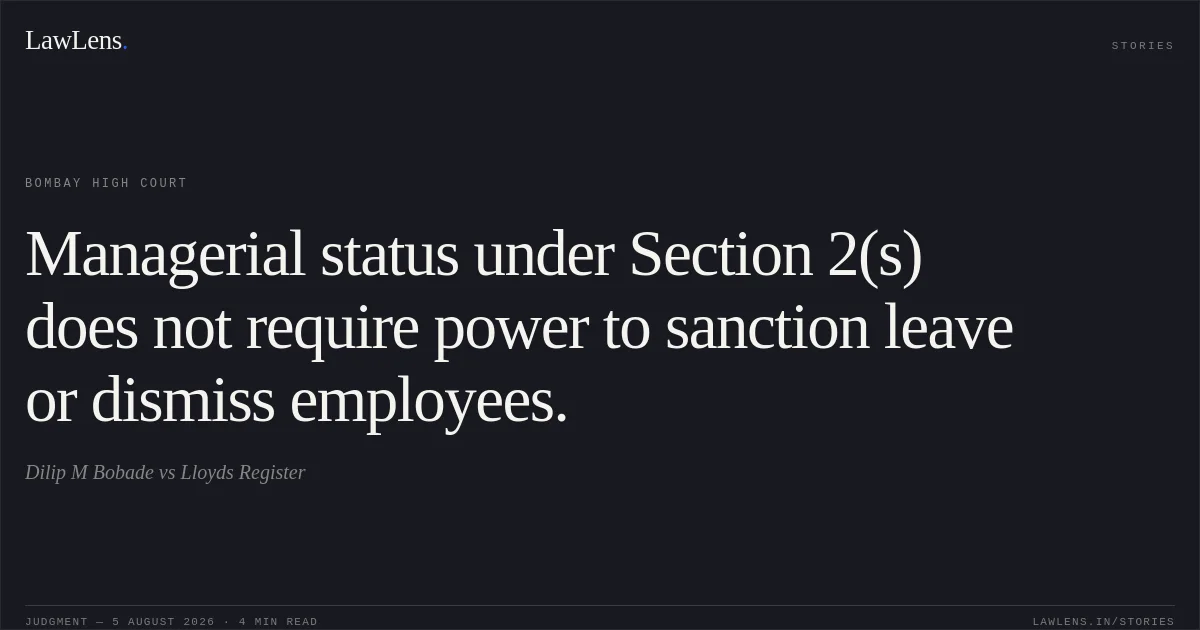
Section 2(s) of the Industrial Disputes Act, 1947 requires the Court to determine an employee’s status by examining the actual and dominant nature of the duties performed, rather than merely relying on the designation assigned by the employer.
Source reference: no citationThe Court relied on Inthru Noronha v. Colgate Palmolive (India) Ltd., 2005 SCC OnLine Bom 47, which recognised that, in modern technology-driven businesses, managerial authority need not necessarily include the power to appoint, dismiss, or sanction leave, and that the assessment must be made in the context of the business and the employee’s actual functions.
Source reference: para. 14; pp. 10–11It also relied on Standard Chartered Bank v. Vandana Joshi, (2010) 1 CLR 163, which held that managerial status is not negated merely because an employee’s decisions are subject to checks, balances, verification, or approval; the decisive consideration is the dominant nature of the duties and responsibilities.
Source reference: para. 15; p. 11The Court further reiterated that no straitjacket formula can be applied merely because an employee is designated an “IT Analyst”; the evidence regarding the actual work and authority exercised must be examined.
Source reference: para. 18; p. 12Reasoning
The Court found that the Petitioner failed to establish that he performed exclusively technical work. In cross-examination, he expressly admitted that while resolving IT queries he did not perform technical work, did not open or repair computers, referred matters to third-party vendors, and escalated unresolved issues to the China headquarters.
Source reference: paras. 10–11; pp. 8–9The evidence further showed that he trained more than 125 users, guided employees providing IT support, was the only person in India with access to the company’s servers, interacted directly with computer vendors, and made software-related decisions accepted by management.
Source reference: para. 12; p. 9His role profile also included advising managers, ensuring the effectiveness of administrative processes, providing management information, suggesting alternative technical solutions, providing specialist support, coaching employees, and ensuring compliance with internal procedures.
Source reference: para. 8; p. 6Applying Inthru Noronha and Standard Chartered Bank, the Court held that the absence of power to grant leave or dismiss employees was not determinative.
Source reference: paras. 14–16; pp. 10–12In the Respondent’s technology-based and geographically dispersed organisational structure, managerial or administrative authority could be exercised through control over systems, processes, vendors, and operational decisions rather than through traditional personnel powers.
Source reference: paras. 14–16; pp. 10–12Considering the Petitioner’s regional responsibility, decision-making authority, training and supervisory functions, and his own admission that he did not perform technical work, the Court agreed that he did not fall within Section 2(s).
Source reference: para. 17; p. 12Holding
The Bombay High Court held that the Petitioner was not a “workman” under Section 2(s) of the Industrial Disputes Act, 1947.
His actual duties and the authority exercised by him were managerial and administrative in character, and the absence of authority to sanction leave or dismiss employees did not alter that conclusion.
Source reference: paras. 16–18; pp. 11–12The Court found no perversity or other basis to interfere with the Labour Court’s Award, dismissed the Writ Petition, and made no order as to costs.
Source reference: para. 19; p. 13Original Court PDF
Dilip M BobadevsLloyds Register
Click to open original judgment
Original judgment, available to read, download and summarize on LawLens.in