Facts
The Petitioner sought a Writ of Mandamus directing the Directorate General of Civil Aviation (DGCA) to issue him a Commercial Pilot License (CPL)
Source reference: para. 1The Petitioner claimed to have completed the mandatory 200 hours of flying experience across two flight schools between 2010 and 2019 and passed the requisite DGCA examinations in 2014 and 2015
Source reference: para. 2–3He applied for the CPL on August 9, 2019
Source reference: para. 3The DGCA withheld the license due to a pending investigation regarding 70 hours and 40 minutes of flying logged at M/s Sai Flytech Aviation
Source reference: para. 3In an order dated August 23, 2023, the DGCA concluded that if the disputed hours were excluded, the Petitioner failed the 200-hour requirement
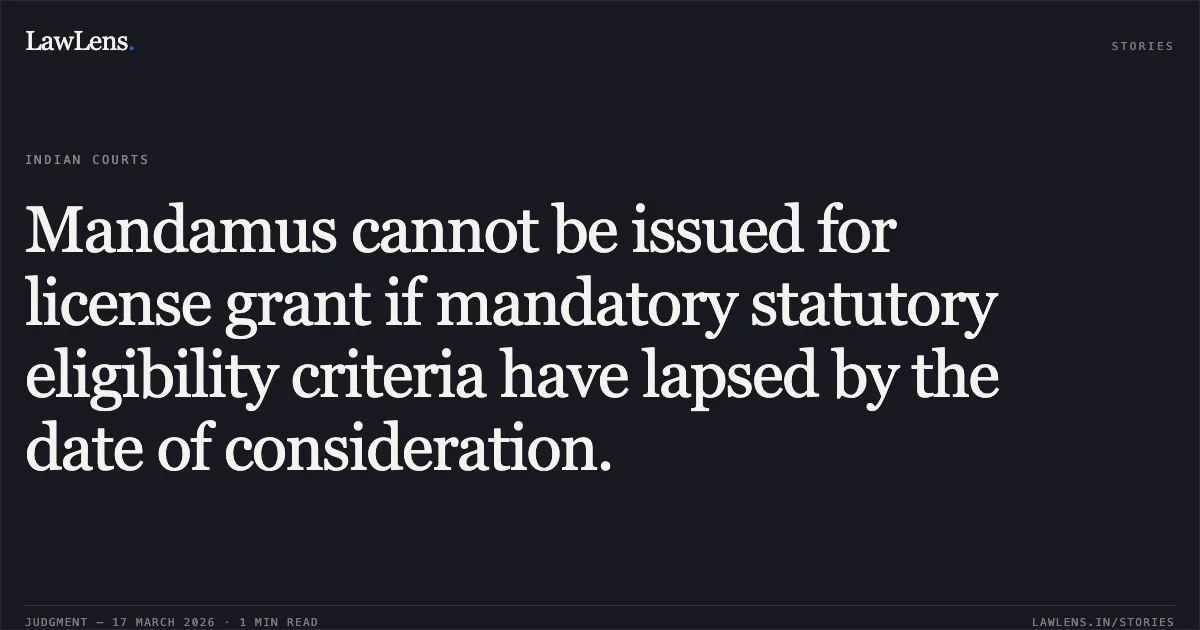
Source reference: para. 4Furthermore, the DGCA noted that by the time of consideration, several mandatory requirements—including knowledge papers, medical fitness, and English Language Proficiency—had lapsed
Source reference: para. 5Issues
1. Whether the Petitioner’s eligibility for the issuance of a CPL should be determined solely based on the criteria met at the time of the application (August 9, 2019) or at the time of the license issuance.
Source reference: para. 6, 122. Whether the Court can issue a Writ of Mandamus directing the DGCA to grant a license when the applicant does not satisfy the current statutory requirements under the Aircraft Rules, 1937.
Source reference: para. 11–12Law Applied
The court applied Schedule II, Section J, Para 1(e) of the Aircraft Rules, 1937, which mandates a minimum of 200 hours of flight time for CPL applicants
Source reference: para. 7It further relied on Section A, Para 8(e) of the same Schedule, which requires valid knowledge examinations, medical fitness, recency of flying, and English Language Proficiency (ELP) at the time of license issuance
Source reference: para. 4, 7The court followed the established legal principle that a Writ of Mandamus cannot be issued in contravention of statutory rules and that a petitioner must fulfill all eligibility criteria at the time of the license's issuance, as the mere filing of an application does not create an indefeasible right
Source reference: para. 12Reasoning
The court observed that while the Petitioner may have fulfilled the criteria on the date of his application in 2019, several mandatory permissions—including Air Regulation, Air Navigation, and Aviation Meteorology—had since expired by 2026
Source reference: para. 7–8The court emphasized that the nature of the Petitioner’s intended profession (pilot) necessitates strict adherence to safety standards and current proficiency
Source reference: para. 8It rejected the Petitioner's argument that eligibility should be frozen at the date of application, ruling that the respondent-authorities are legally empowered to verify that all permissions are valid at the time of consideration and issuance
Source reference: para. 12The court reasoned that directing the DGCA to grant a license despite expired technical and medical requirements would violate the mandate of the Aircraft Rules, 1937, and exceed the court's jurisdiction under Article 226 of the Constitution
Source reference: para. 11–12Holding
The court held that the Petitioner did not possess an indefeasible right to the CPL based on an old application when mandatory requirements had lapsed
The court declined to issue a Writ of Mandamus, stating there was no justification to direct the issuance of the CPL under the current circumstances
Source reference: para. 13The petition was disposed of, granting the Petitioner liberty to apply afresh in accordance with extant rules, which the respondents were directed to consider with due expedition
Source reference: para. 14–15Original Court PDF
Rohan DevvsUnion Of India & Anr.
Click to open original judgment
Original judgment, available to read, download and summarize on LawLens.in


