Facts
The Respondent No. 2 (Union of India) floated a tender (RFP) on 20.11.2025 for Consular-Passport-Visa-OCI Attestation Services (CPV Services) in Abu Dhabi and Dubai
Source reference: p. 2Respondent No. 3 was declared the L-1 bidder with a quote of AED 19 per application, while the Petitioner was the L-2 bidder at AED 52
Source reference: p. 4The Petitioner challenged the bid, alleging it was "predatory," "commercially unviable," and mathematically incapable of covering mandatory costs like rent and salaries
Source reference: p. 5-6The Petitioner noted that while the previous tender (later annulled) contained a "viability clause," the current RFP omitted it
Source reference: p. 8Issues
1. Whether the court can exercise judicial review to examine the financial viability and responsiveness of an L-1 bid in the absence of a specific viability clause in the RFP
Source reference: p. 5 / para. 13.12. Whether the lack of a "viability clause" in the tender document renders the selection process arbitrary or irrational
Source reference: p. 8 / para. 13.73. Whether the principles of "predatory pricing" apply to a competitive bidding process for a single contract where the bidder is a new entrant
Source reference: p. 13 / para. 15.1Law Applied
The limited scope of judicial review in administrative/tender matters as established in Tata Cellular v. Union of India, which restricts intervention to cases of mala fides, arbitrariness, or irrationality
Source reference: p. 14Jagdish Mandal v. State of Orissa, which mandates that courts prioritize public interest and refrain from interfering even if a procedural error is shown, provided the decision is not perverse
Source reference: p. 14-15The principle that the author of the tender is the best interpreter of its requirements and that courts cannot rewrite or imply new terms into commercial documents as per Agmatel India Pvt. Ltd. v. Resoursys Telecom and Uflex Ltd. v. Government of Tamil Nadu
Source reference: p. 15-16Reasoning
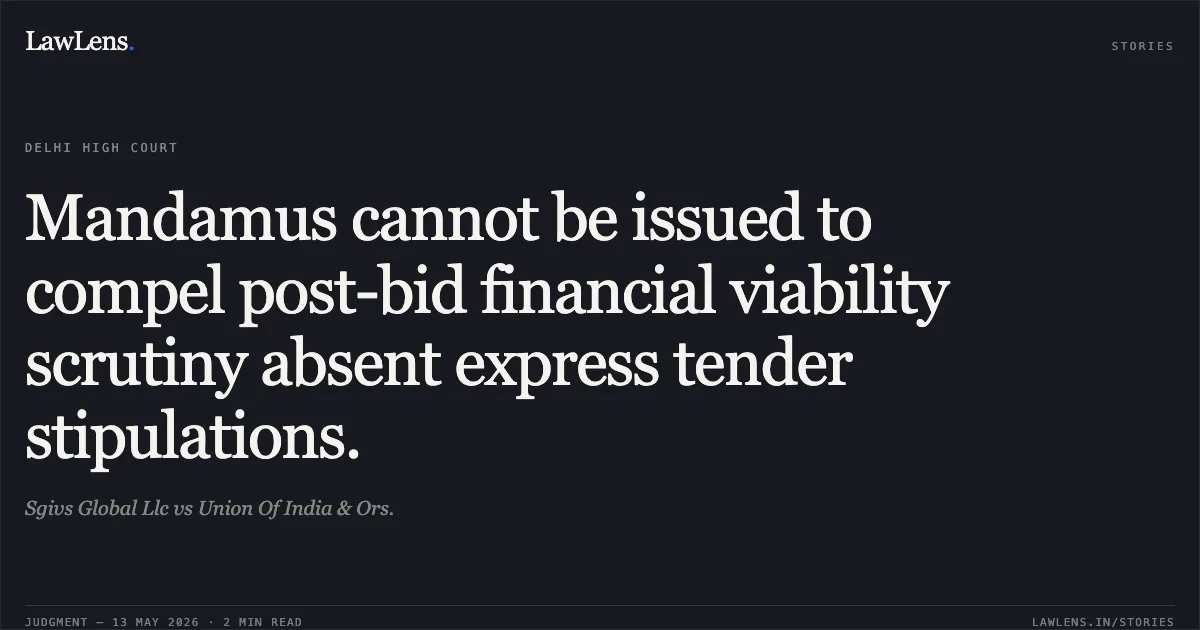
The court reasoned that since the RFP explicitly determined the winner based on the "lowest Service Fee" (L-1) without superadded viability criteria, it cannot judicially insert a "viability review" mechanism
Source reference: p. 16-17The court rejected the Petitioner's self-prepared "cost analysis," stating it cannot substitute its financial assessment for the tendering authority's expertise
Source reference: p. 17It found that the Respondent No. 2’s decision to omit a viability clause was a calibrated policy measure to prevent overcharging of the Indian diaspora
Source reference: p. 10The court noted the Petitioner's inconsistency, as it had previously operated at a much lower rate of AED 4.5
Source reference: p. 11The court held that Respondent No. 3, as a new entrant, has a legitimate interest in quoting low to establish a performance record for future technical qualifications
Source reference: p. 13-14Holding
The court held that the Petitioner failed to prove mala fides, irrationality, or prejudice to public interest
The court held that the L-1 bid of AED 19 advances public interest by reducing costs for Indian citizens in the UAE
Source reference: p. 18The court dismissed the petition, no interference was warranted under Article 226 of the Constitution, and all pending applications were closed
Source reference: p. 18Acts & Sections Cited
1 provisions across 1 statute referred to in this judgment. Each provision opens on LawLens.
Competition Act, 20021
Original Court PDF
Sgivs Global LlcvsUnion Of India & Ors.
Click to open original judgment
Original judgment, available to read, download and summarize on LawLens.in