Facts
The petitioner, a resident of Morai Gram Panchayat, alleged that the then-Sarpanch, Pratikbhai Rameshbhai Patel, and his family misused their positions to misappropriate Panchayat funds.
Source reference: p. 2The petitioner claimed that the Sarpanch demanded a bribe of ₹10,00,000 (settled at ₹7,00,000) for awarding a digging contract, leading the petitioner to file an FIR under the Prevention of Corruption Act.
Source reference: p. 2-3Following the FIR, the Sarpanch was removed from his post on 14.12.2022 by the Taluka Development Officer.
Source reference: p. 3The petitioner submitted representations dated 25.11.2025 and 02.02.2023 to the respondent authorities seeking an inquiry into the Sarpanch's disproportionate income and alleged financial irregularities.
Source reference: p. 2, 3Claiming respondent inaction, the petitioner filed this Writ Petition under Article 226 of the Constitution of India seeking a mandamus to decide said representations.
Source reference: p. 2, 4Issues
1. Whether a writ of mandamus can be issued under Article 226 of the Constitution to compel authorities to act on representations regarding alleged misappropriation and disproportionate assets when alternative administrative machinery exists.
Source reference: p. 4, para. 7Law Applied
The court applied the principles governing the discretionary jurisdiction of High Courts under Article 226 of the Constitution of India.
Source reference: p. 4, para. 7It emphasized the doctrine of alternative remedy and the existence of "separate machinery" for specific administrative or criminal grievances.
Source reference: p. 4, para. 7The court maintained that writ jurisdiction is not the appropriate avenue for reliefs that fall under the purview of specialized departments or statutory frameworks provided for by the state.
Source reference: p. 4, para. 7Reasoning
The Court observed that while the petitioner sought a mandamus to compel a decision on his representations, the issues raised were such that they required investigation by specific departments rather than judicial intervention through writ.
Source reference: p. 4, para. 7The Court highlights that the legal framework provides a specific machinery to deal with allegations of misappropriation of public money and corruption; therefore, the petitioner must exhaust those specific departmental or statutory remedies rather than invoking the High Court's extraordinary jurisdiction.
Source reference: p. 4Holding
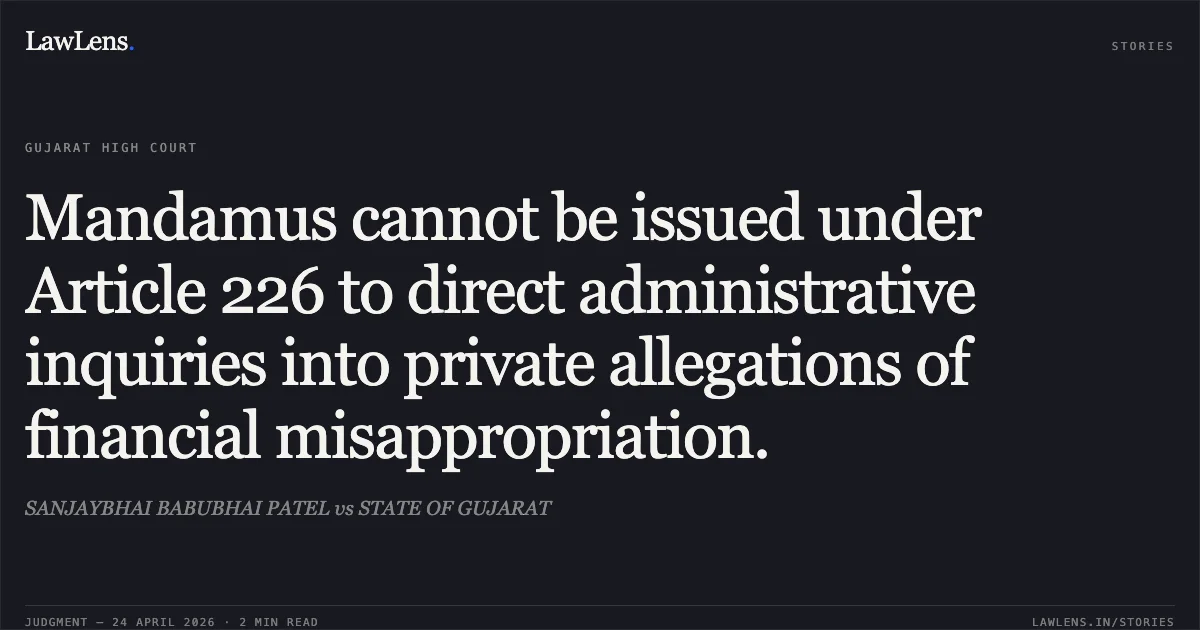
The High Court of Gujarat disposed of the petition, holding that the relief sought cannot be granted under Article 226 of the Constitution because a separate machinery is provided for such grievances.
The Court directed the petitioner to approach the appropriate department for the sought relief but clarified that it had not entered into the merits of the allegations. Notice was discharged.
Source reference: p. 4, para. 7, 8, 9Original Court PDF
SANJAYBHAI BABUBHAI PATELvsSTATE OF GUJARAT
Click to open original judgment
Original judgment, available to read, download and summarize on LawLens.in


