Facts
The petitioners claimed appointment and continued service in Shri Ganesh Sanskrit Pathshala, Peedhin Kauria, District Gonda.
Source reference: paras. 3–5, 14–16Petitioner No. 1 claimed to have been appointed as Principal and to have joined on 08.07.1992 pursuant to an appointment letter dated 30.06.1992, while petitioner Nos. 2 and 3 were appointed as Assistant Teachers.
Source reference: paras. 3–5, 14–16The petitioners alleged that their salaries were withheld and filed the writ petition seeking arrears and regular salary payments.
Source reference: paras. 5, 13, 79–82By interim order dated 08.02.2005, the Court directed payment of salary from January 2005; petitioner No. 1 thereafter received salary as Principal, while petitioner Nos. 2 and 3 received salary during their respective periods of service.
Source reference: paras. 5, 13, 79–82During the proceedings, petitioner No. 1 amended the petition to change the alleged appointment date from 08.07.1989 to 08.07.1992, describing the earlier date as a typographical error.
Source reference: paras. 7–9, 14, 19The respondents disputed the legality of the appointment, contending that the original appointment order had not been produced, the petitioner lacked the requisite qualification on the originally pleaded date, the appointment had not been approved by the University, and the University had directed a fresh selection process by order dated 05.10.1993.
Source reference: paras. 27–36Issues
Whether petitioner No. 1 established a valid and legally sustainable appointment as Principal so as to claim salary from the State exchequer?
Source reference: paras. 57–65, 84–91Whether the alleged subsequent recognition by the University and administrative authorities, prolonged service, inquiry reports, and earlier judicial orders cured or conclusively established the validity of the original appointment?
Source reference: paras. 62–78, 85–89Whether salary paid pursuant to the interim order dated 08.02.2005 created a vested or enforceable right to continued salary or arrears?
Source reference: paras. 79–82, 92–95Whether the petitioners were entitled to a writ of mandamus directing payment of arrears and regular salary from 01.01.2005?
Source reference: paras. 2, 84, 91–94Law Applied
The Court applied Article 226 of the Constitution, holding that a writ of mandamus can issue only when the petitioner establishes an existing legal right and a corresponding public duty.
Source reference: para. 84It applied the principle that payment of salary from public funds cannot be claimed merely on the basis of actual work or long continuance; the underlying appointment must have been made in accordance with the applicable statutory provisions and prescribed procedure.
Source reference: paras. 58, 61, 66–67The Court also referred to the U.P. High Schools and Intermediate Colleges (Payment of Salaries of Teachers and Other Employees) Act, 1971, under which salary in an aided institution is payable from public funds only where the appointment satisfies the governing legal requirements.
Source reference: para. 15Relying on R. Vishwanatha Pillai v. State of Kerala, the Court reiterated that an appointment founded upon fraud, deceit, or a legally void basis creates no enforceable right merely because the appointee continued in service for a long period.
Source reference: paras. 39–40, 56It further applied the rule that an interim order does not finally determine substantive rights and cannot, by itself, create a vested entitlement to salary.
Source reference: paras. 79–80, 92, 95Reasoning
The Court found that the petitioner’s foundational claim was materially uncertain because the original pleadings referred to appointment on 08.07.1989, whereas the petitioner later sought amendment to rely on 08.07.1992; the change affected his age, qualifications, and the legality of the appointment.
Source reference: paras. 59–60, 68–70, 86–87The original appointment order was not satisfactorily produced, and the respondents placed material indicating that the University had declined approval on 05.10.1993 and directed a fresh selection, with no evidence that such selection was subsequently undertaken.
Source reference: paras. 61–64The Court held that later communications recognising petitioner No. 1 for institutional or administrative purposes, the inquiry reports, and his long service could not substitute for proof of a lawful initial appointment or the required statutory approval.
Source reference: paras. 62, 65–67, 76The earlier judgments concerning petitioner No. 1’s displacement by a rival claimant were confined to that controversy and did not adjudicate every aspect of his appointment or salary entitlement.
Source reference: paras. 72–75Finally, salary paid under the interim order remained subject to the final outcome and could not establish a permanent right to payment.
Source reference: paras. 79–82Holding
The Court answered the issues against the petitioners.
It held that petitioner No. 1 failed to establish that his appointment was made through a valid selection process, that he possessed the requisite qualification, that the appointment received necessary statutory approval, or that the University’s direction for fresh selection was complied with.
Source reference: paras. 84, 91Consequently, no enforceable right to arrears or regular salary from the State exchequer was established, and the writ of mandamus was refused.
Source reference: paras. 93–94The writ petition was dismissed, the interim order dated 08.02.2005 was treated as merged in the final judgment and as creating no independent or vested right, and there was no order as to costs.
Source reference: paras. 94–96Original Court PDF
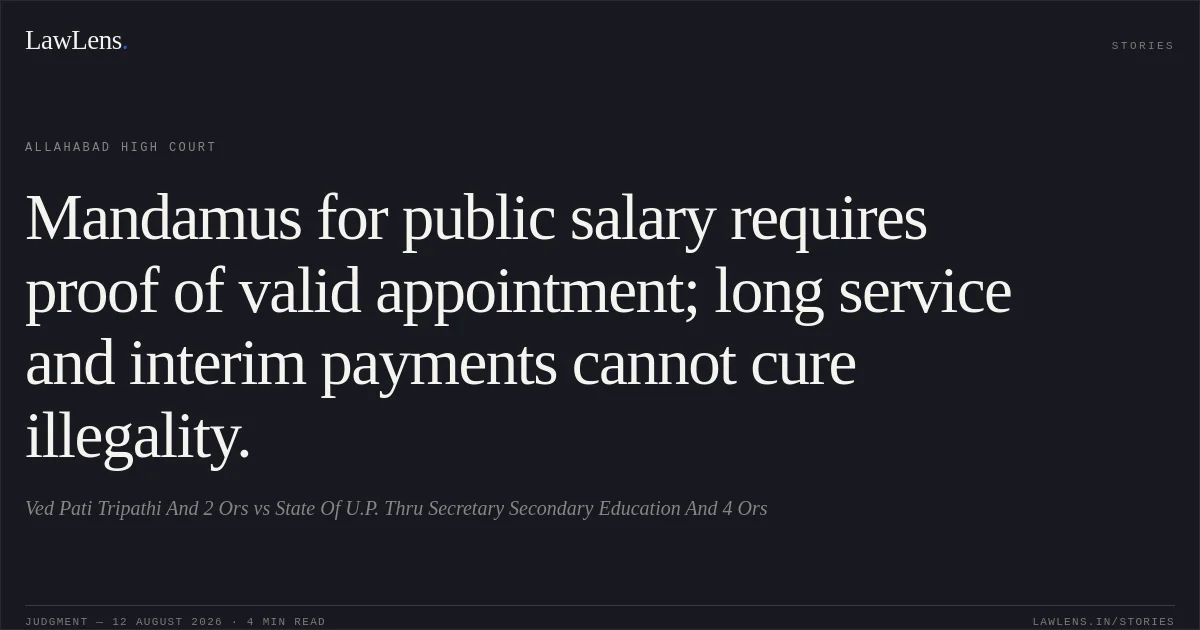
Ved Pati Tripathi And 2 OrsvsState Of U.P. Thru Secretary Secondary Education And 4 Ors
Click to open original judgment
Original judgment, available to read, download and summarize on LawLens.in