Facts
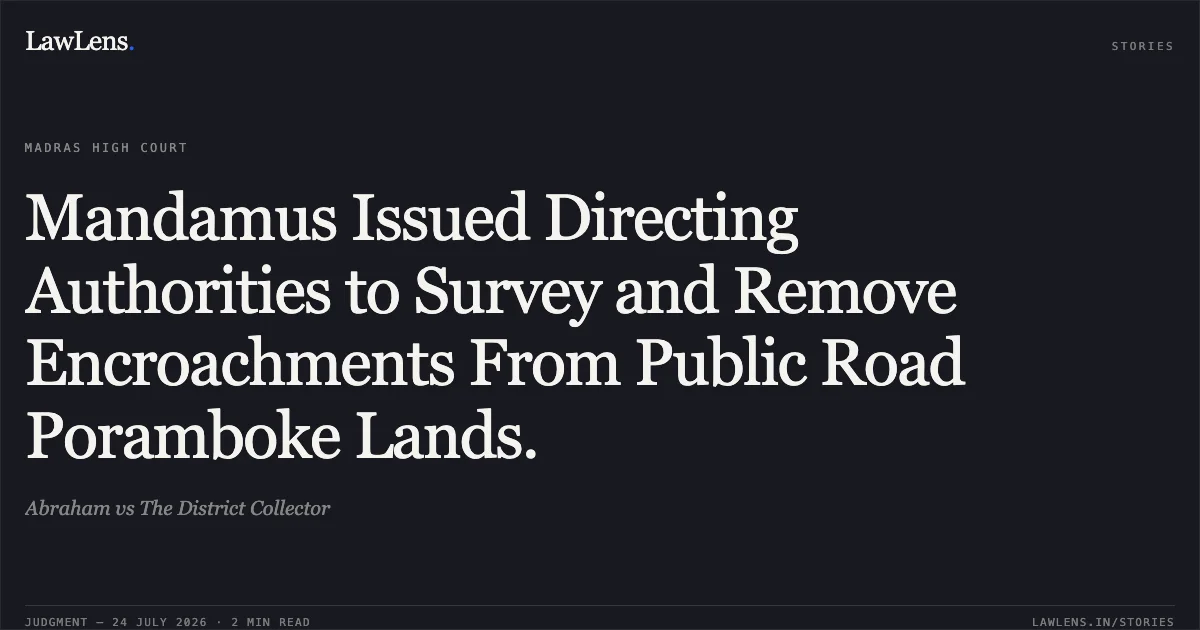
The petitioner filed a Writ of Mandamus to direct the removal of alleged illegal constructions and encroachments by a third party, T.Ratinaraj (Respondent No. 7), in Survey Nos. 159/36 and 159/26 of Nalumavadi Village, which are categorized as public pathways.
Source reference: p. 2The petitioner had submitted a representation on 20.02.2023, but no effective action was taken by the authorities.
Source reference: p. 2A report from the Tahsildar (Respondent No. 5) confirmed that S.No. 159/36 is categorized as Salai Poramboke Pathai (Road Poramboke) and that Respondent No. 7 had encroached upon approximately 11 square meters by constructing a compound wall.
Source reference: p. 3Both the petitioner and the alleged encroacher filed petitions to implead T.Ratinaraj as a respondent, which were allowed.
Source reference: p. 3, 4Issues
1. Whether the authorities are mandated to conduct a fresh survey and take action to remove encroachments on land categorized as public road/pathway (Salai Poramboke).
Source reference: p. 3-4Law Applied
The court applied the principles of administrative accountability and the duty of local authorities to protect public lands under the Tamil Nadu Panchayats Act and related revenue laws.
Source reference: p. 3-4The core principle holds that if land is categorized in revenue records as Salai Poramboke (Road Poramboke), any private construction thereon constitutes an illegal encroachment that state authorities (specifically the Tahsildar and Block Development Officer) are legally obligated to remove after due process of survey and identification.
Source reference: p. 3-4Reasoning
The Court's reasoning was based on the verification of the land's status through the Tahsildar's report, which established that S.No. 159/36 was indeed public road property and that an encroachment existed.
Source reference: p. 3Although the petitioner alleged further encroachment in S.No. 159/26, the Court determined that a comprehensive survey of both survey numbers was necessary to resolve the dispute.
Source reference: p. 3The Court linked the statutory duty of the Tahsildar (to identify boundaries) and the Block Development Officer (to execute removal of encroachments) to the petitioner's right to have public pathways maintained free of obstruction. By setting a strict timeline for survey and enforcement, the Court ensured the application of the rule of law against unauthorized occupation of government land.
Source reference: p. 4Holding
The Court allowed the impleading petitions and disposed of the Writ Petition by issuing a series of time-bound directions.
The Tahsildar (R-5) was directed to conduct a survey of S.Nos. 159/36 and 159/26 within three weeks; if encroachments are found, the Block Development Officer (R-4) is directed to initiate proceedings and remove the same within a subsequent four-week window (two weeks for issuance of proceedings and two weeks for removal). The Registry was further directed to amend the cause title to include T.Ratinaraj as the 7th respondent.
Source reference: p. 4Original Court PDF
AbrahamvsThe District Collector
Click to open original judgment
Original judgment, available to read, download and summarize on LawLens.in