Facts
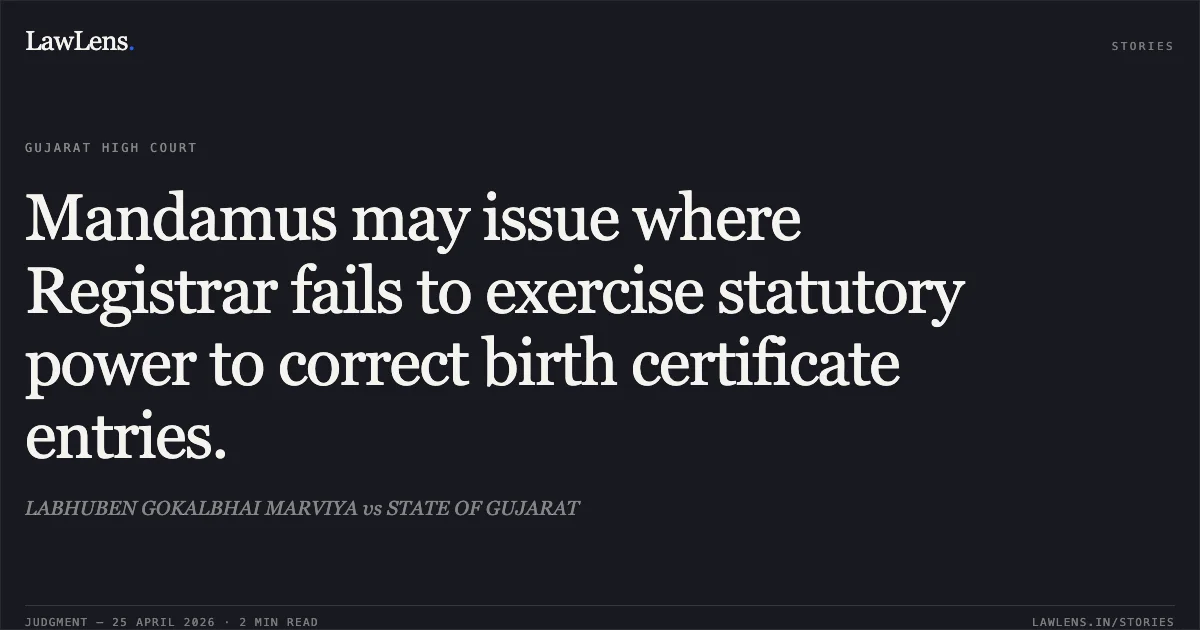
The petitioner filed a petition under Article 226 of the Constitution of India challenging an order dated 04.10.2024 passed by Respondent No. 2 (the Registrar).
Source reference: p. 1-2The Registrar had refused the petitioner's application to issue a birth certificate recording her birth date as 21.07.1951 at Village Chowki, Junagadh.
Source reference: p. 1-2Despite the petitioner providing two affidavits from elders to verify her birth details, the authority declined to exercise its jurisdiction, effectively putting the "onus on the Court" rather than performing its statutory duty.
Source reference: p. 2, 7-8Issues
1. Whether the Respondent Authority failed to exercise the statutory jurisdiction vested in it under the Births and Deaths Registrations Act, 1969 and the Gujarat Registration of Births and Deaths Rules, 2004.
Source reference: p. 22. Whether a writ of mandamus can be issued to compel the authority to correct or enter birth details when it fails to discharge its statutory duties.
Source reference: p. 2Law Applied
Section 15 of the Births and Deaths Registrations Act, 1969, which empowers the Registrar to correct or cancel entries if they are proven to be erroneous in form or substance.
Source reference: p. 3Rule 11 of the Gujarat Registration of Births and Deaths Rules, 2004, which outlines the procedural mechanism for such corrections based on declarations by credible persons.
Source reference: p. 3-4The precedent Nitaben Nareshbhai Patel v. State of Gujarat (2008), which established that the phrase "erroneous in form or substance" is of wide amplitude and that authorities cannot refuse to exercise these powers by citing administrative circulars or lack of jurisdiction.
Source reference: p. 5-7Reasoning
The court reasoned that a combined reading of Section 15 and Rule 11 leaves no doubt that the Registrar has the legal authority and the duty to correct or make entries in the Register of Births and Deaths.
Source reference: p. 5The court observed that Respondent No. 2 passed a "stereotyped order" by refusing to act on the petitioner’s evidence (affidavits), thereby failing to discharge a statutory function.
Source reference: p. 7-8Following the Nitaben Nareshbhai Patel case, the court held that when a competent authority fails to exercise its statutory power, it results in a miscarriage of justice, necessitating judicial intervention under Article 226 to direct the authority to act in accordance with the law.
Source reference: p. 2, 6Holding
The High Court quashed and set aside the impugned order dated 04.10.2024.
The court held that the Registrar must judiciously exercise the power conferred by statute rather than shifting the burden to the judiciary.
Source reference: p. 8The petitioner was directed to file a fresh application within one week, and Respondent No. 2 was ordered to decide the application on its merits in accordance with the law within four weeks.
Source reference: p. 8The State was directed to ensure that this settled legal position is communicated to all competent authorities to prevent multifarious litigation.
Source reference: p. 7Acts & Sections Cited
9 provisions across 2 statutes referred to in this judgment. Each provision opens on LawLens.
Registration of Births and Deaths Act, 19698
Births, Deaths and Marriages Registration Act, 18861
Original Court PDF
LABHUBEN GOKALBHAI MARVIYAvsSTATE OF GUJARAT
Click to open original judgment
Original judgment, available to read, download and summarize on LawLens.in