Facts
The petitioners alleged that Enormous Industries Limited, Barkha Financiers Limited, and their directors/promoters had collected money from them and other investors through redeemable preference shares and various alleged Ponzi schemes.
Source reference: p. 2–4They sought, inter alia, refund of the invested amounts with 12% interest, restraint against transfer of investors’ funds, initiation of proceedings against the companies and their directors, and attachment of their properties.
Source reference: p. 2–4The Union of India, Reserve Bank of India, Securities and Exchange Board of India (“SEBI”), the concerned companies, and their directors/promoters were impleaded as respondents.
Source reference: p. 1–2During hearing, the parties submitted that the issues were covered by the Division Bench decision in Dilip Kumar Ravidas v. State of Bihar, C.W.J.C. No. 13358 of 2019, decided on 2 December 2022.
Source reference: para. 2Issues
1. Whether the petitioners were entitled to the substantive writ directions sought for refund, investigation, restraint, and attachment in relation to the alleged collection of funds by the respondent companies and their directors/promoters?
Source reference: p. 2–4; para. 42. Whether the writ petition could be disposed of by directing the petitioners to submit a representation to the competent authority, particularly SEBI, for consideration and decision in accordance with law?
Source reference: para. 2–43. Whether the petitioners should retain liberty to pursue alternative remedies or approach the Court again if the need subsequently arose?
Source reference: p. 10–12; para. 3Law Applied
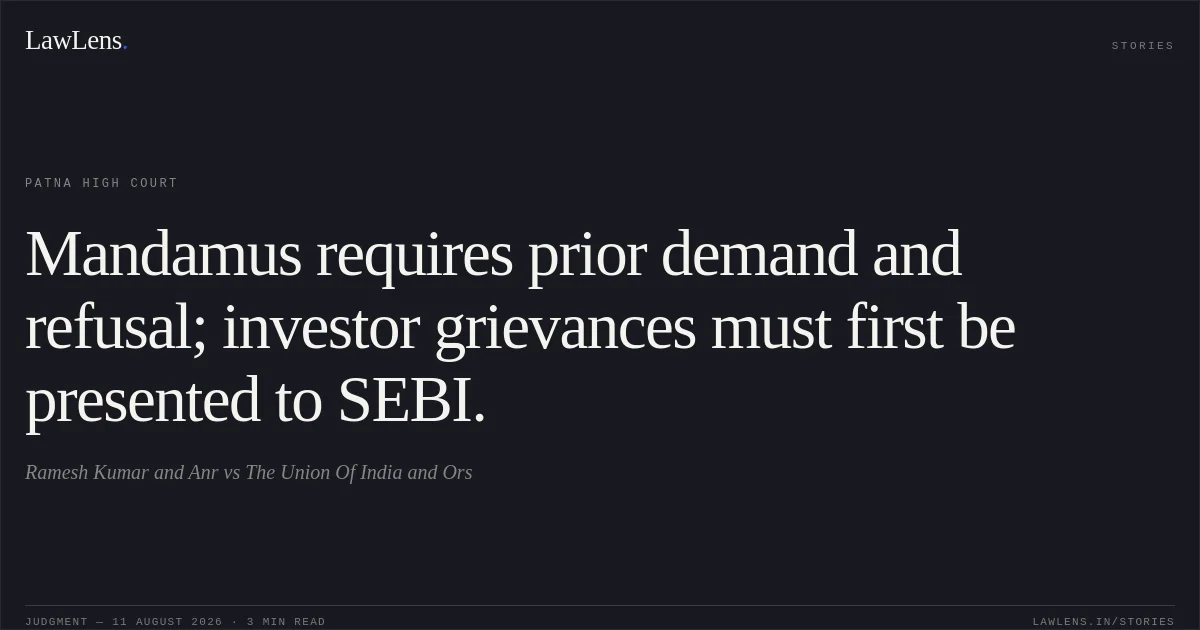
The Court applied the principles governing a writ of mandamus under Article 226 of the Constitution.
Source reference: no citationRelying on Union of India v. S.B. Vohra, (2004) 2 SCC 150, it reiterated that mandamus issues in favour of a person who establishes a legal right and against an authority having a corresponding legal duty which has been neglected or refused.
Source reference: p. 7–8Under Saraswati Industrial Syndicate Ltd. v. Union of India, (1974) 2 SCC 630, a writ of mandamus ordinarily requires a prior demand for performance of the alleged duty and a refusal or failure to comply.
Source reference: p. 8–10The Court also relied on D.N. Jeevaraj v. Chief Secretary, Government of Karnataka, (2016) 2 SCC 653, which recognises that procedural technicalities may be treated liberally in matters of public interest and good governance, while cautioning that matters essentially directed against particular individuals or organisations should ordinarily be pursued through available alternative remedies.
Source reference: p. 5–8These principles were adopted and applied through the Division Bench’s directions in Dilip Kumar Ravidas v. State of Bihar, requiring a representation to the competent authority followed by a reasoned decision after hearing the affected parties.
Source reference: p. 10–12Reasoning
The Court did not undertake an adjudication of the petitioners’ allegations or determine their entitlement to refund, interest, investigation, or attachment.
Source reference: no citationInstead, it accepted the parties’ submission that the matter was covered by the course adopted in Dilip Kumar Ravidas.
Source reference: para. 2Applying the mandamus principles, the Court treated a representation to the competent regulatory authority as the appropriate first step, particularly since the record did not establish the requisite prior demand and refusal or justify the direct grant of the substantive reliefs sought.
Source reference: p. 8–10The Court therefore followed the precedent and directed that the petitioners approach SEBI with their grievance and supporting materials, leaving all merits and alternative remedies open.
Source reference: p. 10–12; para. 4Holding
The writ petition was disposed of in terms of Dilip Kumar Ravidas, without expressing any opinion on the merits.
The petitioners were directed to file a representation before SEBI, through its Chairman/local office, within four weeks, and the authority was directed to consider and decide it expeditiously, preferably within four months of its filing, by a reasoned and speaking order.
Source reference: p. 10–11The petitioners and other concerned parties were to receive an opportunity of hearing and to place relevant documents on record.
Source reference: p. 11Liberty was reserved to pursue alternative remedies in accordance with law and to approach the Court again if necessary; all issues were left open.
Source reference: p. 11–12Any interlocutory application stood disposed of.
Source reference: para. 5Original Court PDF
Ramesh Kumar and AnrvsThe Union Of India and Ors
Click to open original judgment
Original judgment, available to read, download and summarize on LawLens.in