Facts
The Plaintiff (Respondent) filed a commercial suit for recovery of ₹12,45,778/- plus interest against the Defendant (Appellant) for goods supplied between 2019 and 2021
Source reference: p. 2Summons were served on the Defendant on 11.07.2023
Source reference: p. 2Although the Defendant appeared on 04.08.2023, no Written Statement (WS) was filed within the statutory period
Source reference: p. 3On 07.12.2023, the learned District Judge (LDG) closed the Defendant’s right to file the WS as the 120-day limit had expired
Source reference: p. 3The Defendant later filed the WS on 18.12.2023 with a condonation application citing medical grounds, which was not considered
Source reference: p. 3The LDJ eventually decreed the suit ex-parte in favor of the Plaintiff based on unchallenged evidence
Source reference: p. 3Issues
1. Whether the LDJ was justified in closing the Defendant’s right to file the Written Statement after the expiry of the mandatory 120-day statutory period
Source reference: p. 5 / para. 172. Whether the Court possesses discretionary or residuary powers to condone a delay in filing a Written Statement in a commercial suit beyond 120 days
Source reference: p. 6 / para. 193. Whether the Defendant was denied a fair opportunity to cross-examine the Plaintiff's witness
Source reference: p. 8 / para. 25Law Applied
The Court applied Section 16 of the Commercial Courts Act, 2015, which mandates the application of the amended Code of Civil Procedure (CPC) to commercial disputes
Source reference: p. 5Under the amended Order V Rule 1 and Order VIII Rules 1 and 10 of the CPC, a Written Statement must be filed within 30 days, extendable only up to a maximum of 120 days, after which the right is forfeited
Source reference: p. 6The Court relied on the Supreme Court’s ruling in SCG Contracts India Pvt. Ltd. v. K.S. Chamankar Infrastructure Pvt. Ltd., which held that this 120-day timeline is mandatory and cannot be bypassed using Section 151 of the CPC
Source reference: p. 6It distinguished Bharat Kalra v. Raj Kishan Chabra, noting it applied to non-commercial suits where the same rigors do not apply
Source reference: p. 7Reasoning
The Court found that since summons were served on 11.07.2023, the 120-day "hard-stop" period expired on 09.11.2023
Source reference: p. 6The Court observed that the Defendant remained indolent despite multiple appearances in August and October 2023
Source reference: p. 7The medical grounds cited (October to November 2023) were deemed insufficient because they did not explain the lack of diligence in the months prior to the illness, and the Special Power of Attorney was only executed on 16.12.2023, well after the deadline
Source reference: p. 7-8Regarding the denial of cross-examination, the Court noted from the record (Order dated 18.12.2023) that the Defendant was granted the opportunity but failed to avail it
Source reference: p. 8Finally, since the Plaintiff’s ledger and invoices remained unchallenged due to the lack of a WS, the facts were deemed proved
Source reference: p. 9Holding
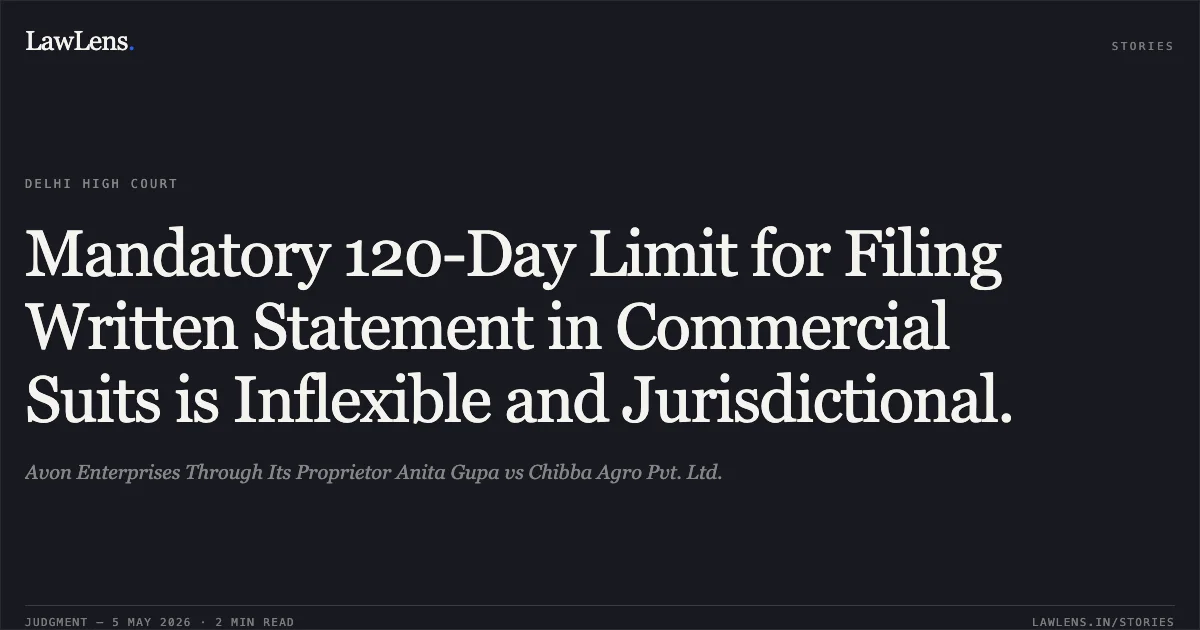
It held that in commercial suits, the 120-day limit for filing a Written Statement is mandatory and the Court loses all discretionary power to condone delay thereafter
The High Court dismissed the appeal and upheld the LDJ's judgment and decree
Source reference: p. 10The Court concluded that the Defendant’s inaction and lack of due diligence justified the forfeiture of the right to file the WS and the subsequent ex-parte decree. All pending applications were closed
Source reference: p. 9-10Acts & Sections Cited
4 provisions across 2 statutes referred to in this judgment. Each provision opens on LawLens.
Commercial Courts Act, 20151
Code of Civil Procedure, 19083
Original Court PDF
Avon Enterprises Through Its Proprietor Anita GupavsChibba Agro Pvt. Ltd.
Click to open original judgment
Original judgment, available to read, download and summarize on LawLens.in


