Facts
The respondent filed a complaint under Section 138 of the Negotiable Instruments (N.I.) Act alleging that a cheque for Rs. 10 lakhs issued by the petitioner was dishonoured due to a signature mismatch
Source reference: p. 2-3The Trial Court (Additional C.J.M. Barpeta) convicted the petitioner on 22.04.2025, sentencing her to six months imprisonment and ordering compensation of Rs. 15 lakhs
Source reference: p. 3The petitioner appealed to the Sessions Court. On 20.05.2025, the Appellate Court admitted the appeal and stayed the sentence subject to the petitioner depositing 20% of the compensation amount within 60 days, as per Section 148 of the N.I. Act
Source reference: p. 3-4The petitioner challenged this conditional stay before the High Court, contending that the demand notice was sent to the wrong address and that the cheques were stolen
Source reference: p. 4Issues
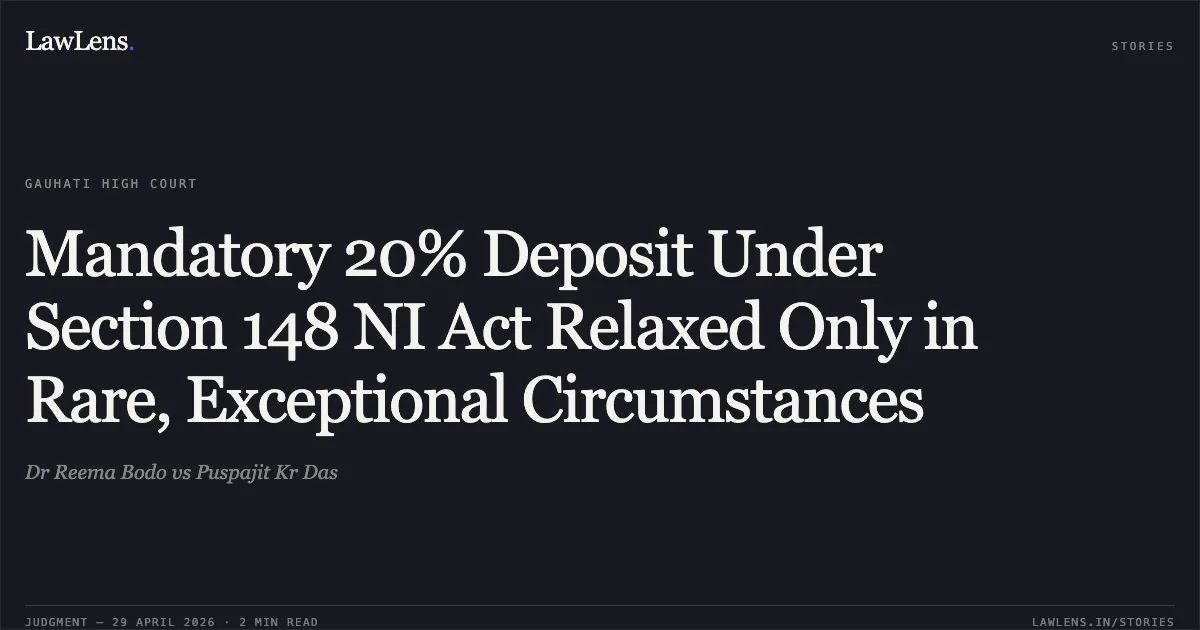
1. Whether the Appellate Court is mandatorily required to order a minimum deposit of 20% of the fine/compensation under Section 148 of the N.I. Act, or if it can waive such a condition in exceptional circumstances
Source reference: p. 6-92. Whether the petitioner’s case presents "exceptional circumstances" justifying a waiver of the 20% deposit requirement
Source reference: p. 12-14Law Applied
The court applied Section 148 of the N.I. Act (as amended in 2018), which empowers Appellate Courts to order a minimum deposit of 20% of the fine or compensation
Source reference: p. 5Following S.S. Deshwal v. Virender Gandhi, the court noted that "may" in Section 148 is generally construed as a "rule" or "shall," making the deposit a mandatory requirement unless special reasons are assigned
Source reference: p. 6-7The court further integrated the "exceptional circumstances" window established in Jamboo Bhandari v. M.P. State Industrial Development Corp. Ltd.
Source reference: p. 8The court specifically relied on the illustrative criteria from Muskan Enterprises v. State of Punjab, which identifies perversity, failure to follow mandatory procedures, or outrageous compensation as grounds for waiver
Source reference: p. 9-11Reasoning
The High Court examined the Trial Court’s findings to determine if the petitioner met the "exceptional circumstances" threshold. Regarding the demand notice, the court observed that the Trial Court had correctly evaluated evidence showing the petitioner's official and residential addresses were identical and that the notice was sent via registered post to that correct address
Source reference: p. 12-13The court noted the petitioner failed to initiate any legal proceedings regarding the allegedly "stolen" cheques, which weakened the claim of perversity in the conviction
Source reference: p. 13Applying the Muskan Enterprises test, the court found no evidence that the Trial Court's judgment was an ipse dixit (unsupported assertion) or that it suffered from a failure to appreciate evidence. Since the signature was admitted, the statutory presumption was properly invoked
Source reference: p. 13-14Consequently, the petitioner failed to demonstrate any rare or fit circumstance to bypass the 20% deposit rule
Source reference: p. 14Holding
The High Court dismissed the petition, holding that there were no exceptional circumstances to interfere with the Appellate Court's order
The court answered that while Section 148 allows for discretion, the 20% deposit remains the norm. The petitioner was directed to pay the 20% amount immediately, as the statutory 90-day period (60 days + 30-day extension) had already elapsed, failing which the Appellate Court is at liberty to take coercive measures
Source reference: p. 14-15Acts & Sections Cited
5 provisions across 3 statutes referred to in this judgment. Each provision opens on LawLens.
Bharatiya Nagarik Suraksha Sanhita, 20231
Negotiable Instruments Act, 18813
Code of Criminal Procedure, 19731
Original Court PDF
Dr Reema BodovsPuspajit Kr Das
Click to open original judgment
Original judgment, available to read, download and summarize on LawLens.in