Facts
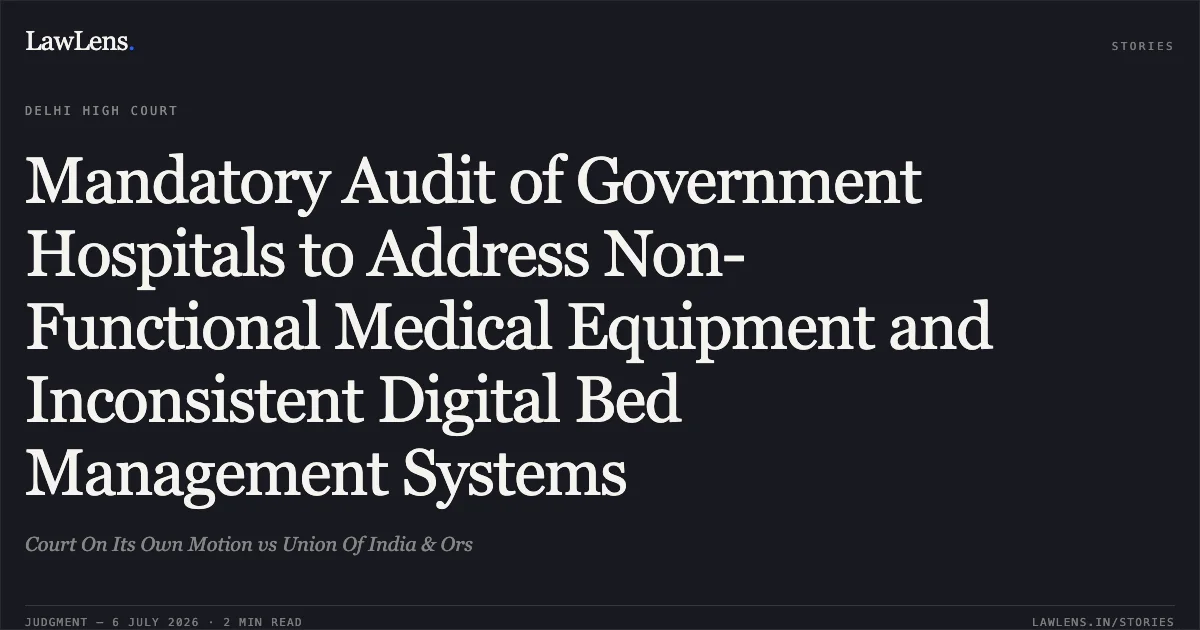
The Delhi High Court addressed ongoing public interest litigations regarding the adequacy of medical infrastructure in Delhi government hospitals.
Source reference: p. 3-4During a hearing intended for a demonstration of digital health systems, the Amicus Curiae highlighted a specific incident where a 70-year-old patient with respiratory distress was denied an ICU bed at LNJP Hospital, despite online records showing availability.
Source reference: p. 3-4Additionally, the court examined reports of high-cost medical equipment, specifically a PET Cyclotron purchased in 2017 for ₹15.42 crore, remaining non-functional due to lack of manpower and expired licenses.
Source reference: p. 7-8Issues
1. Whether there is a lack of uniformity and efficiency in the implementation of the NextGen e-Hospital Management Information System (HMIS) and ICU bed tracking across Delhi hospitals.
Source reference: p. 5 / para. 10-112. Whether the non-utilization of expensive medical machinery constitutes a gross waste of public resources requiring a comprehensive audit.
Source reference: p. 8 / para. 27-28Law Applied
The Court acted under its writ jurisdiction to enforce the right to health and efficient public administration.
Source reference: p. 5-8It applied principles of transparency and accountability in public healthcare delivery, focusing on the duty of the State to ensure that infrastructure (digital and physical) funded by public exchequer is operational and accessible to citizens.
Source reference: p. 5-8The court emphasized the necessity of a centralized, uniform health management system and the obligation of hospital administration to prevent the turning away of emergency patients.
Source reference: para. 13-14Reasoning
The Court observed a critical disconnect between digital data and ground reality; while the 'ICU Beds Saarthi' application showed availability, hospitals were unresponsive to calls or denied admission.
Source reference: p. 4The Court found that the HMIS was being implemented inconsistently, as evidenced by the lack of Unique Health Identifications (UHID) in some hospitals, which prevents seamless patient transfers.
Source reference: p. 4-5Regarding infrastructure, the Court characterized the five-year dormancy of the PET Cyclotron as a "gross waste of public resources," reasoning that procurement without corresponding manpower planning defeats the purpose of public health spending.
Source reference: p. 8Consequently, the Court determined that judicial intervention via surprise audits and mandatory reporting was necessary to bridge these systemic gaps.
Source reference: p. 5-7Holding
The National Informatics Centre (NIC) must conduct surprise inspections and audits of 38 hospitals by July 31, 2026, to verify ICU bed data and HMIS implementation.
GNCTD is to propose a 24/7 toll-free emergency helpline for bed availability.
Source reference: p. 6LNJP Hospital was ordered to immediately provide an ICU bed and treatment to the aggrieved patient.
Source reference: p. 6The Medical Superintendents of all GNCTD hospitals must file a tabular audit report of all unused equipment, including costs and reasons for non-use, prior to the next hearing.
Source reference: p. 8-9Original Court PDF
Court On Its Own MotionvsUnion Of India & Ors
Click to open original judgment
Original judgment, available to read, download and summarize on LawLens.in