Facts
The petitioner, a Nigerian national residing in Bengaluru on an expired business visa
Source reference: para. 29was apprehended by the Anti-Narcotic Wing on April 5, 2025, following credible information regarding the sale of MDMA
Source reference: para. 2.1A search of his two-wheeler led to the seizure of 1 kg of MDMA crystals, a weighing machine, and zip-lock covers
Source reference: para. 4The petitioner was arrested on April 6, 2025, and provided with a written "Ground of Arrest" in English
Source reference: para. 6, 45After the Trial Court rejected his bail application (C.Misc.No. 9369/2025), the petitioner moved the High Court, primarily contending that the arrest was illegal due to improper communication of the grounds of arrest in violation of constitutional mandates
Source reference: para. 11, 12-13Issues
1. Whether the failure to strictly comply with the mandated procedure for furnishing "grounds of arrest" as per recent Supreme Court precedents vitiates the arrest and entitles the petitioner to bail
Source reference: para. 12, 142. Whether the statutory restrictions under Section 37 of the NDPS Act can be overlooked due to alleged procedural irregularities in the arrest process
Source reference: para. 13, 59Law Applied
Article 22(1) of the Constitution of India, which mandates that an arrestee be informed of the grounds of arrest
Source reference: para. 11, 15Section 37 of the NDPS Act, 1985, which imposes a "twin condition" for bail in cases involving commercial quantities: that the court must be satisfied the accused is not guilty and is unlikely to commit further offences while on bail
Source reference: para. 32-34Vihan Kumar v. State of Haryana and Mihir Rajesh Shah v. State of Maharashtra regarding the mandatory written communication of grounds of arrest
Source reference: para. 14-15NCB v. Kashif and State of Punjab v. Sukhwinder Singh, which establish that for commercial quantities of contraband, "negation of bail is the rule and its grant is an exception"
Source reference: para. 55, 56, 57Reasoning
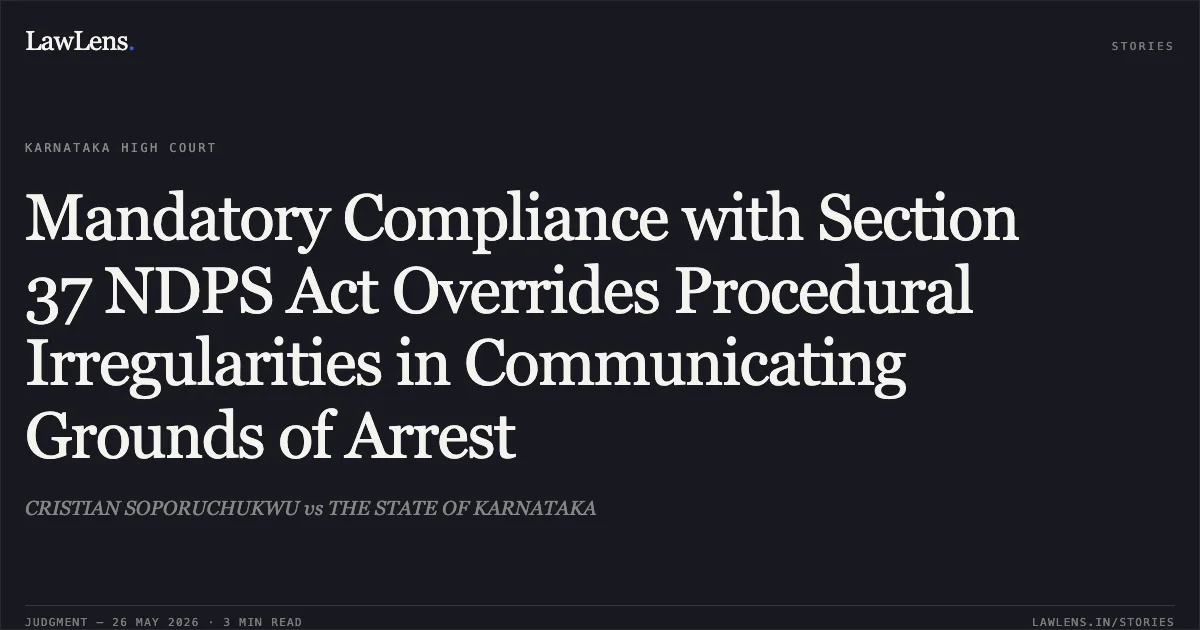
The Court reasoned that unlike general penal offences where innocence is presumed, Section 37 of the NDPS Act reverses this burden when commercial quantities are involved
Source reference: para. 35The Court found that 1 kg of MDMA constitutes a commercial quantity, triggering the stringent "twin conditions" which the petitioner failed to satisfy, as there were no reasonable grounds to believe he was not guilty
Source reference: para. 30, 43Regarding the procedural challenge, the Court distinguished the "reasons for arrest" from "grounds of arrest," noting that the police had indeed furnished the specific role and offences to the petitioner in English, a language he understood
Source reference: para. 45-46The Court observed that the petitioner admitted to the Magistrate that he was informed of the arrest and had no complaints of ill-treatment
Source reference: para. 51-52The Court concluded that procedural technicalities regarding the format of arrest grounds cannot serve as a "back door entry" for bail in serious NDPS cases involving commercial quantities, especially when the petitioner is an illegal immigrant who overstayed his visa
Source reference: para. 59-60Holding
The Court answered the issues in the negative, holding that there was sufficient compliance with the mandatory requirement of furnishing grounds of arrest
The Court dismissed the criminal petition, denying bail due to the severity of the offence, the quantity of contraband seized, and the petitioner's status as an illegal immigrant, holding that the rigors of Section 37 of the NDPS Act were not overcome by the petitioner
Source reference: para. 60-61Acts & Sections Cited
9 provisions across 3 statutes referred to in this judgment. Each provision opens on LawLens.
Narcotic Drugs and Psychotropic Substances Act, 19856
Bharatiya Nagarik Suraksha Sanhita, 20232
Code of Criminal Procedure, 19731
Original Court PDF
CRISTIAN SOPORUCHUKWUvsTHE STATE OF KARNATAKA
Click to open original judgment
Original judgment, available to read, download and summarize on LawLens.in