Facts
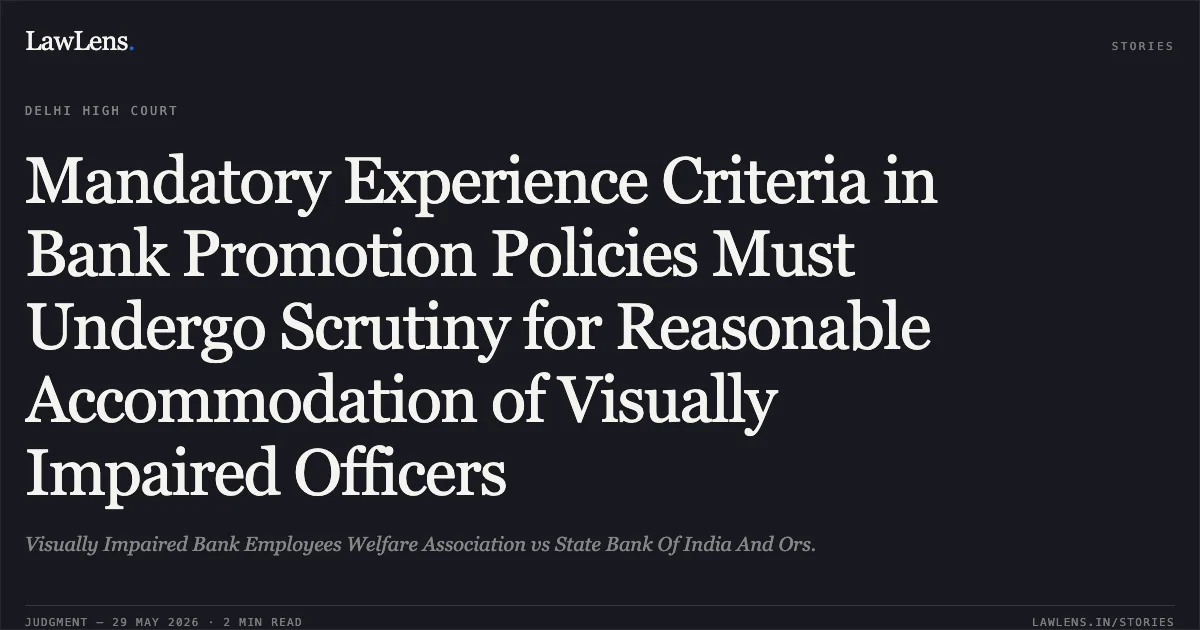
The Petitioner, representing over 600 visually impaired bank employees, challenged Clause D of the State Bank of India’s (SBI) promotion policy.
Source reference: para 1, 5The policy mandates prior experience as a Branch Manager or in Credit/Trade Finance/Forex roles as a prerequisite for promotion from Scale III to IV and Scale IV to V.
Source reference: para 6.3The Petitioner contends these roles are inherently inaccessible due to visual tasks like verifying signatures, physical inspections, and monitoring CCTV, for which no assistive technology is provided.
Source reference: para 6.7, 6.8Despite a 2022 recommendation from the Chief Commissioner for Persons with Disabilities (CCPD) to modify the policy and provide reasonable accommodation, SBI refused to comply, asserting that many visually impaired officers were already successfully discharging these duties.
Source reference: para 2, 6.13, 7.10Issues
1. Whether the mandatory requirement of branch manager or credit-related assignments for promotion constitutes direct or indirect discrimination against visually impaired employees under the RPwD Act and the Constitution.
Source reference: para 5, 212. Whether the Respondent Bank is obligated to implement the recommendations of the CCPD to provide reasonable accommodations in its promotional framework.
Source reference: para 11, 29Law Applied
The court applied Section 20(3) of the Rights of Persons with Disabilities (RPwD) Act, 2016, which prohibits the denial of promotion merely on the ground of disability.
Source reference: para 18The court relied on the Supreme Court’s ruling in State of Kerala v. Leesamma Joseph, which held that functional requirements must not become a ruse to deny promotion or cause stagnation for PwDs.
Source reference: para 6.19, 19It invoked the principle from Re: Recruitment of Visually Impaired in Judicial Services [2025 INSC 300], emphasizing that facially neutral criteria may result in "indirect discrimination" if they disproportionately disadvantage disabled persons.
Source reference: para 20The Court also noted the administrative autonomy of SBI under Section 43(1) of the State Bank of India Act, 1955.
Source reference: para 8.4Reasoning
The Court observed that while the promotion policy appears neutral, it may create systemic barriers (indirect discrimination) if the mandatory roles involve tasks that cannot be performed without assistive technology or reasonable accommodation.
Source reference: para 21, 25The Petitioner highlighted specific visual tasks (e.g., tallying gold loan bags, perusing manuscripts) that lack assistive solutions.
Source reference: para 6.7Conversely, SBI argued that several visually impaired officers had already qualified for promotion under these criteria.
Source reference: para 7.10The Court found that while SBI has the autonomy to set standards, it must ensure a "level playing field".
Source reference: para 28Because the Petitioner failed to identify specific affected individuals or provide concrete technical solutions, the Court determined that a structured dialogue between the Association and the Bank was necessary to reconcile operational requirements with the mandate of the RPwD Act.
Source reference: para 23, 28Holding
The Court did not strike down the policy but directed the Petitioner to submit a detailed representation to SBI within four weeks, identifying specifically affected officers and suggesting concrete alternative mechanisms or assistive technologies.
SBI’s Board of Directors is directed to afford the Petitioner a hearing and consider modifying the policy to provide "reasonable accommodation," such as according equivalent weightage to alternative roles suited for the visually impaired, within twelve weeks thereafter.
Source reference: para 29The petition was disposed of with these directions to ensure compliance with the spirit of the RPwD Act.
Source reference: para 30Acts & Sections Cited
4 provisions across 2 statutes referred to in this judgment. Each provision opens on LawLens.
Rights of Persons with Disabilities Act, 2016.2
State Bank of India Act, 19552
Original Court PDF
Visually Impaired Bank Employees Welfare AssociationvsState Bank Of India And Ors.
Click to open original judgment
Original judgment, available to read, download and summarize on LawLens.in