Facts
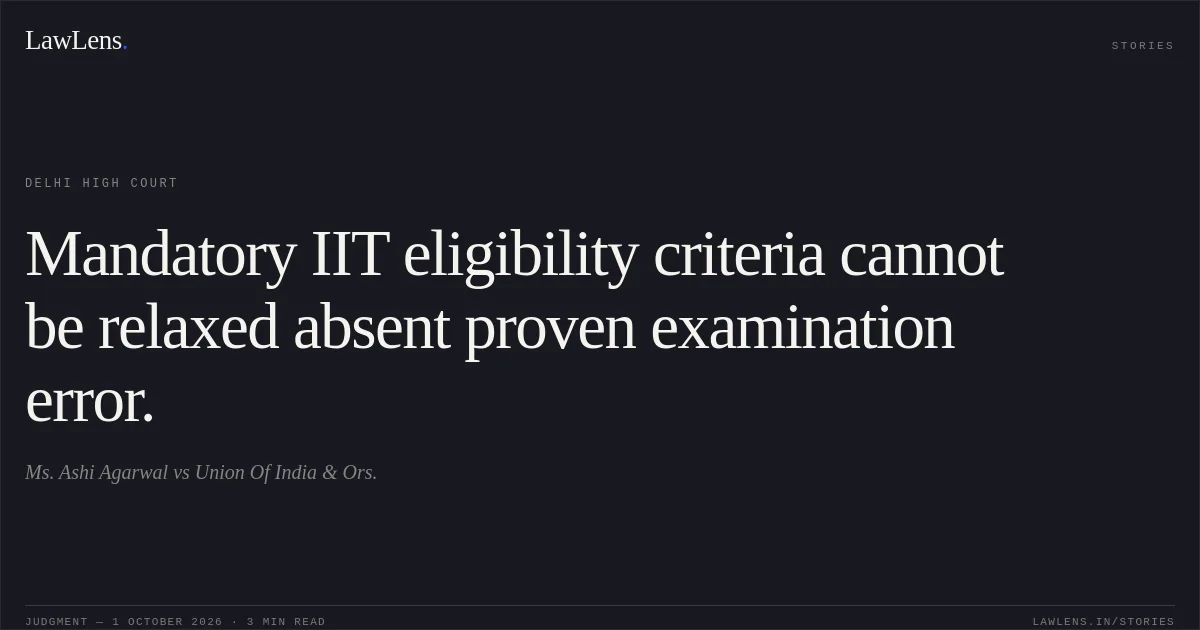
The petitioner challenged the evaluation of five questions in JEE (Main) 2025, Session I, and alleged that she was wrongly denied entry to Session II.
Source reference: paras. 2–14, 41–42; pp. 2–4, 13She contended that correcting the evaluation and allowing her to take Session II would have enabled her to qualify for JEE (Advanced) 2025.
Source reference: paras. 2–14, 41–42; pp. 2–4, 13Her earlier writ petition was disposed of on 12 May 2026 with a direction to the JEE (Advanced) Organising Chairman to consider her case as a representation.
Source reference: paras. 2–14, 41–42; pp. 2–4, 13The Chairman rejected it on 18 May 2026, finding that the JEE (Main) grievances fell outside his remit and that she did not meet the applicable eligibility criteria.
Source reference: paras. 2–14, 41–42; pp. 2–4, 13The petitioner then sought to set aside that rejection and obtain consequential relief, including preservation of her academic year or consideration for an IIT seat.
Source reference: paras. 2–14, 41–42; pp. 2–4, 13Issues
1. Whether the petition was barred by res judicata because the petitioner had raised substantially the same grievances in her earlier writ petition.
Source reference: paras. 47–52; pp. 15–182. Whether the Delhi High Court had territorial jurisdiction to consider the challenge to the rejection order.
Source reference: para. 45; p. 143. Whether the rejection order warranted interference under Article 226, given the alleged JEE (Main) evaluation and examination-record discrepancies.
Source reference: paras. 57–66; pp. 21–294. Whether the petitioner was eligible for JEE (Advanced) 2026 under Criterion A4, or could receive an exception or consequential admission relief despite not meeting that criterion.
Source reference: paras. 67–83; pp. 29–37Law Applied
Article 226 review is not appellate in nature; courts ordinarily do not reappreciate evidence or resolve technical and disputed factual questions in examination matters absent cogent evidence of manifest error or arbitrariness.
Source reference: paras. 53–57, 64–66; pp. 18–21, 29Res judicata applies only where the matter in issue has been heard and finally decided; a prior order directing consideration of a representation, without deciding the substantive issues, does not bar a challenge to the subsequent decision.
Source reference: paras. 48–51; pp. 15–18Academic authorities’ technical expertise and prescribed eligibility standards warrant judicial deference, and courts should not substitute their own standards or relax mandatory conditions merely on grounds of hardship or sympathy (AICTE v. Surinder Kumar Dhawan; NIMS University v. Union of India; CBSE v. Sheena Peethambaran).
Source reference: paras. 54–56; pp. 18–21Criterion A4 of Clause 11 of the JEE (Advanced) 2026 Information Brochure limited eligibility to candidates first appearing in Class XII in 2025 or 2026, subject to stated exceptions.
Source reference: paras. 67–73; pp. 29–31Although relief may be moulded in an exceptional case where an authority’s error caused loss of an academic opportunity (S. Krishna Sradha v. State of Andhra Pradesh), that principle does not itself displace eligibility rules absent an established error attributable to the authorities.
Source reference: paras. 78–82; pp. 35–37Reasoning
The Court rejected the res judicata objection because the earlier proceeding had not determined the merits of the evaluation and audit-log allegations; it also rejected the territorial-jurisdiction objection, considering the present case in the context of the earlier proceedings before the Delhi High Court.
Source reference: paras. 45, 48–52; pp. 14–18On the merits, the alleged discrepancies in the electronic records, percentile calculations, and denial of entry to Session II raised technical and disputed factual questions that the Court found unsuitable for determination through a fact-intensive inquiry under Article 226.
Source reference: paras. 59–66, 75; pp. 26–29, 31The Court noted that, even if the disputed questions were answered in the petitioner’s favour, she would not meet the relevant JEE (Main) cutoff.
Source reference: paras. 59–66, 75; pp. 26–29, 31Separately, because the petitioner first appeared for Class XII in 2024, she did not satisfy Criterion A4 for JEE (Advanced) 2026.
Source reference: paras. 69–73, 76–83; pp. 30–37The alleged loss of an opportunity in the 2025 examination did not create eligibility for the 2026 examination or justify a supernumerary seat, particularly when the underlying errors had not been established and the admission cycle had concluded.
Source reference: paras. 69–73, 76–83; pp. 30–37Holding
The Court held that the petition was not barred by res judicata, but the petitioner had established no ground for interference with the rejection order under Article 226.
She was ineligible for JEE (Advanced) 2026 under Criterion A4, and the Court declined to grant preservation of the academic year, an IIT seat, or other consequential relief.
Source reference: paras. 84–86; p. 37The writ petition and pending applications were dismissed.
Source reference: para. 86; p. 37Original Court PDF
Ms. Ashi AgarwalvsUnion Of India & Ors.
Click to open original judgment
Original judgment, available to read, download and summarize on LawLens.in