Facts
The Appellant, a Head Constable at Police Station Patel Nagar, was accused of demanding and accepting a bribe of ₹300/- from the complainant (PW2) on April 3, 2000
Source reference: p. 2The gratification was allegedly a reward for returning the Registration Certificate (RC) of PW2’s motorcycle, which the Appellant had retained following a theft investigation (FIR 296/1999)
Source reference: p. 8PW2 lodged a complaint with the Anti-Corruption Branch (ACB), leading to a pre-raid proceeding and a subsequent trap
Source reference: p. 2During the trial, PW2 turned partially hostile, claiming another officer (Paltu Ram) initiated the demand, though he admitted the Appellant accepted the money
Source reference: p. 9-10The panch witness (PW8) corroborated that the Appellant made an implied demand in the station corridor and accepted the tainted notes with his left hand
Source reference: p. 13-14The trial court convicted the Appellant under Sections 7 and 13(1)(d) read with 13(2) of the Prevention of Corruption (PC) Act, 1988, sentencing him to concurrent terms of rigorous imprisonment for six months and one year
Source reference: p. 4-5Issues
1. Whether the prosecution established the foundational facts of "demand" and "acceptance" of illegal gratification beyond a reasonable doubt, given that the complainant turned partially hostile
Source reference: p. 7 / para. 142. Whether a clerical error in the trial record regarding the "hand wash" (referring to the right hand instead of the left, when the right was plastered) vitiated the recovery proceedings
Source reference: p. 26 / para. 263. Whether the mandatory legal presumption under Section 20 of the PC Act could be invoked against the accused
Source reference: p. 31 / para. 30Law Applied
The court applied Sections 7 and 13 of the PC Act regarding the demand and acceptance of bribes by public servants
Source reference: p. 1It relied on Neeraj Dutta v. State (NCT of Delhi) (2023), which establishes that proof of demand and acceptance are sine qua non for conviction
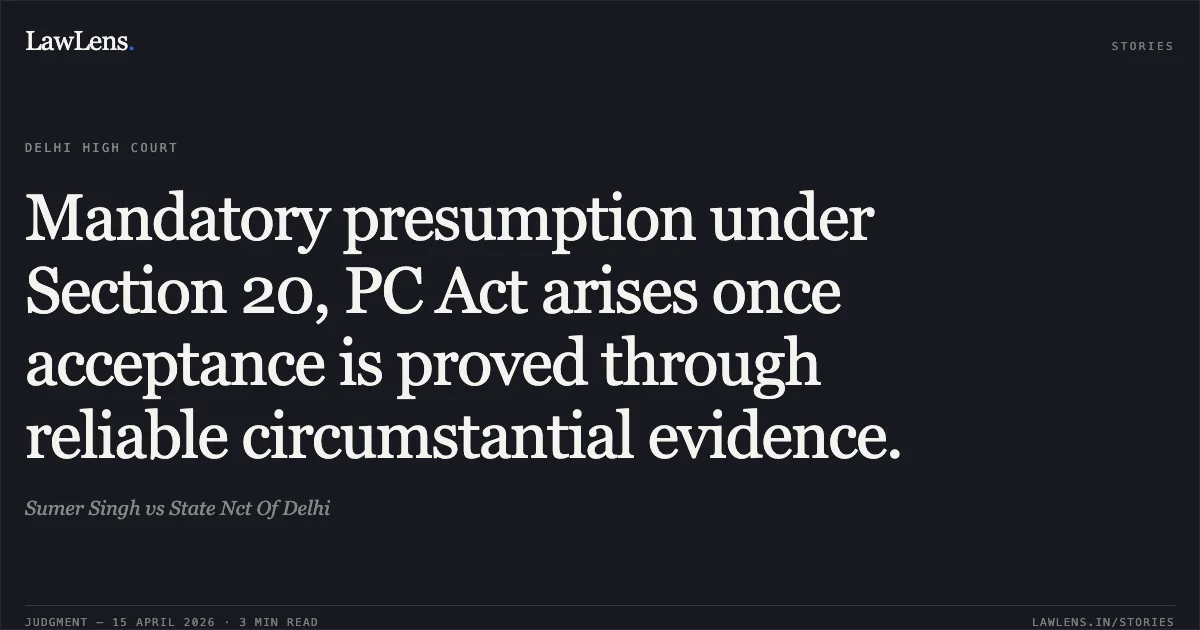
Source reference: p. 22The court further utilized the principles from M. Narsinga Rao v. State of A.P. (2001), holding that Section 20 of the PC Act creates a mandatory legal presumption that once acceptance of money is proved, it is presumed to be illegal gratification unless rebutted
Source reference: p. 31-33Finally, the court applied the doctrine that the testimony of a hostile witness need not be discarded in toto and can be relied upon where corroborated
Source reference: p. 23Reasoning
The court determined that the foundational facts were sufficiently proven despite PW2’s partial hostility. While PW2 attributed the initial demand to another, the panch witness (PW8) provided direct evidence of an "implied demand" when the Appellant asked, "what has happened to what was settled between us"
Source reference: p. 24The court held that the Appellant’s acceptance of the money with his left hand and its recovery from his shirt pocket, corroborated by the phenolphthalein test (which turned pink), established "acceptance"
Source reference: p. 24, 35Addressing the discrepancy regarding the plastered hand, the court clarified that the trial court’s reference to a "right-hand wash" was a mere clerical error, as the evidence consistently showed a left-hand wash was taken
Source reference: p. 26-28The court found that the FSL report (Ext. PW11/B) and the testimony of the Trap Laying Officer (PW9) formed a complete chain of events
Source reference: p. 41Consequently, since the accused failed to provide any plausible explanation for the possession of tainted notes, the mandatory presumption under Section 20 of the PC Act applied
Source reference: p. 36-38Holding
The High Court dismissed the appeal and upheld the conviction and sentence passed by the trial court
The court held that the prosecution successfully proved both the demand and acceptance of illegal gratification through corroborated testimonial and scientific evidence
Source reference: p. 45It ruled that minor inconsistencies or clerical errors in recording evidence do not invalidate a trap proceeding if the core foundational facts remain intact
Source reference: p. 28The Appellant was ordered to undergo the remaining portion of his sentence
Source reference: p. 46Acts & Sections Cited
8 provisions across 3 statutes referred to in this judgment. Each provision opens on LawLens.
Prevention of Corruption Act, 19883
Code of Criminal Procedure, 19734
Indian Penal Code, 18601
Original Court PDF
Sumer SinghvsState Nct Of Delhi
Click to open original judgment
Original judgment, available to read, download and summarize on LawLens.in


