Facts
The applicant, a Constable in the Delhi Police, was subjected to Departmental Enquiry (DE) following allegations of rude behavior and using abusive language against a senior officer on 31.12.2015
Source reference: p. 3, 6-7and shifting temper with passengers on 02.05.2016
Source reference: p. 7-8The Inquiry Officer (IO) examined 10 witnesses and submitted a report on 12.12.2017 finding the first allegation proved but the second unproved
Source reference: p. 11The Disciplinary Authority (DA) imposed a penalty of "forfeiture of one increment permanently with commutative effect" on 24.01.2018
Source reference: p. 9The Appellate Authority (AA) rejected the applicant’s appeal on 26.07.2018, while also suggesting that the second charge (which the IO had cleared) "cannot be ruled out" based on CCTV footage
Source reference: p. 10-11Issues
1. Whether the inquiry was vitiated due to the Inquiry Officer’s failure to frame and explain formal written charges as mandated by Rule 16(iv)(b) of the Delhi Police (Punishment and Appeal) Rules, 1980
Source reference: p. 4, para. 6(i)2. Whether the penalty of "forfeiture of one increment permanently" is a legally permissible punishment under Rule 5 of the said Rules
Source reference: p. 5, para. 6(ii)3. Whether the Appellate Authority committed a jurisdictional error by considering extraneous material and reversing findings on unproved charges without following due process
Source reference: p. 5, para. 6(iv)Law Applied
Rule 16(iv) of the Delhi Police (Punishment and Appeal) Rules, 1980, which mandates that if allegations are not admitted, the IO must proceed to frame formal charges in writing and explain them to the accused
Source reference: p. 8The doctrine from Taylor v. Taylor and A.R. Antulay v. Ramdas Sriniwas Nayak, establishing that when a statute requires an act to be done in a particular manner, it must be done in that manner or not at all
Source reference: p. 9Rule 5 of the same Rules provides an exhaustive list of authorized punishments
Source reference: p. 9Reasoning
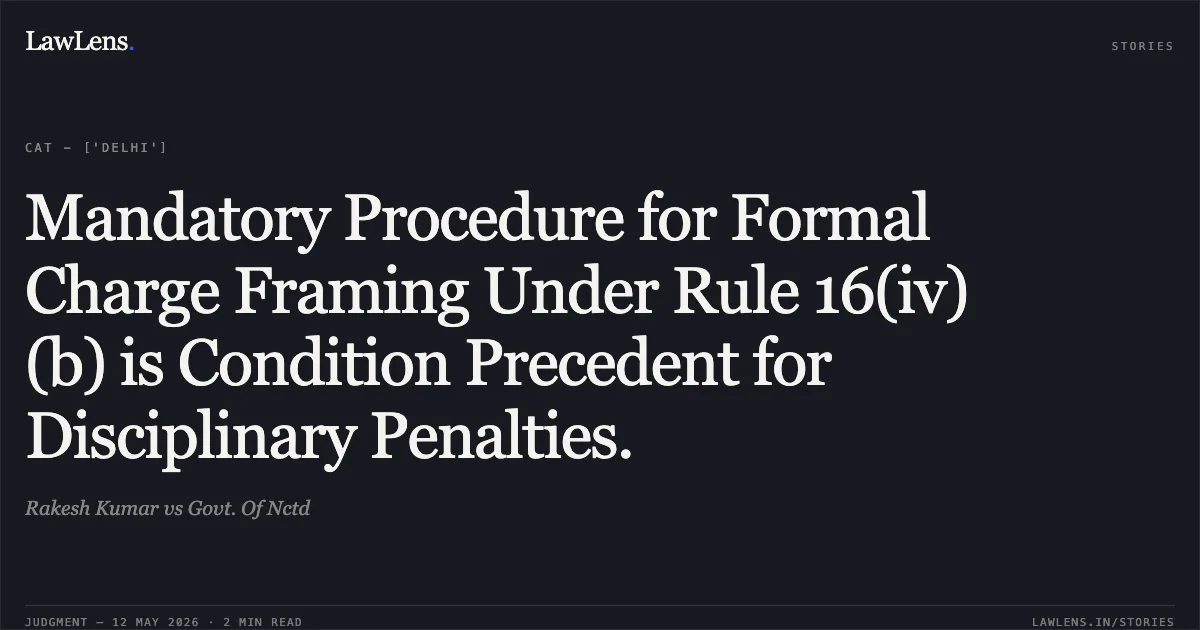
The Tribunal found that the IO failed to frame formal written charges or explain them to the applicant, violating the mandatory procedural requirements of Rule 16(iv)(b)
Source reference: p. 8-9The Disciplinary Authority’s order was found to be a result of non-application of mind because it falsely claimed the IO had served the charges on 12.05.2017, a claim unsupported by the original DE records
Source reference: p. 10Additionally, the penalty imposed (permanent forfeiture of increment) was not among the authorized punishments listed in Rule 5
Source reference: p. 9-10Regarding the Appellate Authority, the Tribunal noted it had improperly relied on "extraneous material" (CCTV footage) to suggest the second charge was proved, despite the IO's exoneration on that count, without issuing a dissenting note or providing the applicant an opportunity to respond, thereby violating natural justice
Source reference: p. 10-11Holding
The Tribunal allowed the O.A., setting aside the penalty order dated 24.01.2018, the appellate order dated 26.07.2018, and the IO’s findings dated 12.12.2017. The Court held that the proceedings were procedurally flawed and the penalty was extra-legal.
The respondents were directed to restore the applicant’s withheld increments with consequential benefits within four weeks. However, the respondents were granted liberty to initiate fresh proceedings from the stage of framing of charges in accordance with the law.
Source reference: p. 12Acts & Sections Cited
1 provisions across 1 statute referred to in this judgment. Each provision opens on LawLens.
Administrative Tribunals Act, 19851
Original Court PDF
Rakesh KumarvsGovt. Of Nctd
Click to open original judgment
Original judgment, available to read, download and summarize on LawLens.in