Facts
The Petitioner was arrested on December 11, 2022, following the interception of a truck on December 9, 2022, containing a commercial quantity of Codeine-based cough syrup and Tramadol capsules.
Source reference: para 07Investigation revealed that the Petitioner and a co-accused arrived at a transport company to receive the contraband.
Source reference: para 08Evidence included call records from a phone registered to the Petitioner's wife—allegedly used by the Petitioner to run a drug syndicate—and records of financial transactions with co-accused persons.
Source reference: para 09After the Trial Court (Principal Sessions Judge, Samba) dismissed his bail application on July 10, 2025, the Petitioner moved the High Court seeking bail under Section 483 of the BNSS, citing long incarceration and a lack of incriminating testimony from witnesses examined so far.
Source reference: para 02, 03Issues
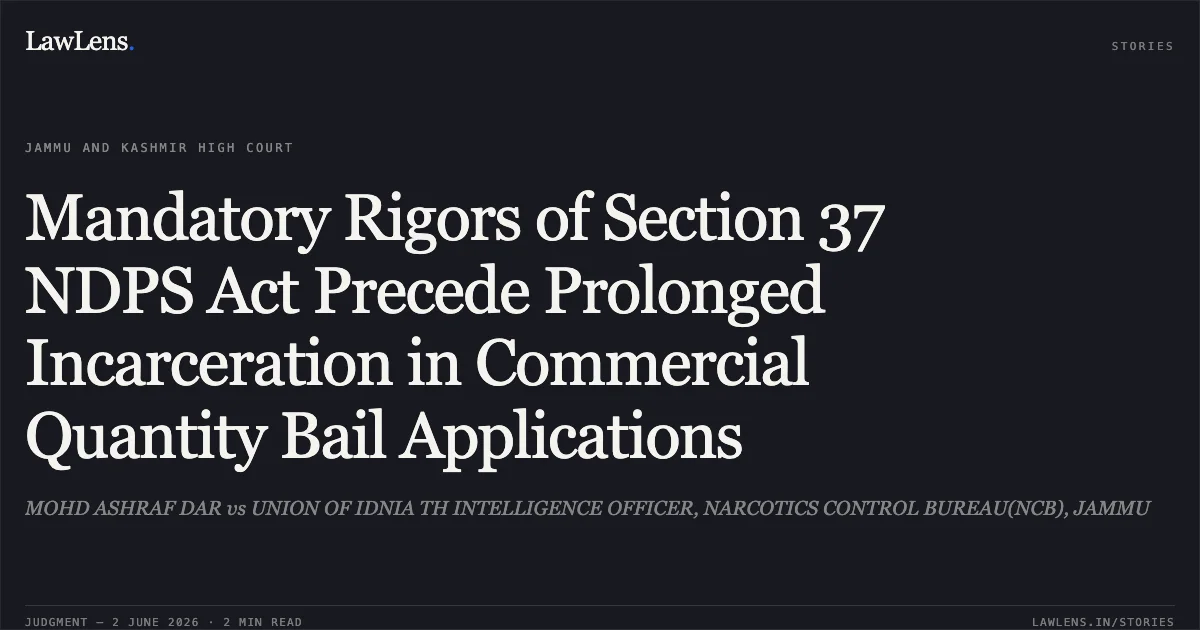
1. Whether the Petitioner satisfied the twin conditions for bail under Section 37 of the NDPS Act despite the recovery of a commercial quantity of narcotics.
Source reference: para 13, 192. Whether prolonged incarceration serves as a sufficient ground to override the statutory rigors of Section 37 of the NDPS Act.
Source reference: para 13, 15Law Applied
The court applied Section 37 of the NDPS Act, which mandates that bail for commercial quantities can only be granted if there are reasonable grounds to believe the accused is not guilty and unlikely to commit further offences.
Source reference: para 12It relied on Narcotics Control Bureau v. Kashif (2025) and State of Meghalaya v. Lalrintluanga Sailo (2024), establishing that "negation of bail is the rule and its grant is an exception" under the Act.
Source reference: para 12The court cited Union of India v. Vigin K. Varghese (2025) to affirm that Section 37 takes precedence over pleas of prolonged incarceration.
Source reference: para 13The court cited Narcotics Bureau v. Mohit Agarwal (2022), which held that the period of custody alone is not a persuasive ground for bail under the NDPS Act.
Source reference: para 15Reasoning
The court reasoned that the Petitioner failed to specifically demonstrate how the evidence recorded thus far exculpated him; mere "wholesale assertions" of innocence are insufficient to rebut the prima facie case established at the time of framing charges.
Source reference: para 14, 18The Court observed that substantial material, including financial links and telephonic evidence, connected the Petitioner to a "well-knit conspiracy" for drug trafficking.
Source reference: para 11Applying the dictum from Shri Darshan (2025), the court conducted a prima facie assessment rather than a "mini-trial," concluding that the gravity of the offense and its social impact outweighed the length of custody.
Source reference: para 16-17The court found that since the Petitioner could not point to "fragile" evidence that would lead to a presumption of innocence, the mandatory rigors of Section 37 remained an absolute bar to discretionary relief.
Source reference: para 19Holding
The High Court dismissed the bail application, holding that the Petitioner did not meet the statutory threshold of Section 37 of the NDPS Act.
The Court held that in heinous crimes involving commercial quantities, length of incarceration does not grant a right to bail unless "countervailing circumstances" are shown.
Source reference: para 17The Trial Court was directed to conclude the trial with "utmost promptitude" in light of the Petitioner's period of incarceration.
Source reference: para 20Acts & Sections Cited
6 provisions across 2 statutes referred to in this judgment. Each provision opens on LawLens.
Bharatiya Nagarik Suraksha Sanhita, 20231
Narcotic Drugs and Psychotropic Substances Act, 19855
Original Court PDF
MOHD ASHRAF DARvsUNION OF IDNIA TH INTELLIGENCE OFFICER, NARCOTICS CONTROL BUREAU(NCB), JAMMU
Click to open original judgment
Original judgment, available to read, download and summarize on LawLens.in