01Facts
The petitioner, a licensed trader in the Krishi Upaj Mandi, Sehore, claims that a plot of about 20' x 70' was allotted to it in the market yard under a Mandi Samiti resolution in 1983, supported by a Directorate communication dated 06.12.1983 (Annexure P/1).
¶ 2(A)It claims to have paid a premium, built a temporary shop, and paid rent.
¶ 2(A)The Mandi Samiti issued an eviction notice under Section 22 of the M.P. Krishi Upaj Mandi Adhiniyam, 1972 ("Adhiniyam") on 01.07.1991.
¶ 2(B)The petitioner's application under Section 59 was rejected by the Additional Director on 10.01.2006, on the ground that a tin shed and pucca floor had been raised without permission, obstructing Mandi work.
¶ 2(C)The State Government's first revision was dismissed as not maintainable. A Co-ordinate Bench remitted the matter and directed status quo.
¶ 2(D)The State Government dismissed the revision on 04.09.2015 and affirmed the Additional Director's order.
¶ 2(E)The respondents contend that the allotment was never sanctioned, no lease deed was executed, the State Government refused sanction for allotment in 1990, and the petitioner withdrew the lease rent deposit.
¶ 4The petitioner filed no rejoinder.
¶ 5 · ¶ 802Issues
i.1. Whether the petitioner acquired an enforceable right, as lessee or tenant, to occupy the plot on the strength of the alleged allotment and payment of rent.
¶ 7(i)ii.2. Whether the Secretary of the Market Committee could invoke Section 22 of the Adhiniyam to remove the petitioner from the plot.
¶ 7(ii)iii.3. Whether the concurrent findings of the Additional Director and the State Government suffer from jurisdictional error, perversity, or procedural impropriety warranting interference under Article 226.
¶ 7(iii)03Law Applied
Sections 7(2), 7(3), 9(2), and 59 of the Adhiniyam together provide that the Market Committee is a body corporate, is deemed a local authority, and may transfer immovable property only by the prescribed manner and with prior permission of the competent authority.
¶ 9Section 22 empowers the Secretary to remove encroachments in open spaces of the market yard.
¶ 10In Orissa Industrial Infrastructure Development Corporation v. MESCO Kalinga Steel Ltd., (2017) 5 SCC 86, execution of a lease deed in the prescribed form is a condition precedent, and without it no lessor-lessee relationship arises.
¶ 13In Dr. H.S. Rikhy v. New Delhi Municipal Committee, AIR 1962 SC 554, no lease arises where the statutory manner is not complied with, and possession and acceptance of rent do not create a tenancy or raise an estoppel against statute.
¶ 19In M/s Sewak Ram v. State of M.P. (W.A. No. 499/2015), occupation of Mandi premises is licence-based, and continued occupation after termination is unauthorised encroachment remediable under Section 22.
¶ 17Ashok Kumar Sahu v. State of M.P. (W.P. No. 3933/2014) holds that Mandi premises are public premises.
¶ 18Under Indian Oil Corporation Ltd. v. M/s Aditya HP Centre, 2026 INSC 182, the party asserting a fact bears the burden of proving it.
¶ 20In Syed Yakoob (AIR 1964 SC 477) and Shalini Shyam Shetty ((2010) 8 SCC 329), writ courts do not reappraise facts absent perversity or error apparent on the record.
¶ 24Provisions in the judgment · 5
M.P. Krishi Upaj Mandi Adhiniyam, 1972 Section 7Section 9Section 22Section 59Section 61
04Reasoning
The 1983 resolutions and possession letters were only a proposal for allotment. Sanction of the competent authority and execution of a lease deed were never obtained, so no lessor-lessee relationship arose.
¶ 11 · ¶ 14Annexure P/1 authorised only a process of open auction and a lease deed to be executed later. The petitioner neither pleaded nor showed that any such process or lease followed.
¶ 12The State Government's 1990 refusal of sanction ended the incomplete proposal, and that decision applied to the earlier allotment.
¶ 16The petitioner's premium and rent payments could not create a tenancy under Dr. H.S. Rikhy and Sewak Ram.
¶ 20The petitioner produced no receipt, and the Mandi Samiti's unrebutted averment that the rent deposit had been withdrawn further supported the finding that no lease existed.
¶ 15 · ¶ 20The occupation was therefore at most a terminated licence, and continued occupation was unauthorised.
¶ 20The pucca construction, undertaken despite repeated directions, constituted encroachment of an open space under Section 22.
¶ 21Because the Market Committee's title was undisputed and the petitioner claimed only an unmatured allotment, no bona fide title dispute existed to oust the summary remedy.
¶ 22On natural justice, the petitioner was heard through counsel and was given an opportunity to file written arguments before the State Government.
¶ 23The concurrent findings were based on the record, so no perversity was shown.
¶ 24The petitioner's failure to file a rejoinder left the return's averments unrebutted.
¶ 5 · ¶ 805Holding
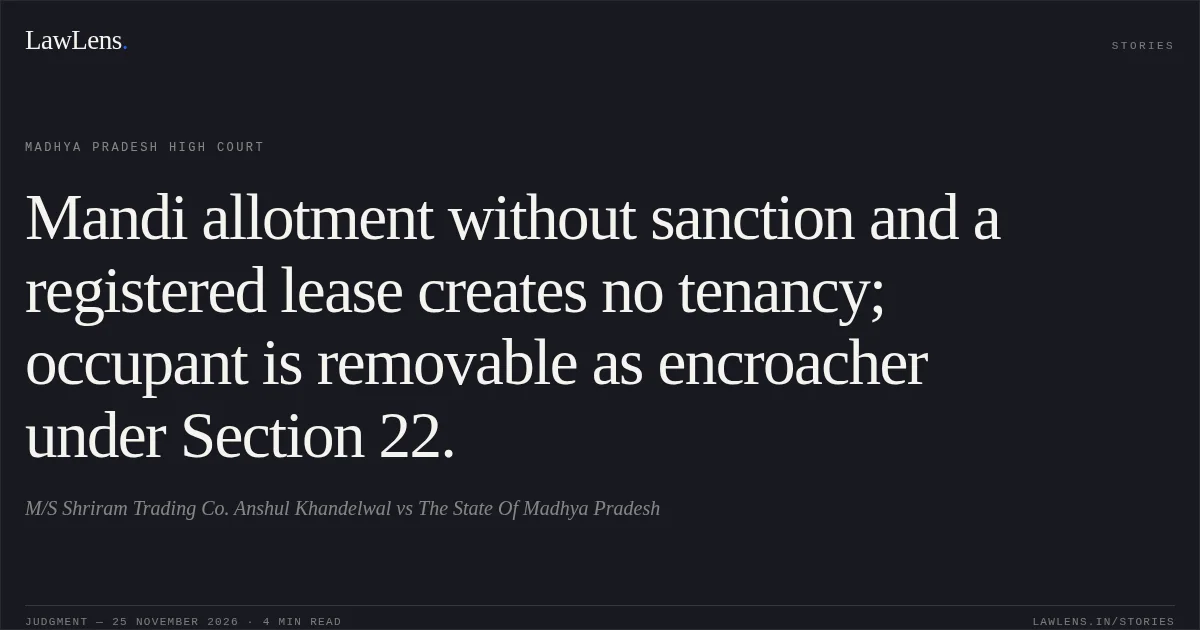
The petitioner has no enforceable right as lessee or tenant, its occupation is unauthorised, and the Secretary may remove the encroachment under Section 22.
¶ 20 · ¶ 25The impugned orders dated 10.01.2006 and 04.09.2015 were upheld, and the writ petition was dismissed.
¶ 25–26As a humanitarian measure, the petitioner may submit a representation within four weeks seeking reasonable time to vacate, which the Secretary must decide within two weeks. Absent a representation or upon its rejection, the Market Committee may proceed under the notice dated 15.09.2015.
¶ 26(i)–(ii)The petitioner may participate in allotment under the M.P. Krishi Upaj Mandi (Allotment of Land and Structures) Rules, 2009, and the Committee may consider its long occupation within the law.
¶ 26(iii)–(iv)The observations do not bar other remedies available in law.
¶ 27Original Court PDF
M/S Shriram Trading Co. Anshul KhandelwalvsThe State Of Madhya Pradesh
Click to open original judgment
Original judgment, available to read, download and summarize on LawLens.in