Facts
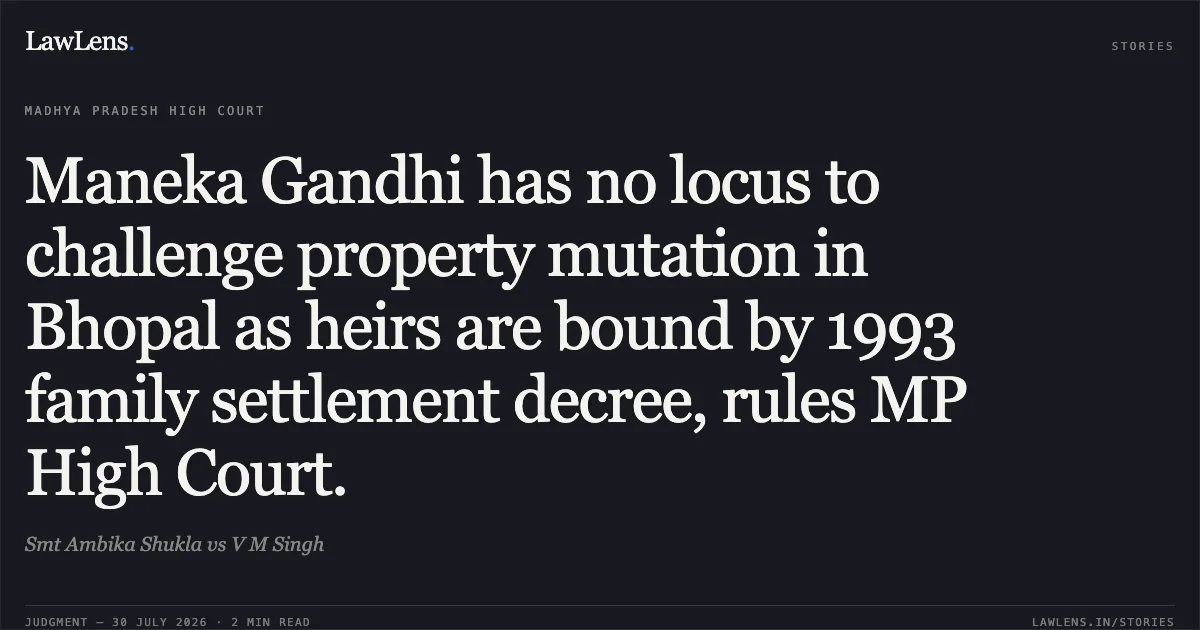
The dispute arises from a partition suit (Suit No. 63/1975) initiated in the Delhi High Court involving the heirs of Shri Datar Singh, where a compromise decree was recorded on 25.08.1993 and subsequently upheld/modified by the Supreme Court in 2005.
Source reference: para. 3Respondent No. 1 (V.M. Singh) filed W.P. No. 5227/2020 seeking mutation of Bhopal-based property based on this decree; the learned Single Judge initially directed the Tehsildar to decide the application "in accordance with law," which the Tehsildar rejected on 13.07.2020.
Source reference: para. 5Respondent No. 1 filed a review petition (R.P. No. 242/2024), and the Single Judge modified the direction to "in accordance with the decree," leading the Tehsildar to allow mutation under Section 32 of the M.P. Land Revenue Code (MPLRC).
Source reference: para. 6The appellants (legal heirs of original defendants) challenged these orders, alleging they were necessary parties excluded from the proceedings.
Source reference: para. 7Issues
1. Whether the appellants were necessary parties in the writ court and revenue court?
Source reference: para. 92. Whether the order of the Tehsildar regarding mutation was sustainable in law?
Source reference: para. 93. Whether the revenue court has the power to review its own earlier order?
Source reference: para. 9Law Applied
Section 32 of the Madhya Pradesh Land Revenue Code, 1959, which defines the inherent powers of Revenue Courts.
Source reference: para. 10The power of review is a creature of statute and cannot be assumed under inherent powers unless expressly conferred.
Source reference: para. 11A party relinquishing all rights and interests in a family settlement and compromise decree ceases to be a necessary party in consequential administrative/revenue proceedings.
Source reference: para. 12, 16Reasoning
The Court examined the compromise decree's conditions, specifically Clauses (d) and (f), where the ancestors of the appellants relinquished all rights, title, and interest in the Bhopal property.
Source reference: para. 12The Court reasoned that since the appellants’ interest was extinguished by a binding, decades-old decree, they had no locus or status as "necessary parties" to the mutation.
Source reference: para. 16The Court clarified that while Section 32 of the MPLRC does not grant a substantive power of review to undo earlier orders, the Tehsildar was justified in passing a new order because the High Court's review order created a "new ground" and a fresh basis for the application under Section 109.
Source reference: para. 11, 17Holding
The appellants were not necessary parties due to the relinquishment of rights in the compromise decree.
While a Tehsildar cannot review its own order under Section 32, a fresh mutation order on a new ground (the modified writ direction) is valid under Section 109.
Source reference: para. 17, 18The Court found no illegality in the Single Judge's order and dismissed the Writ Appeal.
Source reference: para. 18Acts & Sections Cited
3 provisions across 1 statute referred to in this judgment. Each provision opens on LawLens.
MP Land Revenue Code 19593
Original Court PDF
Smt Ambika ShuklavsV M Singh
Click to open original judgment
Original judgment, available to read, download and summarize on LawLens.in