Facts
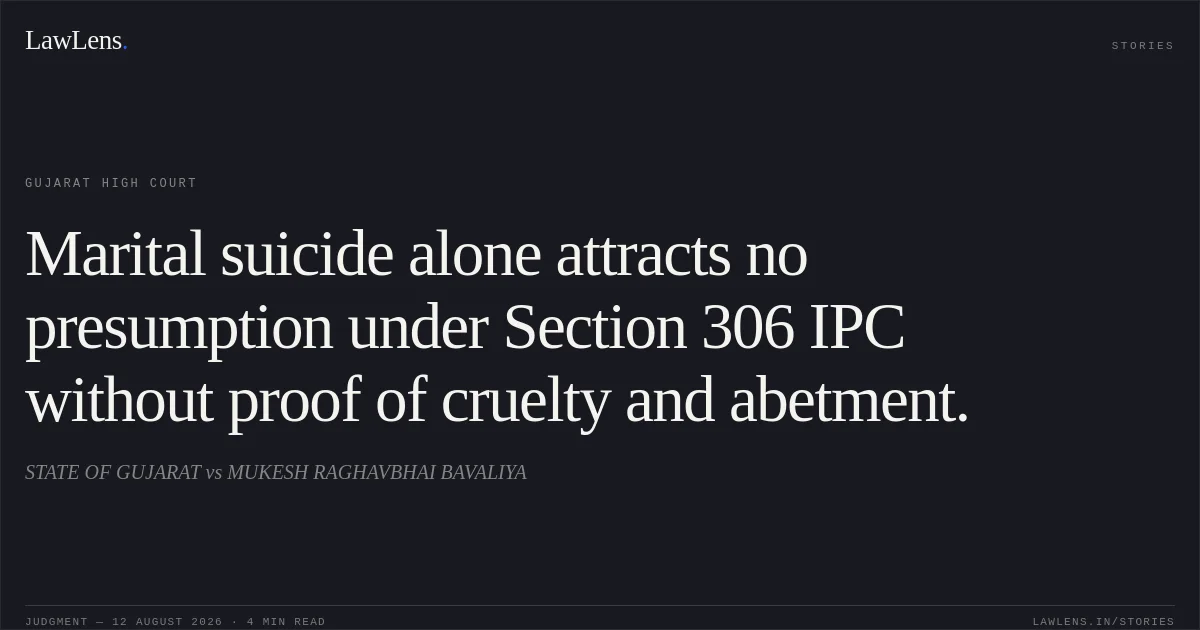
The State of Gujarat preferred an appeal under Section 378(1) and (3) of the Code of Criminal Procedure, 1973, challenging the judgment dated 25 May 2012 by which the Sessions Court, Jamnagar at Khambhaliya, acquitted the respondents of offences under Sections 306, 498A and 114 of the Indian Penal Code (“IPC”).
Source reference: p.1, para.1The prosecution alleged that Respondent No. 1 was the deceased’s husband and Respondent No. 2 her mother-in-law; that the deceased had been subjected to mental and physical harassment; and that, following a dispute concerning the house key and collection of clothes and medical documents, she poured kerosene on herself and set herself on fire on 10 April 2007.
Source reference: p.2, para.2She was treated at multiple medical facilities and subsequently admitted to G.G. Hospital, Jamnagar, where she died on 19 April 2007.
Source reference: p.5, para.9.1The prosecution examined 15 witnesses and produced 15 documentary exhibits, including a dying declaration recorded by an Executive Magistrate.
Source reference: p.3, para.3; pp.7–8, paras.11–12The trial Court acquitted the accused, leading to the present appeal.
Source reference: p.2, paras.2.1, 5–6Issues
1. Whether the trial Court was justified in acquitting the respondents of the offences under Sections 306, 498A and 114 IPC.
Source reference: p.6, para.10(1)2. Whether the trial Court properly appreciated the oral and documentary evidence led by the prosecution.
Source reference: p.6, para.10(2)3. Whether the judgment of acquittal suffered from illegality, irregularity or perversity warranting appellate interference.
Source reference: p.6, para.10(3)4. Whether the prosecution proved cruelty or harassment, abetment of suicide, or any conduct attracting the presumptions under Sections 113A and 113B of the Indian Evidence Act, 1872.
Source reference: pp.9–11, paras.13–13.3Law Applied
The Court considered Sections 306, 498A, 107 and 114 IPC: conviction for abetment of suicide requires proof of instigation, intentional aiding, or conduct amounting to abetment, while Section 498A requires proof of legally cognizable cruelty or harassment.
Source reference: pp.9–10, paras.13–13.2Section 113A of the Indian Evidence Act permits—but does not compel—the Court to presume abetment of suicide by a married woman within seven years of marriage where cruelty by the husband or his relative is first shown; Section 113B concerns the distinct presumption of dowry death and requires proof of cruelty or harassment for, or in connection with, a dowry demand.
Source reference: pp.9–10, paras.13–13.2The Court relied on Ramesh Kumar v. State of Chhattisgarh and Ram Pyarey v. State of Uttar Pradesh for the requirement of proof of cruelty in cases alleging abetment of suicide.
Source reference: pp.9–11, paras.13.1–13.3On appeals against acquittal, the appellate court possesses power to reappreciate the evidence, but must bear in mind the accused’s double presumption of innocence and should not interfere where two reasonable views are possible, as stated in Chandrappa v. State of Karnataka, Rajesh Prasad v. State of Bihar, Babu Sahebagouda Rudragoudar v. State of Karnataka and Ramesh v. State of Karnataka.
Source reference: pp.12–15, paras.15–18Reasoning
The Court held that the prosecution failed to establish a reliable evidentiary link between the respondents and the deceased’s suicide.
Source reference: no citationThe deceased had returned to the shared premises after staying for approximately four days at her uncle’s house, allegedly to collect clothes and her son’s medical files; the incident occurred in the kitchen of her grandmother-in-law’s portion of the premises, where another family member was cooking.
Source reference: p.7, para.11The prosecution did not examine the doctors who treated her at the earlier medical facilities or the treating doctor at G.G. Hospital, and therefore did not satisfactorily establish her physical or mental fitness to make a reliable dying declaration.
Source reference: pp.5–8, paras.9.1, 11–12In any event, the declaration primarily stated that she had set herself on fire following anger over the refusal to provide the house key; it did not clearly attribute the act of suicide to any specific contemporaneous cruelty, harassment, instigation or abetment by the respondents.
Source reference: pp.8–9, para.12The deceased’s parents did not support the prosecution, and the other relatives did not provide evidence of specific acts of cruelty or harassment by the accused.
Source reference: p.9, para.13Since the foundational facts necessary for invoking Section 113A were not proved, the statutory presumption could not substitute for proof of cruelty or abetment.
Source reference: pp.9–11, paras.13–13.3Given the double presumption of innocence and the absence of perversity or manifest illegality in the trial Court’s assessment, appellate interference was unwarranted.
Source reference: pp.12–15, paras.15–18Holding
The High Court answered the issues in favour of the respondents and held that the prosecution had failed to prove the offences under Sections 306, 498A and 114 IPC beyond reasonable doubt.
Finding no illegality, irregularity or perversity in the trial Court’s judgment, the Court dismissed the State’s appeal and confirmed the order of acquittal.
Source reference: p.16, para.21The respondents’ bail bonds were cancelled, and the record and proceedings were directed to be returned to the trial Court.
Source reference: p.16, para.21Acts & Sections Cited
5 provisions across 2 statutes referred to in this judgment. Each provision opens on LawLens.
Code of Criminal Procedure, 19732
Indian Penal Code, 18603
Original Court PDF
STATE OF GUJARATvsMUKESH RAGHAVBHAI BAVALIYA
Click to open original judgment
Original judgment, available to read, download and summarize on LawLens.in